
Last updated: May 18, 2026
Quick Answer: Tiny homes in Georgia are legal, growing in popularity, and genuinely affordable compared to most of the country. Your best options in 2026 are rural land purchases in North Georgia's mountain counties, ADU (accessory dwelling unit) installations in suburban Atlanta, and move-in-ready spots in organized tiny home communities. Costs range from roughly $40,000 for a budget build to $180,000 for a fully finished community home, with rural land running $12,000–$60,000 per acre in the most flexible counties. [1][2]
Key Takeaways
- 🏡 Tiny homes in Georgia are legal across the state, but zoning rules vary a lot by county — some are very welcoming, others are not.
- 📍 Fannin, Rabun, Pickens, and Gilmer counties in North Georgia are among the most permissive for rural tiny home placement and off-grid setups.
- 🏘️ Suburban ADUs are gaining traction in the Atlanta metro area, where many counties now allow backyard cottages on single-family lots.
- 💰 Builder costs typically run $45,000–$110,000 for a professionally built tiny home in Georgia, with budget models starting around $40,000. [2]
- 🌿 Middle Georgia (around Macon) is the most affordable region for community living, while North Georgia mountains are the most popular. [1]
- 🔌 Off-grid setups with well, septic, and solar are common and practical in rural North Georgia counties.
- 🚐 THOWs (tiny homes on wheels) need an RVIA certification — that's a safety standard from the Recreational Vehicle Industry Association — to be parked legally in most Georgia counties.
- 📋 Lot rents in organized communities run $300–$800/month depending on location and amenities. [1]
- 🔍 Always verify zoning with the county planning office before you buy land or sign anything.
What Does Zoning for Tiny Homes in Georgia Actually Look Like?
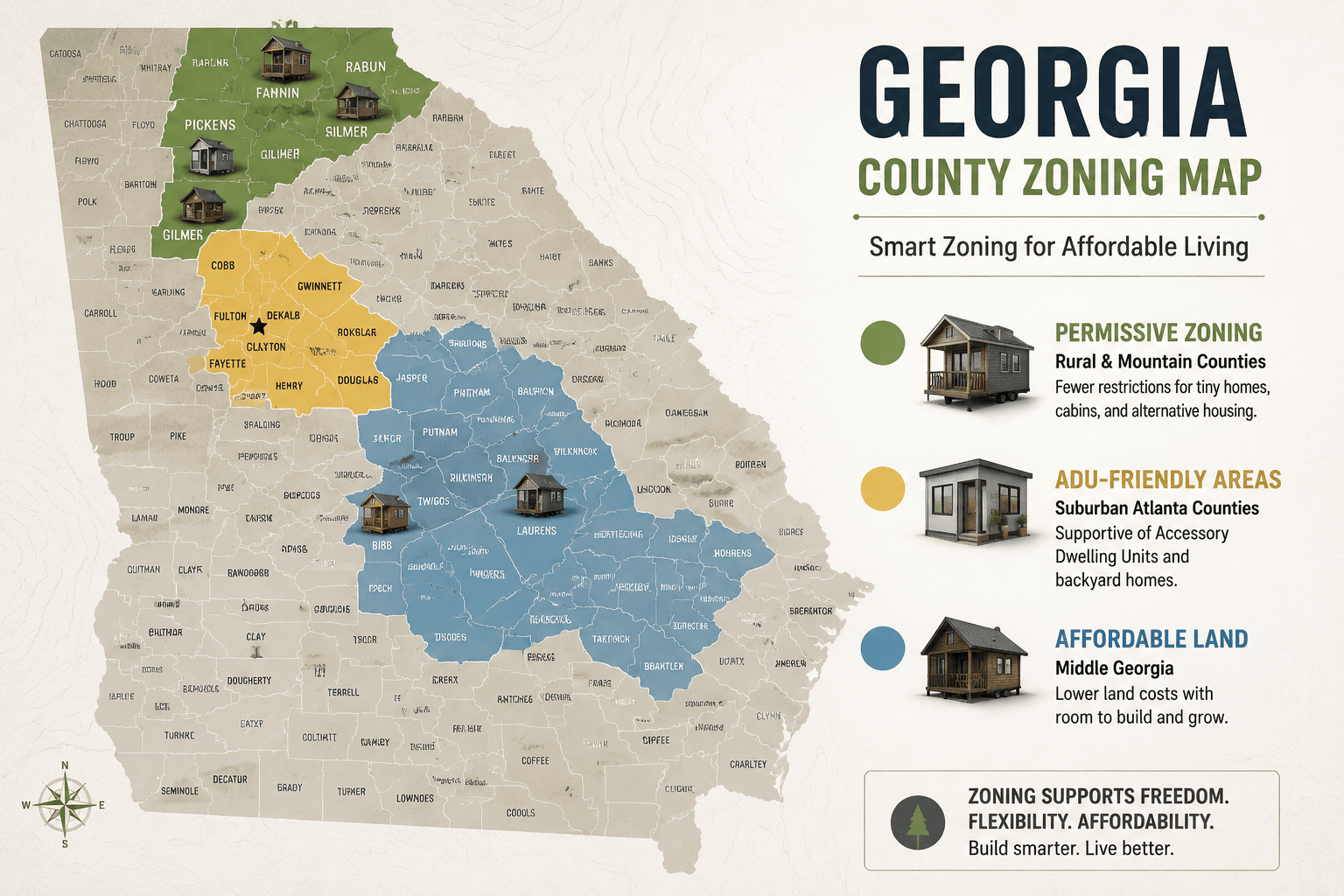
Georgia doesn't have a single statewide tiny home law. Each county sets its own rules. That means your experience in Fannin County (very flexible) will look completely different from your experience in Fulton County (more restrictive).
Here's a practical breakdown of how zoning plays out across the state:
North Georgia Mountain Counties (Most Permissive)
These counties are your best bet if you want to place a tiny home on rural land with minimal red tape:
| County | Zoning Friendliness | Notes |
|---|---|---|
| Fannin | ⭐⭐⭐⭐⭐ Most permissive | Blue Ridge area; popular for off-grid |
| Rabun | ⭐⭐⭐⭐ Very relaxed | Strong tiny home community presence |
| Gilmer | ⭐⭐⭐⭐ Relaxed | Ellijay area; affordable land |
| Pickens | ⭐⭐⭐⭐ Relaxed | Good access to Atlanta |
In these counties, you can often place a tiny home on a permanent foundation with a septic permit and well approval. Off-grid solar setups are common and generally accepted. [2]
Suburban Atlanta Counties
Cobb, Cherokee, and Forsyth counties have updated their ADU ordinances in recent years. You can often add a backyard cottage or garage conversion to an existing single-family lot. These aren't always called "tiny homes" in the code — look for "accessory dwelling unit" or "ADU" language.
Common mistake: Assuming Atlanta city limits and surrounding counties follow the same rules. They don't. Always call the county planning department directly.
Middle Georgia
Places like Macon-Bibb County are the most affordable for community living. Lot rents are lower and land costs are modest, but zoning can be less consistently friendly to standalone tiny home placements. [1]
How Much Do Tiny Homes in Georgia Cost in 2026?
The short answer: plan for $40,000 on the low end and $180,000 on the high end, depending on what you're buying and where.
Here's how costs break down:
New builds from Georgia builders:
- Budget models: $40,000–$55,000 (basic finishes, standard layout)
- Mid-range: $55,000–$90,000 (custom options, better materials)
- High-end custom: $90,000–$125,000+ (premium finishes, full off-grid systems) [2]
Homes in organized communities:
- Purchase price: $55,000–$180,000
- Monthly lot rent: $300–$800/month [1]
Land costs (rural North Georgia):
- Typical range: $12,000–$60,000 per acre
- Smaller parcels (under 5 acres) in Gilmer or Pickens can be found closer to the lower end
Added costs to budget for:
- Septic system: $8,000–$15,000
- Well drilling: $5,000–$12,000
- Solar setup (if off-grid): $10,000–$25,000
- Foundation or pad: $3,000–$8,000
One important note for Georgia specifically: the hot, humid climate means good ventilation and moisture control aren't optional extras. Builders who work in the Southeast build these features in as standard. If a quote doesn't mention them, ask. [2]
Where Are the Best Tiny Home Communities in Georgia?
Georgia has a growing number of organized tiny home communities, and they're not all the same. Some are rural retreats. Others are suburban neighborhoods. A few are designed specifically for families.
North Georgia Mountains remain the most popular region. Communities here tend to sit on wooded lots with mountain views, and many allow short-term rentals, which can offset your costs. [1]
Middle Georgia (Macon area) offers the most affordable entry point if budget is your top priority. You'll find lower lot rents and more available spaces. [1]
Atlanta suburbs are seeing growth in ADU-style communities and small cottage neighborhoods, especially in Cherokee and Forsyth counties.
What to look for in any community:
- Is the land owned or leased? (Owned is almost always better long-term)
- What utilities are included in lot rent?
- Are short-term rentals (Airbnb, VRBO) allowed?
- What's the minimum square footage requirement?
- Is the community RVIA-friendly or foundation-only?
You can also connect with local groups like the Tiny Houses in North Georgia Mountains Facebook group to get real, on-the-ground perspectives from people already living there. [9]
What Are ADUs and How Do They Work in Georgia Suburbs?
An ADU — accessory dwelling unit — is a smaller home built on the same lot as a main house. Think backyard cottage, garage apartment, or basement suite. In Georgia's suburbs, ADUs are one of the most practical ways to get into tiny living without leaving your neighborhood.
Why ADUs make sense for Georgia families:
- You can house aging parents nearby while maintaining privacy
- You can rent the ADU for income to offset your mortgage
- You avoid the complexity of buying separate land
- Suburban infrastructure (water, sewer, power) is already in place
How to get started with an ADU in Georgia:
- Check your county's zoning code for ADU language (search "accessory dwelling unit" + your county name)
- Confirm setback requirements — most counties require the ADU to sit a certain distance from property lines
- Hire a designer or builder familiar with local codes
- Apply for a building permit before construction starts
- Schedule required inspections during and after the build
Choose an ADU if: You already own a home in the suburbs, you want to stay in your neighborhood, or you're looking for a rental income stream alongside your tiny living goals.
Choose rural land instead if: You want more space, full off-grid capability, or lower overall costs and you're comfortable with a longer commute.
For a sense of how other states are handling ADU expansion, our California tiny homes guide covers one of the most ADU-forward regulatory environments in the country — useful context for what Georgia's trajectory might look like.
Which Builders Serve Tiny Homes in Georgia?
Georgia has a solid base of builders, and several Southeast-focused companies serve the state well. When you're evaluating a builder, look for experience with Georgia's climate, clear warranty terms, and a portfolio of completed homes you can actually visit.
A few builders worth knowing about:
- Mustard Seed Tiny Homes builds custom tiny homes with a focus on quality craftsmanship. You can see their full profile in our Mustard Seed Tiny Homes directory listing. [6]
- Dragon Tiny Homes offers a range of models with Georgia-appropriate designs, including good ventilation and moisture management features. [8]
- Southeastern Tiny Homes specializes in the Southeast market and understands local zoning nuances. See their listing at Southeastern Tiny Homes on Tiny Home Sherpa.
- Zook Cabins serves Georgia buyers with prefab cabin-style tiny homes that can be placed on rural land. [5]
What to ask any builder before signing:
- Do you build to RVIA standards, or are your homes foundation-only?
- What moisture and ventilation systems do you include as standard?
- Can I visit a completed home in Georgia before committing?
- What does your warranty cover, and for how long?
- Do you handle permitting, or is that on me?
For a broader search, our full tiny home builders directory lists vetted builders across the country, including those who serve Georgia.
What Are the Pros and Cons of Tiny Home Living in Georgia?
Georgia is genuinely one of the better states for tiny home living in the Southeast. But it's not without tradeoffs. Here's an honest look at both sides.
Pros:
- ✅ Several counties with very permissive rural zoning
- ✅ Affordable land compared to coastal states
- ✅ Mild winters mean lower heating costs
- ✅ Growing builder community with Southeast expertise
- ✅ Active tiny home communities, especially in the mountains
- ✅ Lower cost of living in rural areas
Cons:
- ❌ Hot, humid summers require good HVAC and moisture management — that adds cost
- ❌ Zoning is inconsistent county to county; research is non-negotiable
- ❌ Some counties still don't allow THOWs as permanent residences
- ❌ Financing tiny homes can be harder than traditional mortgages (personal loans and RV loans are common workarounds)
- ❌ Rural placements mean longer drives to services and jobs
The honest bottom line: If you do your homework on zoning before you buy land or a home, Georgia offers real value. The mountain counties in particular are among the most accessible tiny home environments in the entire Southeast. If you skip the research step, you can end up with a home you can't legally place where you want it.
If you're comparing Georgia to neighboring states, our Alabama tiny homes guide and Arkansas tiny homes guide cover similar terrain with their own zoning quirks worth knowing.
How Do You Finance a Tiny Home in Georgia?
Financing is one of the trickiest parts of tiny home ownership, and Georgia is no exception. Traditional mortgage lenders generally won't finance a home under 400 square feet or one that isn't on a permanent foundation.
Your main financing options:
- Personal loan — Fast to get, no collateral required, but interest rates are higher (typically 8–15% in 2026)
- RV loan — Works if your tiny home is RVIA-certified (on wheels); rates are often better than personal loans
- Construction loan — If you're building on land you own; converts to a mortgage once the build is done
- Home equity loan — If you already own a home, this can fund an ADU build at lower rates
- Chattel loan — For manufactured or modular homes on leased land; available through some specialty lenders
- Cash purchase — The simplest path if you have the funds; avoids financing complexity entirely
Common mistake: Assuming you can't finance a tiny home at all. You can — it just takes a different approach than a conventional mortgage. Talk to a lender who has done tiny home deals before, not just any bank.
For a broader look at how tiny home options compare across the country, the Tiny Homes by State directory on Tiny Home Sherpa is a good next stop.
FAQ: Tiny Homes in Georgia
Are tiny homes legal in Georgia? Yes. Georgia doesn't ban tiny homes at the state level. Legality depends on county zoning, which varies widely. North Georgia mountain counties are among the most permissive.
What is the minimum square footage for a home in Georgia? It varies by county. Some counties require a minimum of 150–200 sq ft for a permanent dwelling. Others have no minimum. Always check with your specific county's planning department.
Can I put a tiny home on wheels (THOW) on my land in Georgia? In some counties, yes. Fannin and Rabun counties are known to be more flexible. Most counties require a THOW to be RVIA-certified and may limit how long it can be parked as a residence. Call the county planning office to confirm.
Do I need a permit to build a tiny home in Georgia? Yes, in almost all cases. Any structure intended as a permanent dwelling needs a building permit. ADUs on existing lots also require permits.
What's the cheapest way to get into a tiny home in Georgia? Buying a pre-owned tiny home and placing it on affordable rural land in Middle Georgia or the mountain counties is typically the lowest-cost path. Budget around $40,000–$60,000 for the home plus land and utility hookup costs.
Can I rent out my tiny home or ADU in Georgia? Generally yes, but check local short-term rental ordinances. Some counties and HOAs restrict Airbnb-style rentals. Long-term rentals are usually easier to permit.
How long does it take to build a tiny home in Georgia? Most builders estimate 3–6 months from contract to delivery for a custom build. Prefab or modular options can be faster — sometimes 6–12 weeks.
Is off-grid living legal in Georgia? Yes, in rural counties. You'll need to meet septic and well requirements, but solar and rainwater collection are generally permitted. North Georgia mountain counties are the most off-grid-friendly.
What's the difference between a tiny home and a manufactured home in Georgia? A manufactured home is built to HUD federal standards and is typically larger (often 600+ sq ft). A tiny home is usually under 400 sq ft and may be built to RVIA standards (if on wheels) or local building codes (if on a foundation). The distinction matters for permitting and financing.
Where can I find tiny home communities in Georgia? River Ridge Escapes [10] is one example of a community in Georgia. The North Georgia Mountains Facebook group [9] is a good resource for finding others. Our Tiny Homes by State directory also lists communities as they're added.
For a complete overview of all states, visit our Tiny Homes by State directory to compare zoning, costs, and builder options across the country.
Conclusion: Your Next Steps Toward Tiny Living in Georgia
Georgia is a genuinely good state for tiny home living in 2026. The land is affordable in the right counties, builders know the climate, and communities are growing. The path forward is clearer than it's ever been.
Here's how to move from reading to doing:
- Decide on your setup first. Rural land, suburban ADU, or community living — each has a different process. Pick the one that fits your life.
- Research your target county's zoning. Call the planning department. This one step saves enormous headaches later.
- Set a realistic budget. Include the home, land, utilities, and a 10–15% buffer for surprises.
- Talk to at least two builders. Ask about Georgia-specific climate features, warranties, and whether they handle permitting.
- Explore financing early. Don't wait until you've found the perfect home to discover your financing options.
- Connect with the community. Groups like the North Georgia Mountains tiny home community on Facebook give you real answers from people already living this life. [9]
Start where you are. You don't need to have everything figured out to take the next step. Browse our complete Tiny Homes by State guide to see how Georgia compares to other states, or dive deeper into specific builders in our directory.
Small footprint. Full life. Georgia makes it possible.
Looking for a builder in Georgia? Mustard Seed Tiny Homes and Hummingbird Tiny Housing are local options serving the Georgia market with modular and THOW builds.
References
[1] 10 Best Tiny Home Communities in Georgia - https://illustrarch.com/tiny-house/72945-10-best-tiny-home-communities-in-georgia.html
[2] Top 7 Best Tiny House Builders in Georgia 2026 - https://www.littlehousesforsale.com/best-tiny-house-builders/georgia
[3] Tiny Homes For Sale in Georgia - https://tinyhouselistings.com/countries/united-states/states/georgia
[5] Tiny Homes For Sale In GA - https://www.zookcabins.com/service-areas/georgia/tiny-homes-for-sale-in-ga
[6] Mustard Seed Tiny Homes - https://mustardseedtinyhomes.com
[8] Dragon Tiny Homes - Our Models - https://www.dragontinyhomes.com/our-models/
[9] Tiny Houses in North Georgia Mountains (Facebook Group) - https://www.facebook.com/groups/TinyHousesinNGaMtns/
[10] River Ridge Escapes - https://riverridgeescapes.com