
Last updated: May 15, 2026
Quick Answer: Tiny homes in California are legal, increasingly popular, and more accessible than ever — but the rules vary a lot depending on where you live and what type of structure you want. In 2026, California law allows most homeowners to add an ADU (accessory dwelling unit) to their property with fewer barriers than before. Prices range from around $60,000 for a basic prefab ADU to $200,000+ for a custom build. Your biggest decisions are: foundation or wheels, coastal or inland, and which builder you can actually trust.
Key Takeaways
- Two main types: Tiny homes in California fall into two categories — ADUs (built on a foundation, attached to a property) and THOWs (tiny homes on wheels, which are treated more like RVs).
- State law is on your side: California's SB 9, AB 68, and AB 2221 have made it much easier to add an ADU to most residential properties since 2020.
- Coastal areas have extra rules: If you're near the ocean, the California Coastal Commission adds another layer of review on top of local zoning.
- Pricing starts around $60,000 for prefab ADUs and goes well above $160,000 for larger or custom units.
- Builder quality varies widely: Stick to RVIA-certified builders for THOWs and licensed contractors for foundation units.
- Communities exist: There are 13+ documented tiny home communities in California with varying rules and amenities.
- Financing is possible but requires a different approach than a traditional mortgage — personal loans, construction loans, and ADU-specific programs are your main options.
- Start with your local planning department before you buy anything. Zoning rules at the city and county level still matter, even under state law.
What Counts as a "Tiny Home" in California?
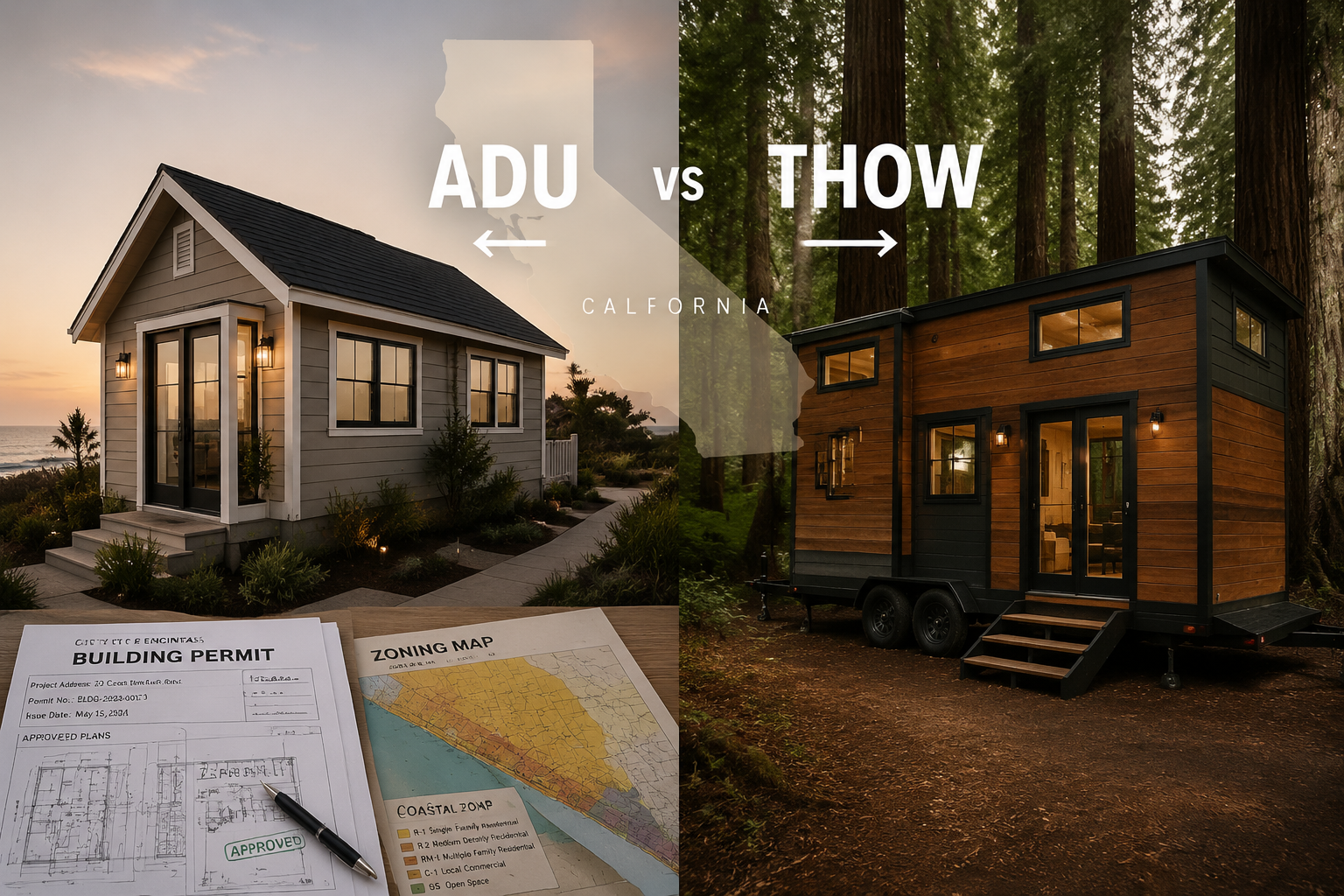
In California, the term "tiny home" covers two very different legal categories. Knowing which one you're dealing with changes everything — from where you can put it to how you finance it.
ADU (Accessory Dwelling Unit): A permanent structure built on a foundation, either attached to or separate from a main house. California state law governs these, and recent legislation has made them much easier to build and permit.
THOW (Tiny Home on Wheels): A home built on a trailer chassis. These are treated more like recreational vehicles than permanent housing. They need to be RVIA-certified (Recreation Vehicle Industry Association) to be road-legal, and finding a legal place to park one long-term is often the hardest part.
A third option is park model homes — factory-built units that sit on a permanent or semi-permanent site, often in RV parks or tiny home communities. These fall somewhere in between.
Choose an ADU if you own property and want a permanent, financeable structure that adds value to your land.
Choose a THOW if you want mobility, lower upfront cost, or don't own land.
How Do California ADU Laws Work in 2026?
California has passed some of the most ADU-friendly legislation in the country. The short version: if you own a single-family or multi-family property, you almost certainly have the right to add at least one ADU.
Key laws to know:
- AB 68 and AB 881 (2020): Removed many local barriers to ADU approval. Cities can no longer deny ADUs based on minimum lot size alone.
- SB 9 (2022): Allowed homeowners in single-family zones to split their lot or add a duplex, opening up more ADU possibilities.
- AB 2221 (2023): Further streamlined the permitting process and limited the fees cities can charge.
What this means for you: your local city or county still processes the permits, but they have to follow state minimums. They can't just say no because they don't like tiny homes [4].
Common mistake: Assuming state law means your city will be easy to work with. Local planning departments still have discretion on design standards, setbacks, and utility connections. Always call your local planning department first.
What Are the Coastal Regulations for Tiny Homes in California?
If your property is within the California Coastal Zone, you have one more layer of review to deal with: the California Coastal Commission.
The Coastal Commission's job is to protect coastal resources and public access. That means ADUs and new structures near the coast may need a Coastal Development Permit (CDP) in addition to your local building permit.
Here's what that means in practice:
- Not every coastal property needs a CDP. Some cities have "certified Local Coastal Programs" that handle this locally. Check with your city's planning department.
- The review process takes longer. Plan for additional weeks or months if a CDP is required.
- Design standards may be stricter. Height limits, setbacks from bluffs, and visual impact rules are common.
- Flood zone considerations apply. Many coastal areas are in FEMA flood zones, which affects foundation requirements and insurance.
The bottom line: coastal tiny homes are absolutely possible, but budget more time and potentially more money for the permitting process. Don't buy a builder's model before you know your local rules.
How Much Do Tiny Homes in California Cost?
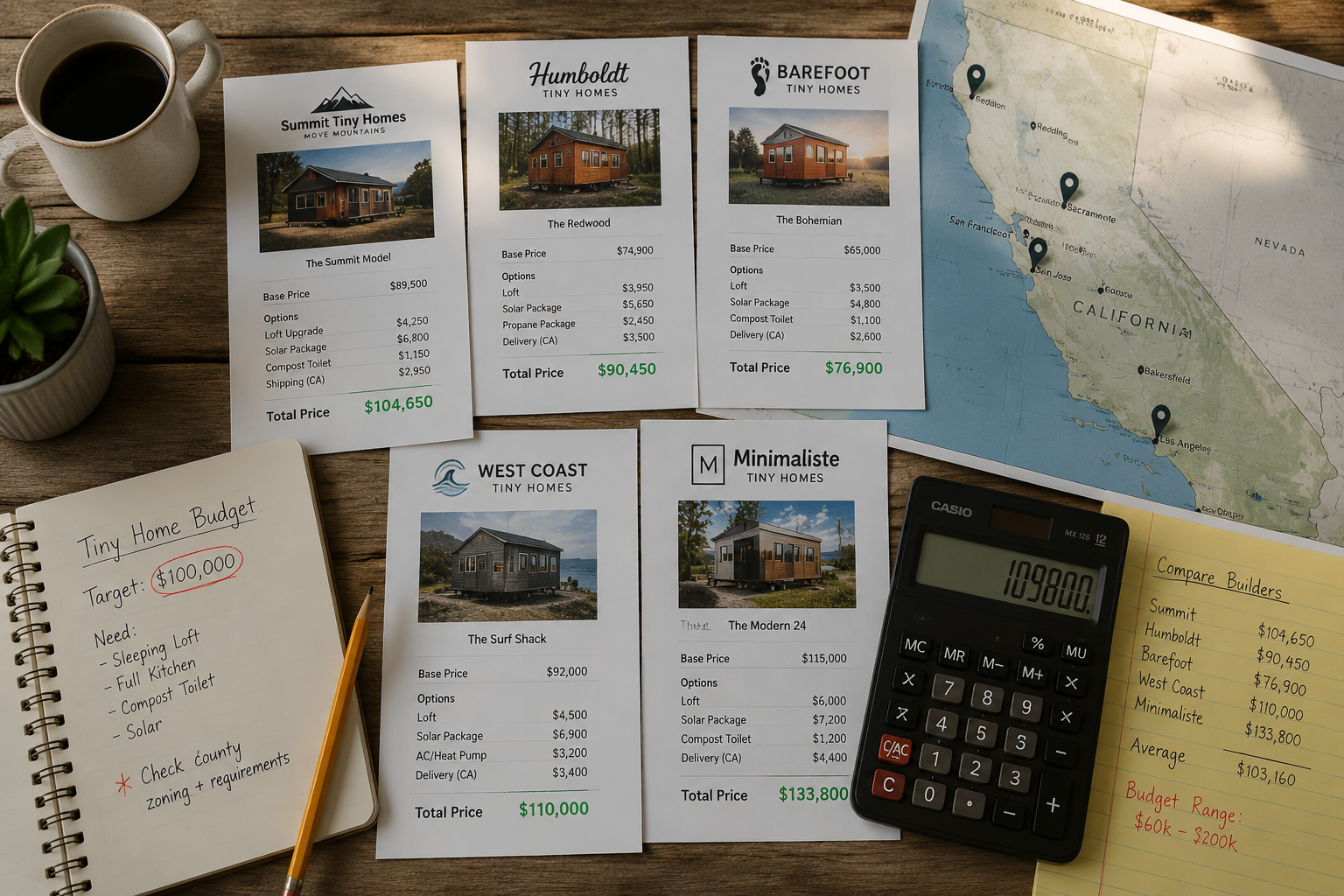
Pricing for tiny homes in California varies a lot based on type, size, and builder. Here's a realistic breakdown.
ADU Pricing
| Type | Size | Price Range |
|---|---|---|
| Prefab ADU (basic) | 300–325 sq ft | $59,000–$70,000 [1] |
| Prefab ADU (mid-range) | 400 sq ft | $120,000–$160,000 [2] |
| Custom ADU (contractor-built) | 400–800 sq ft | $150,000–$350,000+ |
| Garage conversion ADU | Varies | $80,000–$150,000 |
For reference, Central Coast Tiny Homes offers their Corbett Canyon Studio at $120,000 (300 sq ft) and the Corbett Canyon Max starting at $160,000 (400 sq ft, one or two bedrooms) [2]. On the more affordable end, prefab ADUs in the Central Valley have been listed as low as $59,000 for a 325 sq ft unit [1].
THOW Pricing
- Entry-level THOW: $50,000–$80,000
- Mid-range custom THOW: $80,000–$130,000
- High-end or luxury THOW: $130,000–$200,000+
What's not included in most quotes: site prep, utility hookups, permits, and delivery. These can add $10,000–$40,000 depending on your location and lot conditions.
Edge case: If you're in a rural area far from utilities, off-grid systems (solar, rainwater, composting toilets) add cost upfront but reduce ongoing bills. Look for builders who offer off-grid ready configurations if this fits your situation.
Which Builders Serve California?
Several builders operate in California or ship to the state. Here's a practical breakdown of who's active and what they offer.
California-based builders:
- Forever Tiny Homes — Northern California, woman-owned, RVIA-certified THOWs and ADUs, nationwide delivery [7]. You can explore their profile on the Forever Tiny Homes listing page.
- Central Coast Tiny Homes — Serves the Central Coast region with foundation-based ADU models starting at $120,000 [2].
- Nest Tiny Homes — Offers 1-bedroom ADU models designed for California compliance [6].
- California Backyard Homes — Bay Area-focused ADU specialist [3].
- WellNest Company — Bay Area builder offering the WellNest Pod, a 300 sq ft single-level ADU at 30' x 10' [5].
Builders that ship to California:
- Zook Cabins — Offers tiny homes for sale in California with multiple configurations [9].
- Factory Direct Homes — ADU-focused builder with California delivery options [10].
For a broader search, the California tiny house builder directory on Tiny Home Sherpa lists vetted options across the state. You can also browse the full tiny home builders directory to compare builders side by side.
What to look for in a builder:
- RVIA certification (for THOWs)
- Licensed contractor status in California (CSLB license)
- References from California customers specifically
- Clear warranty terms
- Experience with local permitting
Where Can You Park or Place a Tiny Home in California?
This is the question that trips up most buyers. The answer depends entirely on your type of tiny home.
For ADUs: You place them on your own property (or a property you're developing). State law protects your right to do this on most residential lots. The structure becomes part of the property.
For THOWs: Legal long-term parking is genuinely hard to find. Your options include:
- Tiny home communities: California has 13+ documented communities with documented zoning and amenities [8]. These range from RV parks that allow THOWs to purpose-built tiny home villages.
- RV parks: Many allow THOWs, especially RVIA-certified ones. Rules on length of stay vary.
- Agricultural land: Some rural counties allow caretaker dwellings or farm worker housing that can accommodate THOWs. Check local ordinances carefully.
- A friend or family member's property: Possible in some jurisdictions, but you'll need to check local rules on accessory structures and occupancy.
Common mistake: Buying a THOW before securing a legal place to put it. This is the single most common and costly error in the tiny home world. Find your land first.
How Do You Finance a Tiny Home in California?
Financing tiny homes in California is possible, but it works differently than a traditional home loan. The right approach depends on your type of tiny home.
For ADUs:
- Construction loan: Covers the build, then converts to a mortgage or home equity loan.
- Home equity loan or HELOC: If you already own property with equity, this is often the most straightforward path.
- ADU-specific programs: Some California cities and counties offer low-interest ADU loans to encourage housing production. Check with your local housing authority.
- Cash-out refinance: If your primary home has appreciated, you may be able to pull equity to fund an ADU.
For THOWs:
- Personal loan: Most common option. Rates vary widely based on credit score.
- RV loan: Some lenders treat RVIA-certified THOWs like RVs, which can mean better rates and longer terms.
- Manufacturer financing: Some builders offer in-house financing or partnerships with lenders.
What doesn't work: Traditional 30-year mortgages almost never apply to THOWs. And ADUs typically can't be mortgaged separately from the main property — they're considered part of the same parcel.
FAQ: Tiny Homes in California
Can I legally live in a tiny home in California? Yes, in most cases. ADUs are legal permanent residences. THOWs are legal to own but require a legal parking location, which varies by city and county.
Do I need a permit for an ADU in California? Yes. All ADUs require building permits. However, state law has simplified the process significantly, and many jurisdictions now offer streamlined or pre-approved ADU plans.
How long does it take to build an ADU in California? Prefab ADUs can be installed in weeks once permits are approved. Custom builds typically take 6–18 months from design to move-in, including permitting time.
Can I rent out my ADU in California? Yes. Renting an ADU is legal and common. Some cities have short-term rental restrictions (like limits on Airbnb), so check local rules if that's your plan.
Are tiny homes in California a good investment? ADUs generally add value to a property and can generate rental income. THOWs depreciate more like vehicles than real estate. The investment case is stronger for foundation-based units.
What's the minimum size for an ADU in California? State law requires cities to allow ADUs of at least 150 sq ft (efficiency units) and up to 850 sq ft for one-bedroom units, with some exceptions for larger lots.
Do coastal rules apply to ADUs? Yes, if your property is in the California Coastal Zone. You may need a Coastal Development Permit in addition to standard building permits.
Can I put a tiny home on agricultural land in California? Sometimes. Agricultural zoning rules vary by county. Some allow caretaker or farm worker dwellings. Others don't. Always verify with the county planning department before purchasing land.
What's the difference between a park model and a THOW? A park model is a factory-built unit designed to sit semi-permanently in one place. A THOW is built on a road-legal trailer and can be moved. Both are different from foundation-based ADUs.
Is off-grid living allowed in California? In rural areas, yes — with the right permits for septic, well, and solar systems. Urban and suburban areas typically require utility connections for permitted structures.
Conclusion: Your Next Steps Toward Tiny Living in California
Tiny homes in California are more accessible in 2026 than they've ever been. The laws have improved. The builders are better. And the communities are growing.
But this is still a path that rewards preparation. Here's where to start:
- Decide on your type first. ADU or THOW? That single decision shapes everything else — your budget, your land situation, your financing options.
- Check your local zoning. Call your city or county planning department before you spend a dollar. State law sets the floor, but local rules still matter.
- If you're coastal, add extra time. Research whether your property requires a Coastal Development Permit.
- Get real quotes from multiple builders. Don't rely on base prices alone — ask for all-in estimates including site prep, permits, and delivery.
- Secure your land before your home. Especially for THOWs, this is non-negotiable.
For a broader view of how California compares to other states, the Tiny Homes by State directory is a good next stop. And if you're ready to compare builders, the California tiny house listings page is a solid starting point.
Small footprint. Full life. You can do this — start where you are.
References
[1] California Tiny House Listings — https://tinyhouselistings.com/countries/united-states/states/california
[2] Central Coast Tiny Homes — https://cctinyhomes.com
[3] California Backyard Homes — https://cabackyardhomes.com
[4] MagicBox Tiny House: Tiny Houses California — https://www.magicboxtinyhouse.com/tiny-houses-california/
[5] WellNest Pod ADU Video — https://www.facebook.com/dreambiglivetiny/videos/300-sqft-single-level-adu-tiny-house-/916591224229044/
[6] Nest Tiny Homes: 1 Bedroom CA — https://nest-tinyhomes.com/1-bedroom-ca/
[7] Forever Tiny Homes — https://www.forevertinyhomes.com
[8] Little Houses For Sale: California Communities — https://www.littlehousesforsale.com/communities/california
[9] Zook Cabins: Tiny Homes for Sale in CA — https://www.zookcabins.com/service-areas/california/tiny-homes-for-sale-in-ca
[10] Factory Direct Homes: ADU — https://factorydirecthomes.com/adu/