
Last updated: May 15, 2026
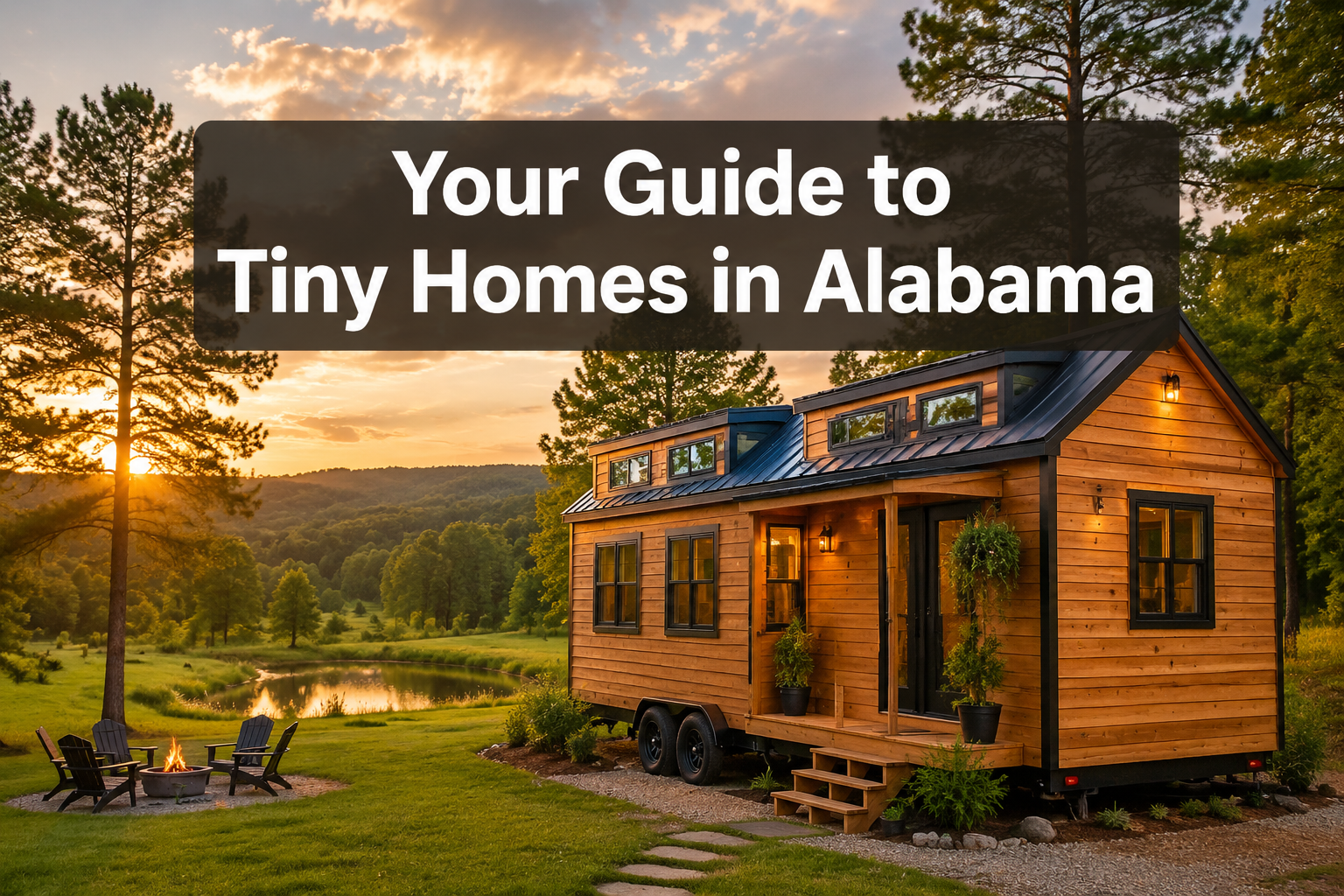
Quick Answer: Alabama is one of the most affordable states in the South for tiny home living. Land is cheap, rural counties often have flexible zoning, and a growing number of Alabama tiny house builders offer everything from custom builds to ready-to-deliver prefab units. Whether you want a tiny home on wheels or a permanent foundation on your own land, Alabama gives you real options at prices that are hard to find anywhere else.
Key Takeaways
- Tiny homes for sale in Alabama range from around $25,000 for a basic THOW (tiny house on wheels) to $120,000+ for a custom-built, fully off-grid cabin.
- Many rural Alabama counties have no zoning at all, which makes placing a tiny home much easier than in most states.
- Alabama does not have a statewide tiny home law, so rules vary by county and municipality.
- RVIA certification matters if you plan to finance or insure a tiny home on wheels — look for builders who offer it.
- Several Alabama tiny home communities are emerging, especially in the northern hill country and along the Gulf Coast.
- Financing options include personal loans, chattel loans, RV loans, and land-home packages — each with different requirements.
- Local builders tend to offer better customization and faster delivery than out-of-state manufacturers.
- Rural land in Alabama can be purchased for as little as $1,500–$3,000 per acre in some counties (estimate based on rural land listings, 2025–2026).
If you're comparing states, check out the complete state-by-state tiny home directory to see how Alabama stacks up against neighboring states.
What Types of Tiny Homes Are Available in Alabama?
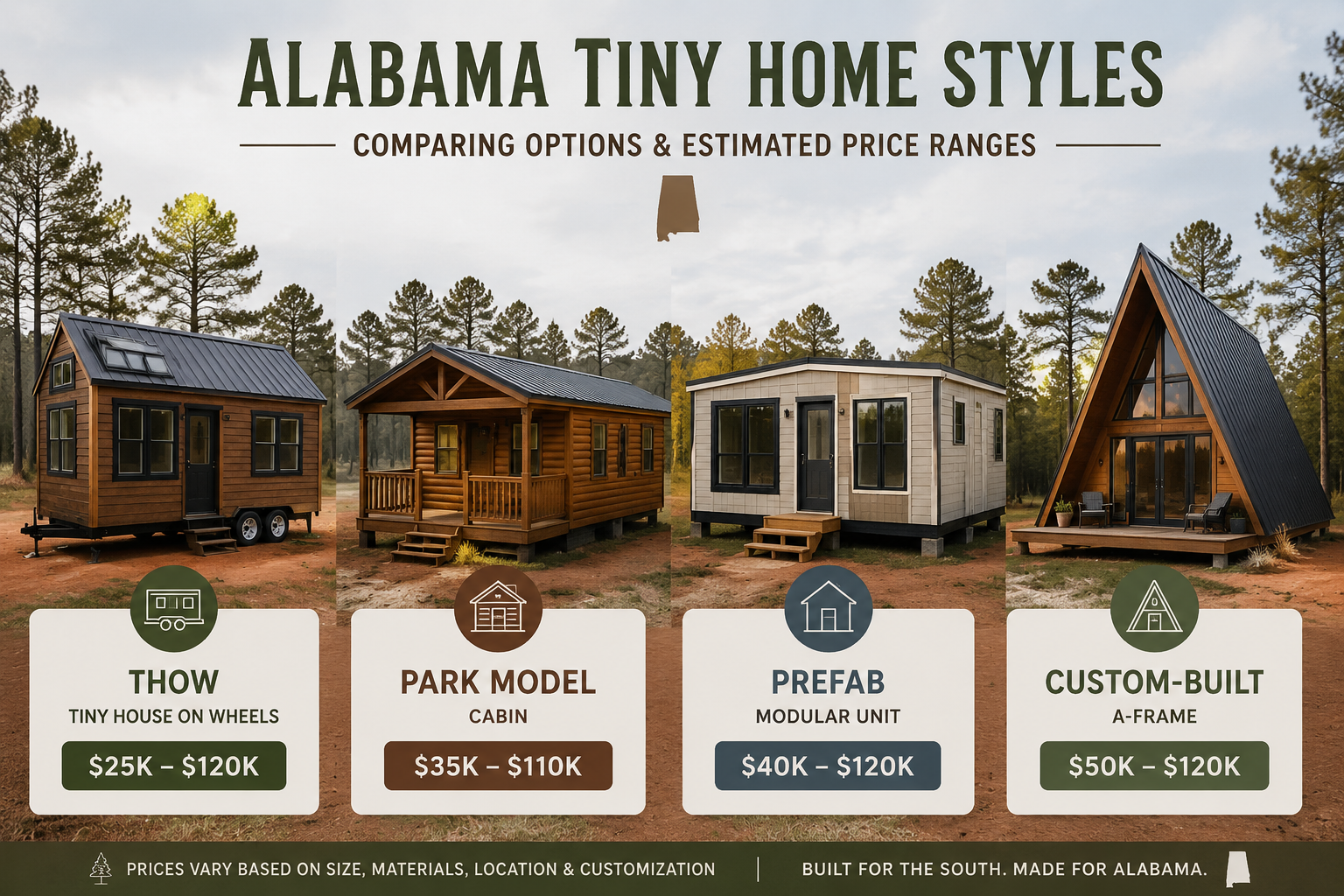
Alabama buyers have four main types of tiny homes to choose from. Each one fits a different lifestyle and budget.
Tiny Houses on Wheels (THOWs)
A THOW is built on a trailer chassis, which means it can move. This is the most popular option for people who want flexibility or aren't ready to commit to a piece of land. In Alabama, THOWs are often classified as RVs, which affects where you can park them and how you finance them.
Best for: People who want mobility, renters testing tiny living, or buyers who haven't found land yet.
Park Model Homes
Park models are factory-built homes, usually between 400 and 500 square feet. They sit on a semi-permanent foundation and are common in RV parks and tiny home communities. They're often more affordable than custom builds and come ready to move in.
Best for: Buyers who want a move-in-ready option in an established community.
Modular and Prefab Tiny Homes
These are built in a factory and delivered to your land in sections or as a complete unit. Quality has improved a lot in recent years. Many modular builders now offer energy-efficient packages with spray foam insulation and mini-split HVAC systems.
Best for: Buyers who want a permanent foundation home with faster build times than stick-built construction.
Custom Stick-Built Tiny Homes
Built on-site by a contractor or tiny home builder, these offer the most design freedom. They can be built to any local code and placed on a permanent foundation. They also tend to hold their value better over time.
Best for: Buyers purchasing rural land who want a long-term home with full customization.
How Much Do Tiny Homes for Sale in Alabama Cost?
Tiny home prices in Alabama vary widely depending on type, size, and builder. Here's a general breakdown.
| Type | Estimated Price Range | Notes |
|---|---|---|
| Basic THOW (DIY or entry-level) | $25,000–$55,000 | Smaller footprint, fewer features |
| Mid-range THOW (builder-made) | $55,000–$85,000 | Better finishes, loft, full kitchen |
| Park Model Home | $45,000–$90,000 | Delivered, semi-permanent |
| Prefab/Modular Tiny Home | $60,000–$110,000 | Foundation-ready, energy-efficient options |
| Custom Stick-Built | $80,000–$150,000+ | Full customization, highest resale value |
These are estimates based on builder pricing observed in 2025–2026. Costs vary by location, materials, and builder.
Don't forget land costs. Rural Alabama land can be very affordable — some counties in the Black Belt region or the Tennessee Valley have acreage available under $3,000 per acre. That's a meaningful advantage compared to states like Tennessee or Texas where land near amenities costs significantly more.
Common mistake: Many buyers budget only for the home and forget about site prep — clearing land, installing a septic system, running power, and drilling a well. These costs can add $15,000–$40,000 depending on your property.
Who Are the Alabama Tiny House Builders Worth Knowing?
Alabama has a small but growing builder community. Here are the types of builders operating in the state, along with what to look for.
Local Alabama Builders
Several small custom builders operate across the state, particularly in the Huntsville, Birmingham, and Mobile areas. Local builders understand Alabama's county-level zoning quirks, can pull permits more easily, and often offer better post-build support.
What to ask any local builder:
- Are you licensed and insured in Alabama?
- Do you offer RVIA certification for THOWs?
- Can you provide references from Alabama clients?
- What's your current build timeline?
Regional Builders Serving Alabama
Builders based in neighboring states — Tennessee, Georgia, and Mississippi — frequently deliver to Alabama. Some of the more established regional names in the Southeast tiny home space include:
- Wind River Tiny Homes (Tennessee-based, delivers to Alabama) — known for high-end custom THOWs and strong craftsmanship ratings
- Incredible Tiny Homes (Tennessee-based) — offers a range of sizes and price points, RVIA-certified
- Timbercraft Tiny Homes (Tennessee-based) — popular for their design-forward interiors
Note: Always confirm current delivery availability and pricing directly with any builder. Builder availability changes.
What RVIA Certification Means
RVIA stands for Recreation Vehicle Industry Association. If a THOW is RVIA-certified, it means it was built to a recognized safety standard. This matters because:
- Most RV parks and some tiny home communities require RVIA certification
- RV loans and some insurance policies require it
- It adds credibility to the build if you ever want to sell
If a builder can't tell you whether their THOWs are RVIA-certified, that's a red flag.
Where Can You Find Alabama Tiny Home Communities?
Alabama tiny home communities are still developing, but the landscape is shifting. A few established and emerging options exist across the state.
Northern Alabama
The hill country around Huntsville and the Tennessee Valley has attracted several small intentional communities and tiny home neighborhoods. The area's relatively mild climate, outdoor recreation access, and proximity to Huntsville's growing job market make it appealing.
Gulf Coast Region
Baldwin County and the Mobile Bay area have seen interest in tiny home resort communities and short-term rental parks. Zoning here is more regulated than in rural counties, but some developments have worked through the approval process successfully.
Rural Central Alabama
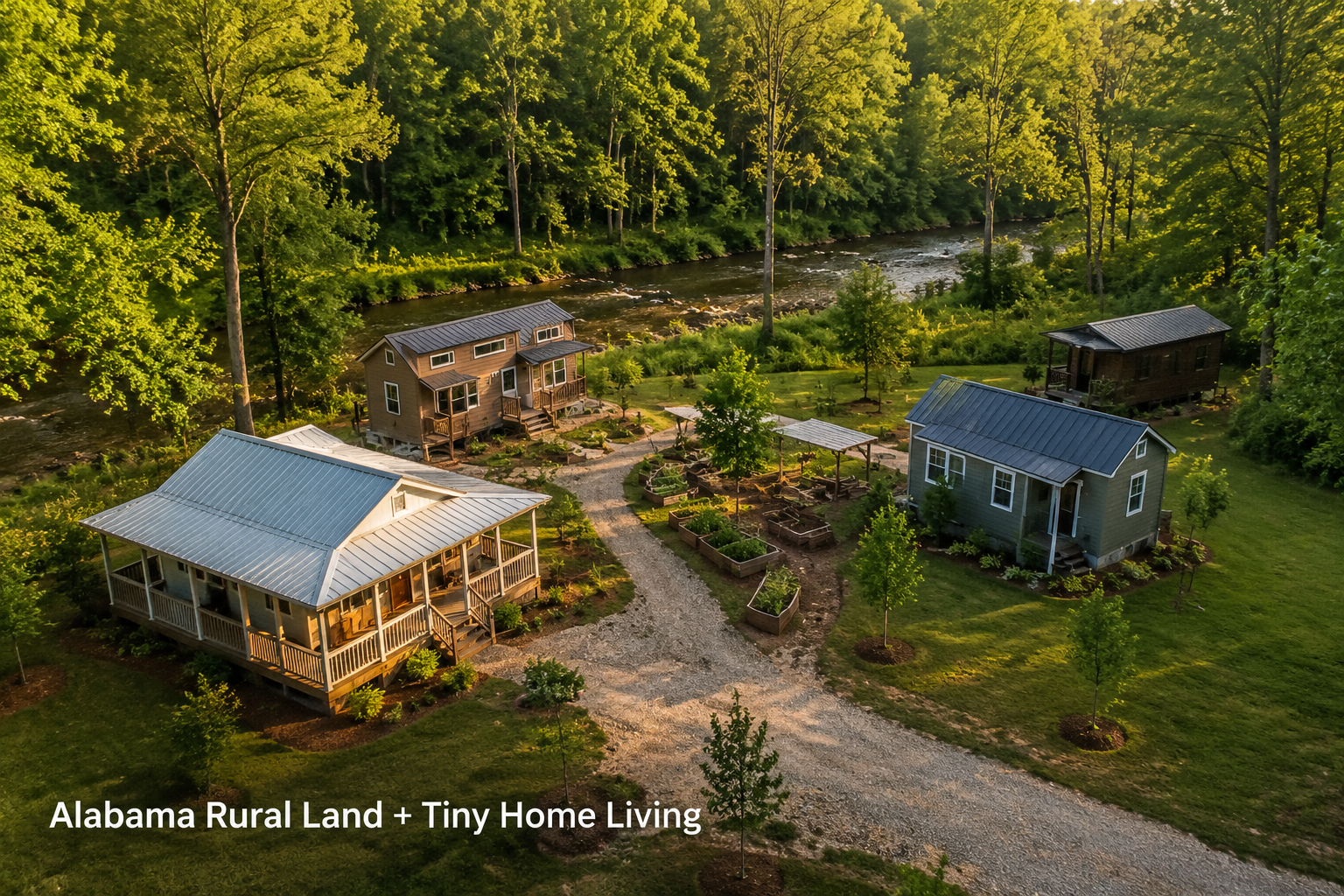
This is where land is cheapest and zoning is most flexible. The Black Belt region — named for its dark, fertile soil — has large tracts of affordable land. It's more remote, but for buyers interested in homesteading or off-grid living, it's worth serious consideration.
"The combination of low land costs and flexible rural zoning makes Alabama one of the most underrated states for tiny home living in the South." — A perspective shared consistently by tiny home land buyers and builders in the region.
What Are Alabama's Zoning Rules for Tiny Homes?
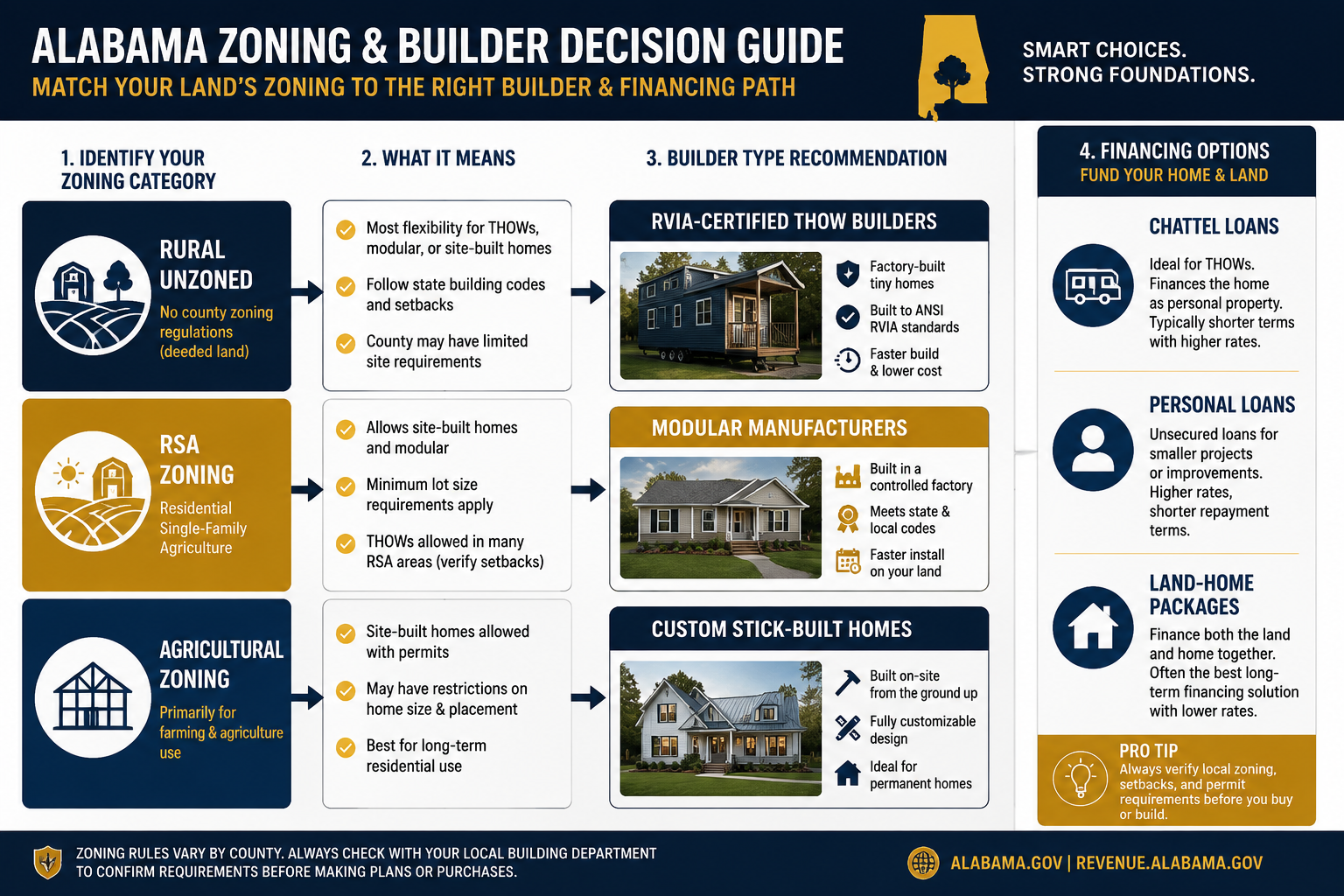
Alabama's zoning rules for tiny homes depend entirely on where you want to place your home. There is no single statewide law.
Unzoned Rural Counties
A significant portion of Alabama's rural land falls outside any zoning jurisdiction. In these areas, you have the most freedom. You can often place a THOW, a modular home, or a stick-built tiny home with minimal bureaucratic friction. You'll still need to meet state building codes for permanent structures, and you'll need to handle utilities (septic, well, power) independently.
Choose this path if: You want maximum flexibility, you're buying rural acreage, and you're comfortable managing your own utilities.
Counties and Cities With Zoning
In zoned areas, tiny homes face more scrutiny. Common restrictions include:
- Minimum square footage requirements (some municipalities require 600–1,000 sq ft for a permanent dwelling)
- Prohibition on THOWs as permanent residences
- ADU (accessory dwelling unit) rules that may or may not allow tiny homes on existing lots
Before you buy land in a zoned area, call the county planning office and ask directly: "Can I place a [THOW / modular home / tiny home] on this parcel as a primary residence?" Get the answer in writing if possible.
Alabama's ADU Opportunity
Some Alabama municipalities have updated their codes to allow ADUs — smaller secondary homes on a property that already has a primary residence. This can be a path to placing a tiny home legally on land you already own or are purchasing with an existing structure.
How Do You Finance a Tiny Home in Alabama?
Financing is one of the biggest hurdles for tiny home buyers. Here's what actually works in Alabama in 2026.
RV Loans
If your THOW is RVIA-certified, you can often finance it through an RV loan. These are available through credit unions, banks, and specialty lenders. Terms typically range from 10 to 20 years, and rates vary based on credit score and loan amount.
Good option if: Your THOW is RVIA-certified and you want a lower monthly payment over a longer term.
Personal Loans
Unsecured personal loans work for smaller builds — typically under $50,000. They're faster to get but carry higher interest rates. Best for buyers with strong credit who want a simple process.
Chattel Loans
A chattel loan is a loan for personal property — like a manufactured home or THOW — that isn't permanently attached to land. Some lenders specialize in these for tiny homes. Terms are usually shorter than a traditional mortgage.
Land-Home Packages
If you're buying land and placing a permanent tiny home, some lenders will bundle the land and home into a single loan. This is closer to a traditional mortgage and often has the best long-term rates. It requires the home to be on a permanent foundation.
What Doesn't Work
Traditional mortgages are hard to get for tiny homes under 400 square feet. Most lenders require a minimum home size that tiny homes don't meet. Don't waste time applying for a conventional mortgage unless your tiny home meets local minimum size requirements.
What Should You Look for in an Alabama Tiny House Builder?
Choosing the right builder is the most important decision you'll make. Here's a simple checklist.
Builder vetting checklist:
- Licensed contractor in Alabama (or the state where they build)
- General liability insurance — ask for a certificate
- Portfolio of completed builds with photos and references
- Clear, written contract with timeline and payment schedule
- Warranty on materials and workmanship (1 year minimum is standard)
- RVIA certification offered for THOWs (if applicable)
- Transparent pricing — no vague "starting at" numbers without detail
- Experience with Alabama-specific zoning or delivery logistics
Red flags to watch for:
- Large upfront deposits (over 30–40%) before any work begins
- No physical address or verifiable business history
- Pressure to decide quickly or "lock in pricing" without a written quote
- No references from past clients
Is Tiny Home Living in Alabama Right for You?
Tiny home living in Alabama works well for specific types of buyers. It's not the right fit for everyone, and we'd rather be honest about that upfront.
It's a strong fit if you:
- Want to own land and a home without a 30-year mortgage
- Are drawn to rural or semi-rural living
- Value lower utility costs and a smaller environmental footprint
- Are comfortable with DIY maintenance or have a local support network
- Want to homestead, farm, or live off-grid
It may not be the right fit if you:
- Need to be in a city or suburb for work and can't find a compliant community
- Have a large family that needs significant square footage
- Aren't comfortable with the uncertainty of zoning approval processes
- Prefer the financing simplicity of a traditional home purchase
This isn't about discouraging you. It's about helping you make a decision you'll feel good about in five years, not just five weeks from now.
Frequently Asked Questions
Q: Are tiny homes legal in Alabama? A: Yes, but legality depends on location. Unzoned rural counties offer the most flexibility. Incorporated towns and cities often have minimum square footage rules that can restrict tiny homes as primary residences. Always check with the local planning office before purchasing land.
Q: Can I park a tiny home on wheels on my own land in Alabama? A: In unzoned rural areas, often yes. In zoned areas, THOWs are frequently classified as RVs and may not be permitted as permanent residences. Check county and municipal rules first.
Q: What is the cheapest way to get a tiny home in Alabama? A: Buying a used THOW or a basic prefab unit is the most affordable entry point — sometimes under $30,000. Adding land in a rural county can still keep your total cost well under $100,000.
Q: Do I need a permit to build a tiny home in Alabama? A: For permanent structures, yes — Alabama requires building permits for new construction. For THOWs classified as RVs, permit requirements vary. Always check with your county building department.
Q: Can I live in a tiny home community in Alabama year-round? A: Some communities allow it, others are seasonal or short-term only. Confirm residency rules with any community before committing.
Q: How long does it take to build a custom tiny home in Alabama? A: Custom builds typically take 3–9 months depending on builder workload and complexity. Prefab and park model homes can be delivered in 6–12 weeks.
Q: What utilities do I need for a tiny home on rural Alabama land? A: Most rural properties will need a septic system, a drilled well, and either a grid connection or solar/battery system. Budget $15,000–$40,000 for site prep depending on your land's conditions.
Q: Is Alabama a good state for off-grid tiny living? A: Yes. Affordable land, mild winters, good solar potential, and flexible rural zoning make Alabama one of the better Southern states for off-grid setups.
Q: What's the resale value of a tiny home in Alabama? A: Custom stick-built homes on owned land hold value best. THOWs depreciate more like vehicles than real estate. If resale value matters to you, prioritize a permanent foundation on titled land.
Q: Are there tiny home builders near Huntsville or Birmingham? A: Yes, both metro areas have local builders and access to regional builders who deliver statewide. Search for licensed contractors who specialize in small home construction, and ask specifically about tiny home experience.
- Browse the full state directory. If you're still comparing Alabama to other states, our Tiny Homes by State guide maps out your options across the country.
Conclusion: Start Where You Are
Alabama is genuinely one of the best states in the South for affordable tiny home living. Low land costs, flexible rural zoning, and a growing builder community mean you have real options — whether you're dreaming of a cedar-sided cabin in the hill country or a Gulf Coast park model with a screened porch.
The path forward isn't complicated, but it does require a few concrete steps:
- Decide on your home type — THOW, modular, or stick-built — based on your land situation and lifestyle.
- Research zoning in the specific county or municipality where you want to live before you buy anything.
- Set a realistic total budget that includes land, site prep, the home, and a 10–15% contingency.
- Vet at least three builders using the checklist above before signing any contract.
- Explore financing early — knowing what you qualify for shapes every other decision.
You don't have to figure all of this out at once. Start where you are, take the next step, and use this guide as a reference point along the way. The tiny home world in Alabama is mapped out — and it's more accessible than most people expect.
References
- Recreation Vehicle Industry Association (RVIA). RVIA Certification Standards Overview. rvia.org. 2023.
- Alabama Department of Economic and Community Affairs. Building Codes and Construction Standards. adeca.alabama.gov. 2022.
- U.S. Census Bureau. American Housing Survey: Alternative Housing Units. census.gov. 2023.
- National Association of Realtors. Rural Land Market Report. nar.realtor. 2024.
- Tiny Home Industry Association (THIA). State of the Industry Report. tinyhomeindustryassociation.org. 2023.