
Last updated: June 24, 2026
Quick Answer: The monthly cost of living in a tiny home park typically runs between $700 and $1,800 total when you add lot rent, utilities, insurance, and maintenance. Lot rent alone ranges from $300 to $800 per month depending on location, amenities, and demand. Where you park matters as much as what you drive.
Key Takeaways
- Lot rent is the biggest variable, ranging from roughly $300/month in rural areas to $800 or more in high-demand metros
- Total monthly expenses in a tiny home park generally fall between $700 and $1,800 for most residents in 2026
- Utilities in a park are often lower than in a traditional home but still add $100 to $250 per month
- Insurance for a tiny home on wheels (a THOW, meaning a tiny home built on a trailer) runs $50 to $150 per month depending on coverage type
- HOA or community fees, where they exist, typically add $25 to $75 per month
- Location is the single biggest cost driver: coastal and mountain resort areas cost significantly more than the rural South or Midwest
- Maintenance costs for a tiny home are lower than a conventional house but should still be budgeted at $50 to $150 per month
- The monthly cost of living in a tiny home park is almost always lower than renting a conventional apartment in the same metro area
Table of Contents
- What Does Lot Rent Actually Cover?
- Breaking Down the Monthly Cost of Living in a Tiny Home Park
- How Location Changes Everything
- Sample Monthly Budget: Three Real-World Scenarios
- Hidden Costs Most People Miss
- How to Find a Reputable Tiny Home Park
- Is the Monthly Cost of Living in a Tiny Home Park Worth It?
- FAQ
What Does Lot Rent Actually Cover?
Lot rent is the monthly fee you pay to park your tiny home on a community's land. It is not a mortgage, and it does not build equity. What it does buy you is a legal, serviced place to live.
Most lot rents include:
- A designated parking pad (gravel, concrete, or asphalt)
- Access to water and sewer hookups
- Trash pickup
- Common area maintenance (roads, landscaping, shared spaces)
- Sometimes: laundry facilities, Wi-Fi, or a community clubhouse
What it typically does not include: your electricity, your propane, your personal internet, or renter's insurance. Those come out of your pocket separately.
Breaking Down the Monthly Cost of Living in a Tiny Home Park
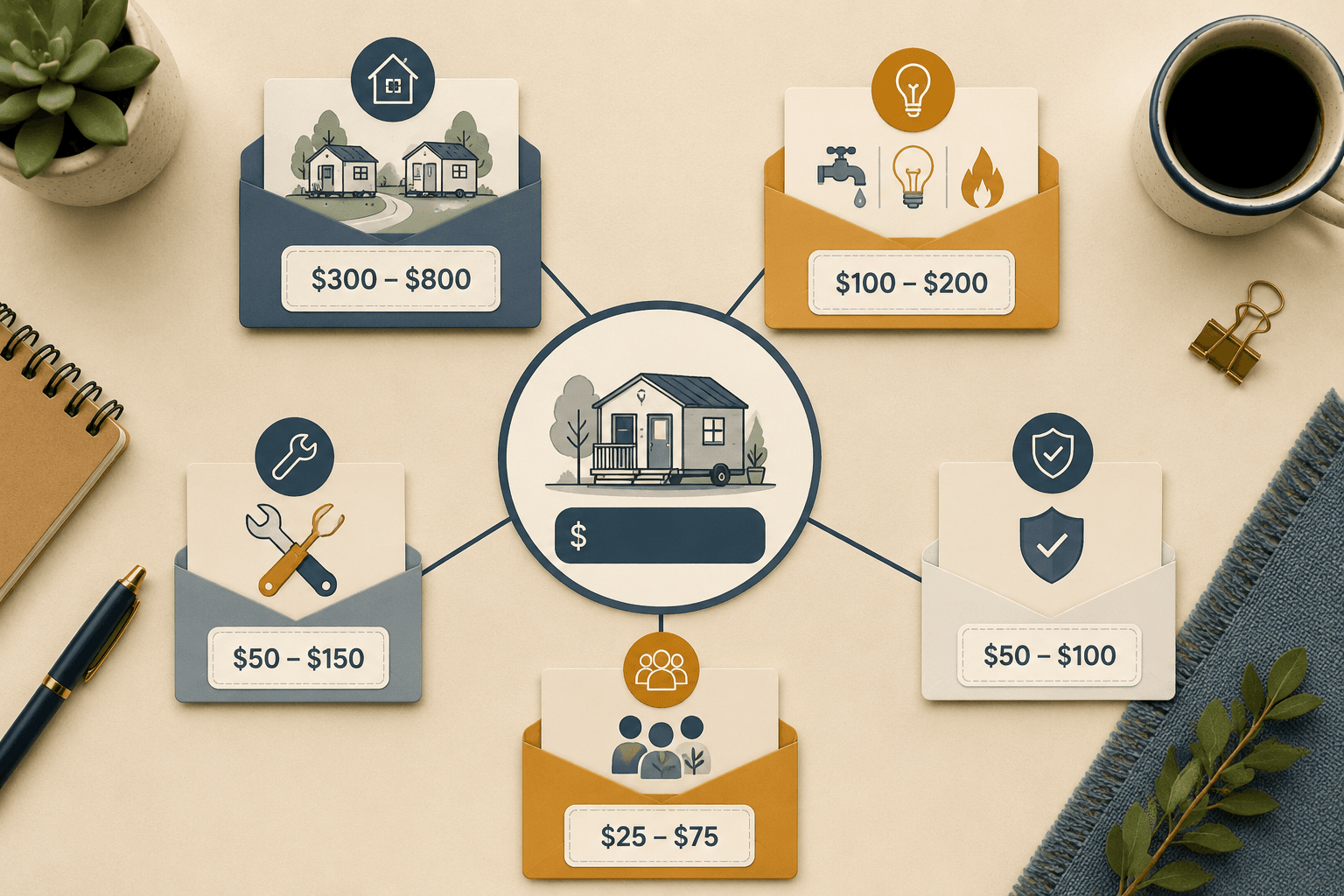
The monthly cost of living in a tiny home park has several moving parts. Here is what each line item looks like in practice.
Lot Rent: $300 to $800/month
This is your anchor expense. Rural parks in states like Arkansas, Alabama, and Tennessee tend to sit at the lower end. Parks near Asheville, Denver, or coastal California push toward $700 to $900 or more. The Tiny Homes by State directory is a good starting point for understanding what's available in specific regions.
Utilities: $100 to $250/month
Tiny homes use less energy than conventional homes, but they are not free to run. Budget for:
- Electricity: $40 to $120/month (varies by climate and season)
- Water/sewer: Often included in lot rent, but not always — add $30 to $60 if billed separately
- Propane or natural gas: $20 to $80/month depending on your heating and cooking setup
- Internet: $40 to $80/month if not bundled with park fees
Insurance: $50 to $150/month
A THOW (tiny home on wheels) is typically insured as a specialty RV or through a dedicated tiny home policy, not a standard homeowner's policy. RVIA-certified homes (those built to Recreational Vehicle Industry Association standards) are easier to insure and often cheaper. Foundation-based tiny homes may qualify for a standard homeowner's or renter's policy. Expect $600 to $1,800 annually.
HOA or Community Fees: $0 to $75/month
Not all parks charge these. When they exist, they usually cover shared amenities: a pool, a dog run, a community garden, or event programming. Some parks fold this into lot rent. Ask before you sign.
Maintenance: $50 to $150/month
Tiny homes need less maintenance than a 2,000-square-foot house, but they still need it. Roof seals, trailer inspections, appliance upkeep, and weatherproofing add up. Setting aside $600 to $1,800 per year is a reasonable buffer.
How Location Changes Everything
Location is the most powerful variable in the monthly cost of living in a tiny home park. The same 200-square-foot home costs dramatically different amounts to park depending on the zip code.
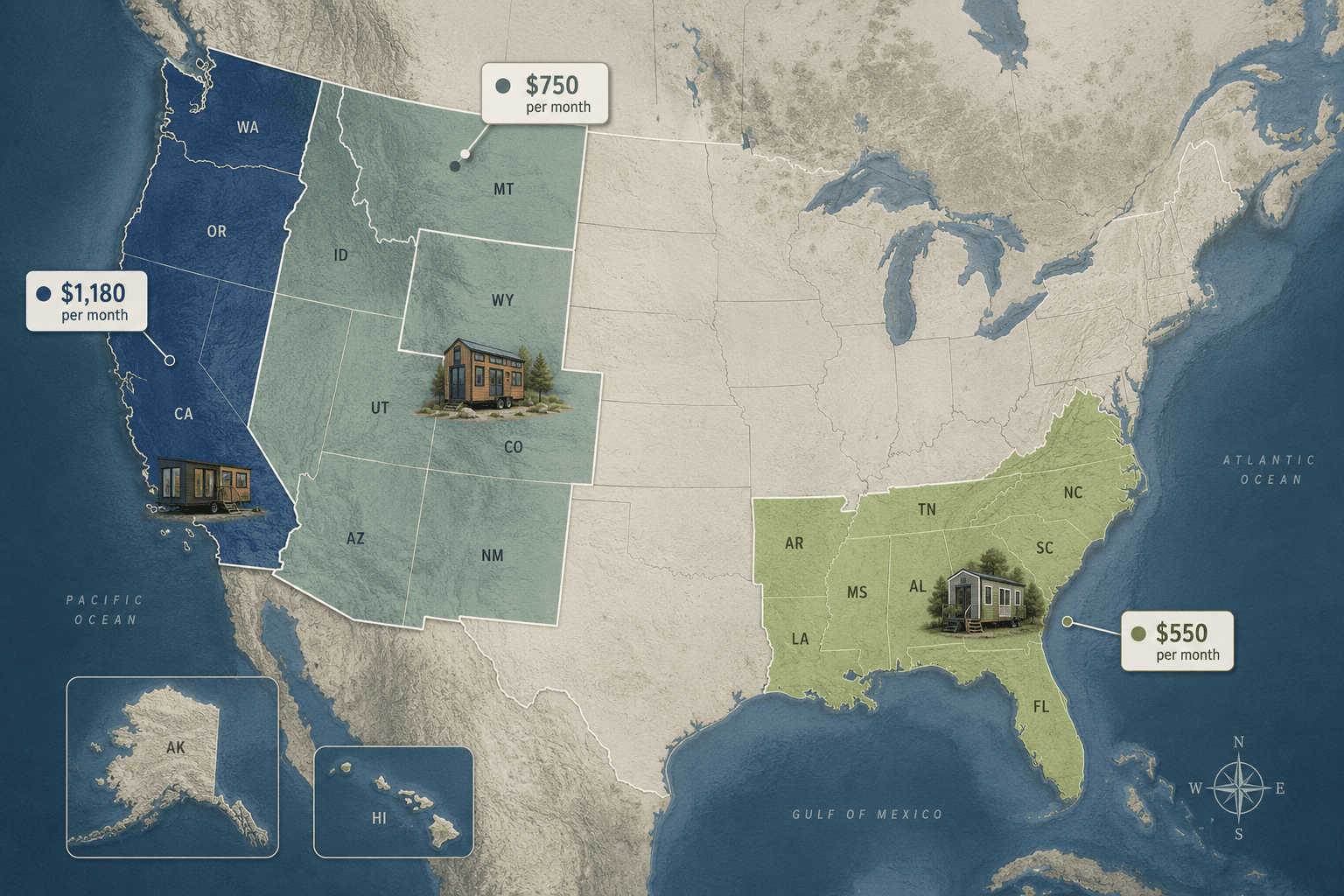
Here is a rough regional breakdown for 2026:
| Region | Typical Lot Rent Range |
|---|---|
| Rural South (AR, AL, TN, MS) | $300 to $450/month |
| Midwest (OH, IN, MI, MO) | $350 to $500/month |
| Mountain West (CO, AZ, NM) | $450 to $700/month |
| Pacific Coast (CA, OR, WA) | $600 to $900+/month |
| Northeast (NY, MA, CT) | $550 to $850/month |
If you're considering the Southeast, the guide to tiny homes in Alabama and the Arkansas tiny home guide both cover land costs and community options in detail. For the West Coast, the California tiny homes guide addresses the higher cost environment honestly.
Sample Monthly Budget: Three Real-World Scenarios
These are illustrative estimates based on typical park costs across different regions in 2026. Actual costs will vary.
Scenario A: Rural Southeast (e.g., rural Tennessee or Arkansas)
| Expense | Estimated Monthly Cost |
|---|---|
| Lot rent | $350 |
| Electricity | $60 |
| Water/sewer | $35 |
| Propane | $30 |
| Internet | $50 |
| Insurance | $65 |
| Maintenance reserve | $75 |
| Total | $665 |
Scenario B: Mountain West (e.g., outside Flagstaff, AZ or Albuquerque, NM)
| Expense | Estimated Monthly Cost |
|---|---|
| Lot rent | $550 |
| Electricity | $90 |
| Water/sewer | $45 |
| Propane | $50 |
| Internet | $60 |
| Insurance | $90 |
| HOA fee | $40 |
| Maintenance reserve | $100 |
| Total | $1,025 |
Scenario C: Pacific Coast (e.g., Northern California or Oregon)
| Expense | Estimated Monthly Cost |
|---|---|
| Lot rent | $750 |
| Electricity | $110 |
| Water/sewer | $55 |
| Propane | $40 |
| Internet | $70 |
| Insurance | $130 |
| HOA fee | $60 |
| Maintenance reserve | $130 |
| Total | $1,345 |
Even the highest scenario here compares favorably to renting a one-bedroom apartment in most Pacific Coast cities.
Hidden Costs Most People Miss
A few expenses catch first-timers off guard.
Trailer registration and inspection. If your tiny home is on wheels, it is a vehicle in most states. Annual registration fees and periodic safety inspections apply. Budget $100 to $300 per year.
Move-in fees. Some parks charge a one-time setup or connection fee, ranging from $200 to $800.
Deposit. Many parks require a security deposit equal to one or two months of lot rent.
Towing costs. If you ever need to relocate your THOW, professional transport runs $2 to $5 per mile. A 300-mile move could cost $600 to $1,500.
Skirt and pad requirements. Some parks require skirting around the base of your home for aesthetics or weather protection. This is a one-time cost but can run $300 to $1,000 depending on materials.
How to Find a Reputable Tiny Home Park
Finding a park is not as simple as a Google search. Many listings are outdated, and not every park accepts THOWs. The Tiny Home Sherpa builder and community directory is a useful starting point for connecting with vetted options.
When evaluating a park, ask these questions:
- Is the park zoned for full-time residency, or is it RV/seasonal only?
- Are utilities metered individually or shared?
- What is the lease term — month-to-month or annual?
- Are there size or age restrictions on homes?
- What is the pet policy?
- Is the park in a flood zone?
If you're working with a builder, they often have relationships with parks in their region. Builders like Sprout Tiny Homes and New Frontier Tiny Homes can sometimes point you toward communities that welcome their builds.
Is the Monthly Cost of Living in a Tiny Home Park Worth It?
For most people who make the move intentionally, yes. The monthly cost of living in a tiny home park is almost always lower than conventional renting or owning in the same area. The tradeoffs are real: less space, less privacy, no land ownership, and dependence on park management. But for someone prioritizing financial freedom, reduced overhead, or geographic flexibility, the math usually works.
The key is going in with clear eyes. Know what lot rent covers. Know your total monthly number before you sign. And choose a park the same way you'd choose a landlord: carefully, with references.
Small footprint. Full life. That's the goal, and it's achievable with the right numbers in front of you.
FAQ
What is the average lot rent in a tiny home park in 2026? The national average lot rent sits somewhere between $400 and $600 per month, but the range is wide: $300 in rural areas, $800 or more near desirable metros. Location is the biggest factor.
Does lot rent include utilities? Sometimes water and sewer are included; electricity almost never is. Always ask for a written breakdown of what the lot rent covers before signing a lease.
Can I own the land in a tiny home park? Most tiny home parks operate on a land-lease model, meaning you own your home but rent the land. Some communities do offer land ownership or co-op structures, but they are less common.
Is tiny home park living cheaper than renting an apartment? In most US markets, yes. A total monthly budget of $700 to $1,200 in a tiny home park compares favorably to one-bedroom apartment rents, which averaged over $1,500 nationally in recent years.
What insurance do I need for a tiny home in a park? If your home is a THOW, you typically need a specialty RV or tiny home policy. If it's a foundation-built tiny home, a standard homeowner's or renter's policy may apply. Expect $600 to $1,800 annually.
Are there age-restricted tiny home parks? Yes. Some parks are 55+ communities. Others accept all ages. Check the park's rules before applying, especially if you have children.
How do I know if a park is legitimate and well-managed? Visit in person, talk to current residents, check for a formal lease agreement, and verify zoning status with the local municipality. Online directories like Tiny Home Sherpa can help you find communities with verified listings.
Conclusion
The monthly cost of living in a tiny home park is not a single number — it's a range shaped by where you live, what your park includes, and how you manage your home. For most people in 2026, that range runs between $700 and $1,400 per month all-in. That's a meaningful difference from conventional housing costs, and it's real.
Start where you are. Get the actual lot rent numbers for the regions you're considering. Add utilities, insurance, and maintenance. Then compare that total to what you're paying now. The math will tell you a lot.
To keep researching, explore the Tiny Homes by State directory for location-specific cost and zoning guidance, and browse the full builder directory to find builders who know the parks in your target area. Vetted builders. Real answers. Fewer dead ends.