Last updated: May 18, 2026
Quick Answer
Florida is one of the most active tiny home markets in the country, driven by year-round tourism, a fast-growing retiree population, and a real need for storm-resistant housing. Tiny homes in Florida range from RVIA-certified homes on wheels to permanent foundation cottages in age-55-plus communities, with prices generally starting around $60,000 and climbing past $200,000 for custom hurricane-rated builds. Zoning rules vary widely by county, so where you plan to place your home matters as much as what you buy.
Key Takeaways
- 🌴 Florida's tiny home market serves three main buyer groups: retirees, vacation rental investors, and seasonal residents.
- 🌀 Hurricane-ready construction features — impact windows, metal roofs, SIP panels, and elevated foundations — are not optional in Florida. They're essential.
- 🏘️ Several Florida counties have become more tiny-home-friendly in recent years, but zoning still varies dramatically from county to county.
- 💰 Vacation rental tiny homes in high-demand areas (Keys, Gulf Coast, Central Florida) can generate strong short-term rental income, though local STR regulations apply.
- 🏡 Age-55-plus tiny home communities are expanding across the state, offering affordable retirement living with shared amenities.
- 📋 RVIA certification (Recreational Vehicle Industry Association) matters if you want to place a tiny home on wheels in an RV park or resort community.
- 🔧 Builders with Florida-specific experience understand local building codes, wind load requirements, and flood zone rules — choose them over out-of-state generalists.
- 🗺️ Always verify zoning, HOA rules, and utility hookup options before you purchase land or a home.
What Makes Tiny Homes in Florida Different From Other States?
Florida's climate, geography, and demographics create a tiny home market unlike anywhere else in the country. The combination of hurricane risk, high tourism demand, and a large retiree population shapes every decision — from how a home is built to where it can legally sit.
Three factors stand out:
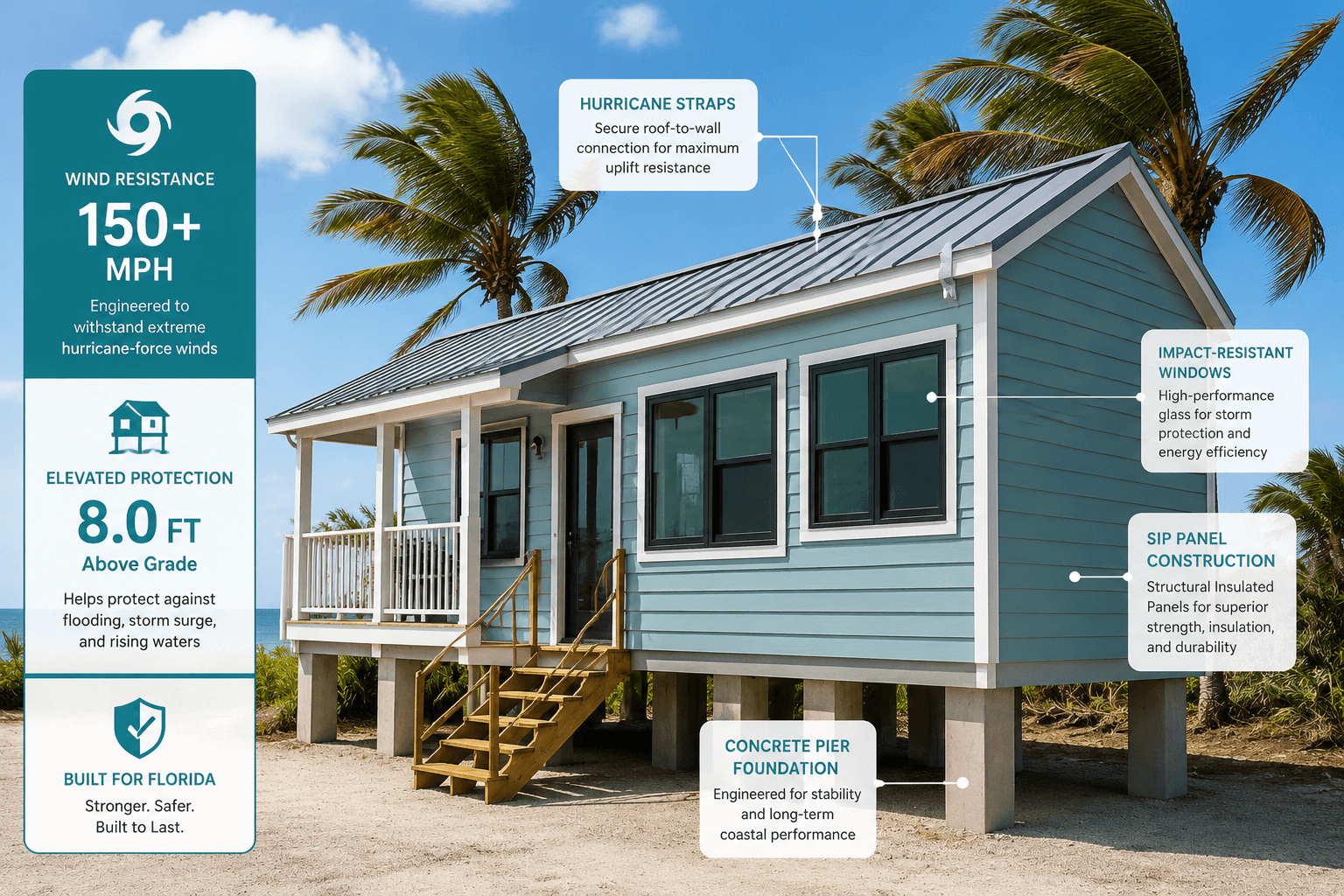
1. Storm resilience is non-negotiable. Florida sees more named storms than any other U.S. state. A tiny home built to standard specs from a northern state may not meet Florida's wind load requirements, which in coastal counties can exceed 150 mph. Builders who know Florida build differently — and you should expect them to.
2. The rental market is exceptional. Florida welcomed over 130 million visitors in 2024, according to Visit Florida. That demand makes vacation rental tiny homes a legitimate investment strategy, especially near the Keys, Gulf Coast beaches, and Central Florida theme parks.
3. Retirement demand is surging. Florida has long been a retirement destination. Tiny home retirement communities offer a lower-cost entry point into that lifestyle — often with shared amenities, social programming, and maintenance-free living.
If you're comparing Florida to other warm-weather states, our complete guide to tiny homes by state is a good place to see how the landscape differs.
How Are Hurricane-Ready Tiny Homes in Florida Built?
A hurricane-ready tiny home uses specific construction methods that standard tiny homes often skip. If you're buying or building in Florida, these features aren't upgrades — they're baseline requirements.
Here's what to look for:
- SIP panels (Structural Insulated Panels): These sandwich panels combine insulation and structural support in one unit. They resist wind and moisture better than standard stick framing.
- Metal standing-seam roofs: Metal roofs rated for 130–160 mph winds are far more durable than asphalt shingles in hurricane conditions.
- Impact-resistant windows and doors: Standard windows shatter in high winds. Impact-rated glass holds together even when struck by debris.
- Elevated foundations: Homes built on concrete piers or stem walls sit above flood levels. FEMA flood maps determine the required elevation in your area.
- Hurricane straps and anchoring systems: These metal connectors tie the roof to the walls and the walls to the foundation, keeping the whole structure together under wind load.
- Whole-home generator hookups: Power outages after storms can last days or weeks. Pre-wired generator connections are a practical feature in Florida.
"Built on trust, not hype" — when a builder claims their home is hurricane-ready, ask for the specific wind rating, the building code standard it meets (Florida Building Code vs. IRC), and whether it's been third-party tested.
Choose a Florida-experienced builder if: you're placing the home in a coastal county, a flood zone, or any area with a wind speed design requirement above 130 mph.
Tampa Bay Tiny Homes is one builder with direct experience building for Florida's Gulf Coast conditions. The Brevard Tiny House Company serves the Space Coast region and understands local code requirements well.
Where Are the Best Tiny Home Retirement Communities in Florida?
Florida has a growing number of age-55-plus tiny home communities, particularly in Central Florida, the Gulf Coast, and the Panhandle. These communities offer an affordable alternative to traditional retirement housing — without sacrificing community or comfort.
What to expect in a tiny home retirement community:
| Feature | Typical Offering |
|---|---|
| Home size | 200–500 sq ft |
| Lot rent (estimate) | $400–$900/month |
| Amenities | Clubhouse, pool, garden plots, walking paths |
| Ownership model | Own home, rent land (land-lease) |
| Age requirement | 55+ (HUD-compliant communities) |
| Pet policies | Varies; many are pet-friendly |
Key regions to research:
- Central Florida (Ocala, Leesburg, The Villages area): Lower land costs, established retirement infrastructure, and a large existing retiree community make this region a natural fit.
- Gulf Coast (Sarasota, Fort Myers, Naples area): Higher land costs but strong resale value and access to beaches and healthcare.
- Panhandle (Pensacola, Panama City area): More affordable than South Florida, with a slower pace and access to the Gulf.
Common mistake: Many buyers focus entirely on the home price and overlook lot rent. A $90,000 tiny home with $800/month lot rent costs more over 10 years than a $130,000 home with no lot rent. Run the full numbers before you commit.
For a broader look at how retirement-focused tiny living compares across the Southeast, see our guide to tiny homes in Alabama.
Can You Use a Tiny Home as a Vacation Rental in Florida?
Yes — and it can be a strong income-producing investment. But the rules vary significantly by city and county, and ignoring them can cost you.
The short version: Florida does not have a statewide ban on short-term rentals (STRs), but many municipalities have passed their own restrictions. Some require STR licenses. Others limit the number of rental days per year. A few popular tourist areas have banned new STR permits entirely.
Before you buy for vacation rental purposes, verify:
- The county and city STR ordinance for your target area
- Whether the property is in a homeowners association (HOA) — many HOAs prohibit rentals under 30 days
- Florida's state lodging tax requirements (currently 6% state sales tax plus local discretionary surtax)
- Whether the property is in a flood zone, which affects insurance costs significantly
Where vacation rental tiny homes perform well in Florida:
- Florida Keys: High nightly rates, strong year-round demand, but strict Monroe County regulations apply.
- 30A / Walton County: Popular Gulf Coast corridor with strong vacation rental culture.
- St. Pete / Clearwater area: High tourism volume, proximity to beaches.
- Central Florida near theme parks: Consistent demand from family travelers year-round.
A small, well-designed tiny home with a full kitchen and outdoor living space can command nightly rates competitive with much larger vacation rentals — especially when the design is distinctive and the location is right.
Island Tiny Homes specializes in builds suited for coastal and vacation rental applications. For investors looking at the broader Southeast market, Southeastern Tiny Homes is worth reviewing as well.
What Are the Zoning Rules for Tiny Homes in Florida?
Florida zoning for tiny homes is a patchwork. There is no single statewide standard — each county and municipality sets its own rules.
The three most common placements and their rules:
1. Tiny homes on foundations (permanent): These are treated like any other single-family home. They must meet the Florida Building Code, including local wind load requirements. Minimum square footage rules vary — some counties require 600 sq ft minimum for a permanent dwelling. Check your target county's land development code.
2. Tiny homes on wheels (THOWs) in RV parks: THOWs are generally classified as recreational vehicles in Florida. If the home is RVIA-certified, it can typically be placed in a licensed RV park or resort. You cannot permanently reside in an RV park in most Florida counties without a special use permit.
3. ADUs (Accessory Dwelling Units): Some Florida counties allow tiny homes as ADUs on existing residential lots. This is one of the most practical paths for retirees who want to downsize while staying on family property — or for investors adding a rental unit to a single-family lot.
Edge case: Several Florida counties — including Alachua and Sarasota — have made specific rule changes to allow tiny home villages or micro-communities. These are worth researching if you're open to community living.
The Tiny Homes by State directory is a good starting point for comparing zoning climates across states if you're still deciding where to land.
How Much Do Tiny Homes in Florida Cost in 2026?
Prices vary based on construction type, size, hurricane-rating level, and whether you're buying land or renting a lot. Here's a realistic breakdown for 2026.
| Home Type | Estimated Price Range |
|---|---|
| Basic THOW (pre-owned) | $30,000–$65,000 |
| New RVIA-certified THOW | $70,000–$130,000 |
| Foundation tiny home (basic) | $80,000–$140,000 |
| Hurricane-rated foundation home | $120,000–$220,000+ |
| Custom vacation rental build | $150,000–$300,000+ |
Additional costs to budget for in Florida:
- Flood insurance: Required in many Florida counties. Can range from $700 to $3,000+ per year depending on flood zone.
- Wind/hurricane insurance: Separate from standard homeowner's insurance in Florida. Budget $1,500–$4,000+ per year for coastal properties.
- Land or lot rent: If you're not buying land, factor in $400–$1,000/month for lot rent in a community.
- Utility connections: Running water, sewer, and electric to a new site can cost $5,000–$20,000 depending on distance from existing infrastructure.
The honest reality: Florida's insurance market is one of the most challenging in the country. Several major insurers have reduced or ended coverage in the state. Get insurance quotes before you finalize any purchase — not after.
How Do You Find a Reputable Tiny Home Builder in Florida?
The best approach is to look for builders with documented Florida experience, not just builders who say they can ship to Florida.
What to ask any builder:
- What wind speed is your home rated for, and which building code standard does it meet?
- Have you built homes placed in Florida flood zones? What elevation requirements did you meet?
- Do you offer RVIA certification for homes on wheels?
- Can you provide references from Florida customers?
- What is your warranty, and how do you handle warranty claims for out-of-state buyers?
Florida-relevant builders in the Tiny Home Sherpa directory:
- Tampa Bay Tiny Homes — Gulf Coast specialist
- Brevard Tiny House Company — Space Coast builder with local code knowledge
- Timbercraft Tiny Homes — Known for high-quality custom builds that can be spec'd for Florida conditions
- Cornerstone Tiny Homes — Solid foundation-style builds with customization options
You can also browse the full tiny home builders directory to filter by features and location.
Quick rule: If a builder can't give you a specific wind rating and the building code standard their home meets, keep looking. Vetted builders. Real answers. Fewer dead ends — that's the standard we hold listings to here.
Looking for a builder in Florida? Check out Florida Tiny House Builders, Craftsman Tiny Homes, or Jax Tiny Homes for THOW, ADU, and park model options throughout the state.
FAQ: Tiny Homes in Florida
Q: Are tiny homes legal in Florida? Yes, but the rules depend on where you want to place the home. Permanent foundation tiny homes must meet local building codes. THOWs are classified as RVs and can be placed in licensed RV parks. Always verify county and municipal rules before purchasing.
Q: Can I live in a tiny home full-time in Florida? Yes, in the right location. Permanent foundation homes in areas that allow them, and land-lease communities designed for full-time residents, are both viable options. Full-time living in an RV park is restricted in most Florida counties.
Q: What is the minimum size for a tiny home in Florida? It varies by county. Some counties have no minimum for RV-classified homes. For permanent dwellings, many counties require a minimum of 400–600 sq ft. Check your specific county's land development code.
Q: Do tiny homes in Florida need to be hurricane-rated? Any home built as a permanent dwelling in Florida must meet the Florida Building Code, which includes wind load requirements. Coastal counties have stricter requirements. Even THOWs placed long-term should have hurricane anchoring systems.
Q: Is it worth buying a tiny home in Florida as a vacation rental? It can be, especially in high-demand tourist areas. The key variables are location, local STR regulations, insurance costs, and whether the design appeals to vacation renters. Do your due diligence on all four before buying.
Q: What is RVIA certification and why does it matter in Florida? RVIA (Recreational Vehicle Industry Association) certification means a tiny home on wheels meets RV safety standards. In Florida, most licensed RV parks require RVIA certification for any home placed on their lots.
Q: Can I put a tiny home on my existing Florida property? Possibly, as an ADU (Accessory Dwelling Unit). Some Florida counties allow this; others don't. Check your county's ADU ordinance and your property's zoning designation.
Q: How does flood insurance work for tiny homes in Florida? If your home is on a permanent foundation in a FEMA-designated flood zone, flood insurance is typically required by lenders. For THOWs, standard RV insurance may cover some flood damage, but policies vary. Always read the fine print.
Q: Are there tiny home communities in Florida specifically for retirees? Yes. Several age-55-plus communities in Central Florida, the Gulf Coast, and the Panhandle include tiny homes as a housing option. Some are land-lease communities; others allow lot ownership.
Q: How do I finance a tiny home in Florida? Financing options include personal loans, RV loans (for RVIA-certified THOWs), construction loans (for foundation builds), and chattel loans (for homes on leased land). Traditional mortgage financing is available for homes on owned land that meet minimum size requirements.
For a complete overview of all states, visit our Tiny Homes by State directory to compare zoning, costs, and builder options across the country.
Conclusion: Start Where You Are
Florida is one of the most compelling states in the country for tiny home living — whether you're retiring, investing, or just looking for a smarter way to spend time in the Sunshine State. The opportunities are real. So are the challenges.
The path forward looks different depending on where you are in the process. Here's how to take the next step:
Clarify your use case first. Are you retiring full-time, buying a vacation rental, or looking for a seasonal base? Your answer shapes every decision that follows — location, build type, zoning path, and financing.
Research your target county's zoning rules. Don't rely on general Florida information. Pull the actual land development code for the specific county you're considering.
Get insurance quotes early. Florida's insurance market is unpredictable. Know your costs before you fall in love with a specific property or home.
Talk to Florida-experienced builders. Ask the specific questions listed above. A builder who knows Florida's wind load requirements and flood zone rules will save you significant money and stress.
Browse the directory. The Tiny Home Sherpa builder directory lists vetted builders with real information — so you spend less time chasing dead ends and more time making progress.
Small footprint. Full life. Florida makes both possible — if you go in with clear eyes and the right information.
Your guide to living smaller, on purpose, starts here.