
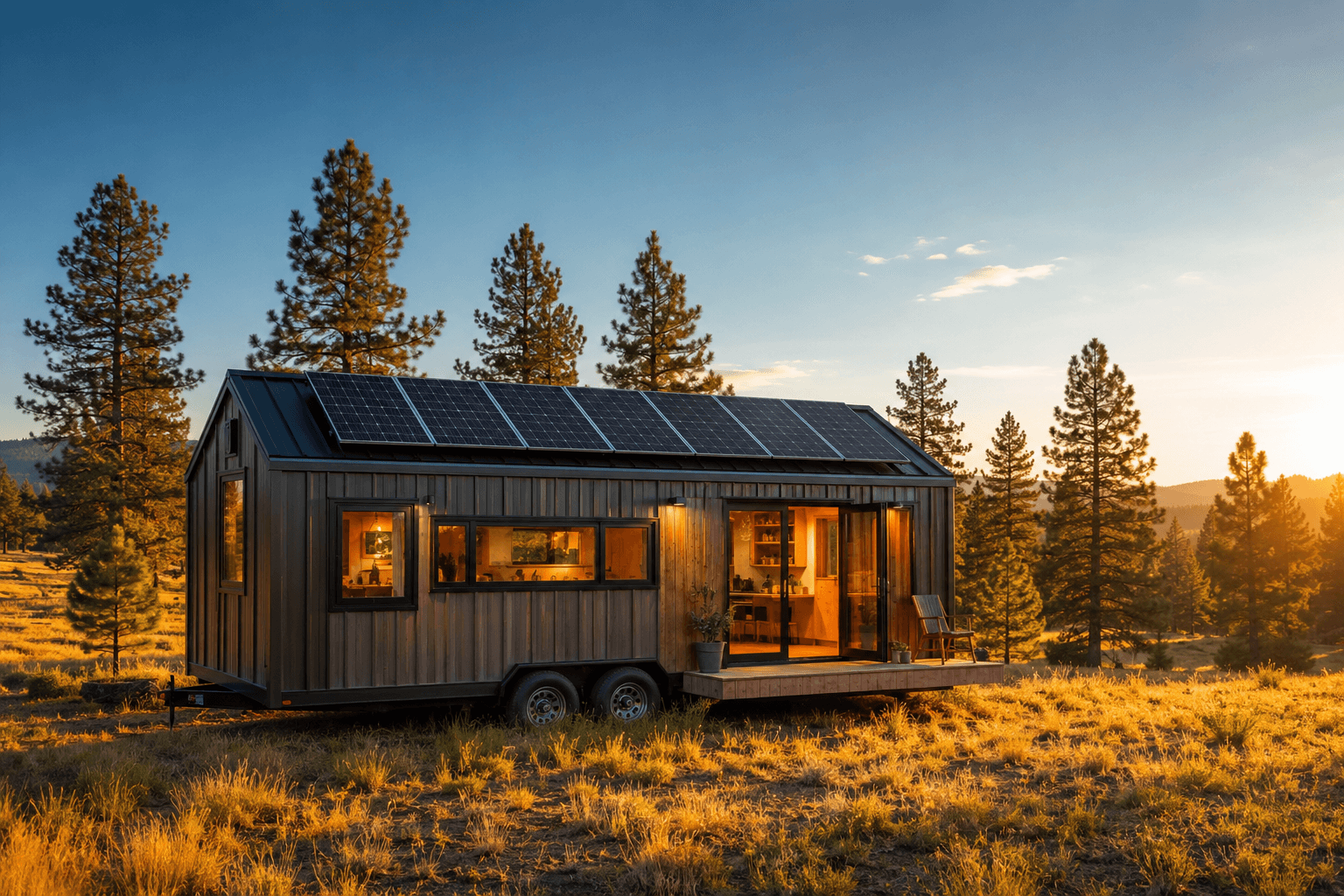
Last updated: June 24, 2026
Quick Answer: For off-grid tiny home solar panel placement, mount panels on a south-facing roof or ground array tilted between 30 and 45 degrees, matching your latitude. A medium-load tiny home using 4 to 5 kWh daily typically needs 6 to 8 high-efficiency panels and a 10 to 15 kWh lithium battery bank. Shade, roof space, and whether your home is mobile or stationary are the three factors that change everything else.
Key Takeaways
- South-facing panels at a tilt angle equal to your latitude produce the most energy for most US locations
- A typical tiny home on wheels (THOW) has roughly 120 to 150 square feet of usable roof space after accounting for vents and curvature
- Monocrystalline panels rated at 21 to 23% efficiency are the best fit for tight roof areas
- A medium-load off-grid tiny home needs 6 to 8 panels and a 10 to 15 kWh lithium iron phosphate (LFP) battery bank
- Ground-mounted arrays work better for stationary homes and allow optimal tilt adjustment
- Even partial shading on one panel can reduce output across the entire array
- East-west split configurations are a practical option when south-facing roof space is limited
- Portable ground arrays give mobile tiny homeowners flexibility when parked for extended periods
Table of Contents
- Why Placement Decisions Make or Break Your Off-Grid Solar System
- How Much Roof Space Does a Tiny Home Actually Have?
- South-Facing vs. East-West: Which Orientation Produces More Power?
- What Tilt Angle Should You Use for Off-Grid Tiny Home Solar Panel Placement?
- Roof-Mounted vs. Ground-Mounted: Choosing the Right Setup
- How Shading Affects Off-Grid Tiny Home Solar Panel Placement
- How Many Panels Does an Off-Grid Tiny Home Actually Need?
- Battery Storage: What Pairs With Your Solar Setup
- Location-Specific Considerations Across the US
- FAQ
Why Placement Decisions Make or Break Your Off-Grid Solar System
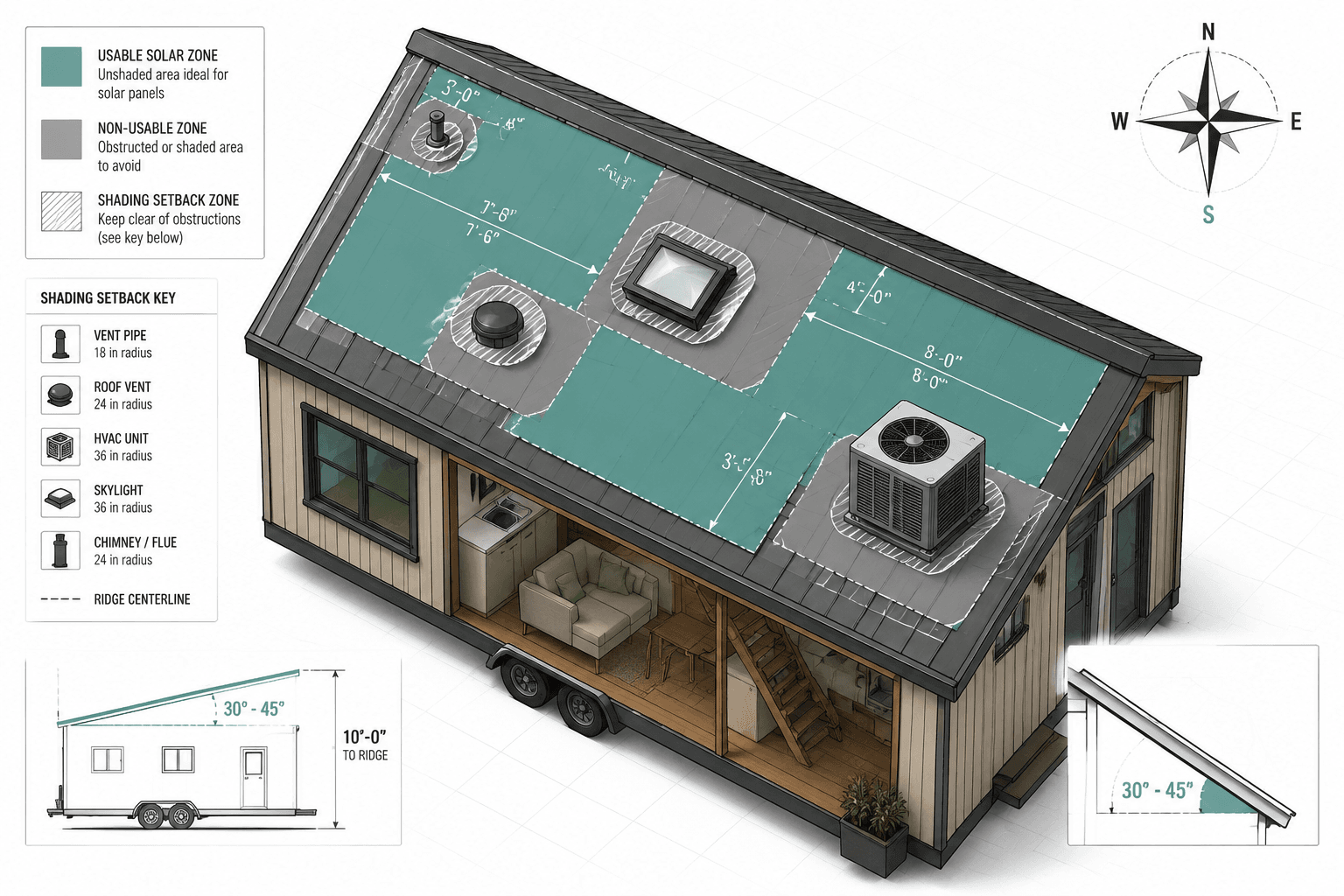
Solar panel placement is not just a technical detail — it is the foundation of whether your off-grid system produces enough power to live comfortably. A poorly placed array on a well-designed tiny home will underperform every single day, while a thoughtfully positioned system on a modest budget can cover your full energy load with panels to spare.
The core challenge with off-grid tiny home solar panel placement is that you are working with limited roof real estate, a fixed or semi-fixed structure, and energy needs that do not flex much. Getting placement right from the start saves money, reduces frustration, and means you are not running a generator at 11 PM because your batteries ran dry.
Start where you are: assess your roof, your site, and your daily energy use before buying a single panel.
How Much Roof Space Does a Tiny Home Actually Have?
A standard tiny home on wheels offers roughly 170 to 200 square feet of total roof area. Once you subtract space lost to roof vents, plumbing stacks, skylights, and any roof curvature, usable space drops to approximately 120 to 150 square feet.
That is enough room for 6 to 8 standard 400-watt panels, depending on their dimensions. A typical 400W monocrystalline panel measures about 69 by 41 inches, producing roughly 20.5 watts per square foot.
What reduces usable roof space:
- HVAC or mini-split condenser units
- Skylights and roof windows
- Plumbing vents and exhaust fans
- Curved or vaulted roof profiles
- Loft dormers or raised sections
Builders like New Frontier Tiny Homes and Timbercraft Tiny Homes often design roof layouts with solar integration in mind, so it is worth asking any builder directly how they handle solar-ready rooflines before you commit to a floor plan.
South-Facing vs. East-West: Which Orientation Produces More Power?
South-facing panels produce the most total daily energy for homes in the northern hemisphere. Full stop. If your roof ridge runs east-west and you have a south-facing slope, that is your primary placement zone.
But not every tiny home roof cooperates. If your ridge runs north-south, or if a south-facing slope is partially shaded, an east-west split configuration becomes a practical alternative.
East-west split setup:
- Panels on the east side capture morning sun
- Panels on the west side capture afternoon sun
- Total daily output is typically 10 to 15% lower than a pure south-facing array
- Production is more evenly spread across the day, which can reduce battery cycling stress
Choose east-west if: your south-facing slope is shaded, obstructed, or too small to fit your required panel count.
Choose south-facing if: you have clear southern exposure and enough roof area to meet your load.
What Tilt Angle Should You Use for Off-Grid Tiny Home Solar Panel Placement?
The ideal tilt angle for fixed panels equals your latitude. For most of the continental US, that falls between 30 and 45 degrees.
| Location | Approximate Latitude | Recommended Tilt |
|---|---|---|
| Southern Arizona / Texas | 30 to 33 degrees | 30 to 33 degrees |
| Tennessee / North Carolina | 35 to 36 degrees | 35 to 36 degrees |
| Colorado / Utah | 39 to 41 degrees | 39 to 41 degrees |
| Pacific Northwest / Great Lakes | 44 to 48 degrees | 44 to 48 degrees |
| Alaska | 60 to 65 degrees | 60 to 65 degrees |
Roof-mounted panels on a THOW often sit at whatever pitch the roof was built with, typically 3:12 to 6:12 (14 to 27 degrees). That is below optimal for most US latitudes, which is one reason ground-mounted or tilt-adjustable rack systems outperform flush roof mounts in raw energy terms.
If your roof is relatively flat, low-profile tilt mount brackets can raise panels to a better angle without adding significant wind resistance — an important consideration for mobile homes.
Roof-Mounted vs. Ground-Mounted: Choosing the Right Setup
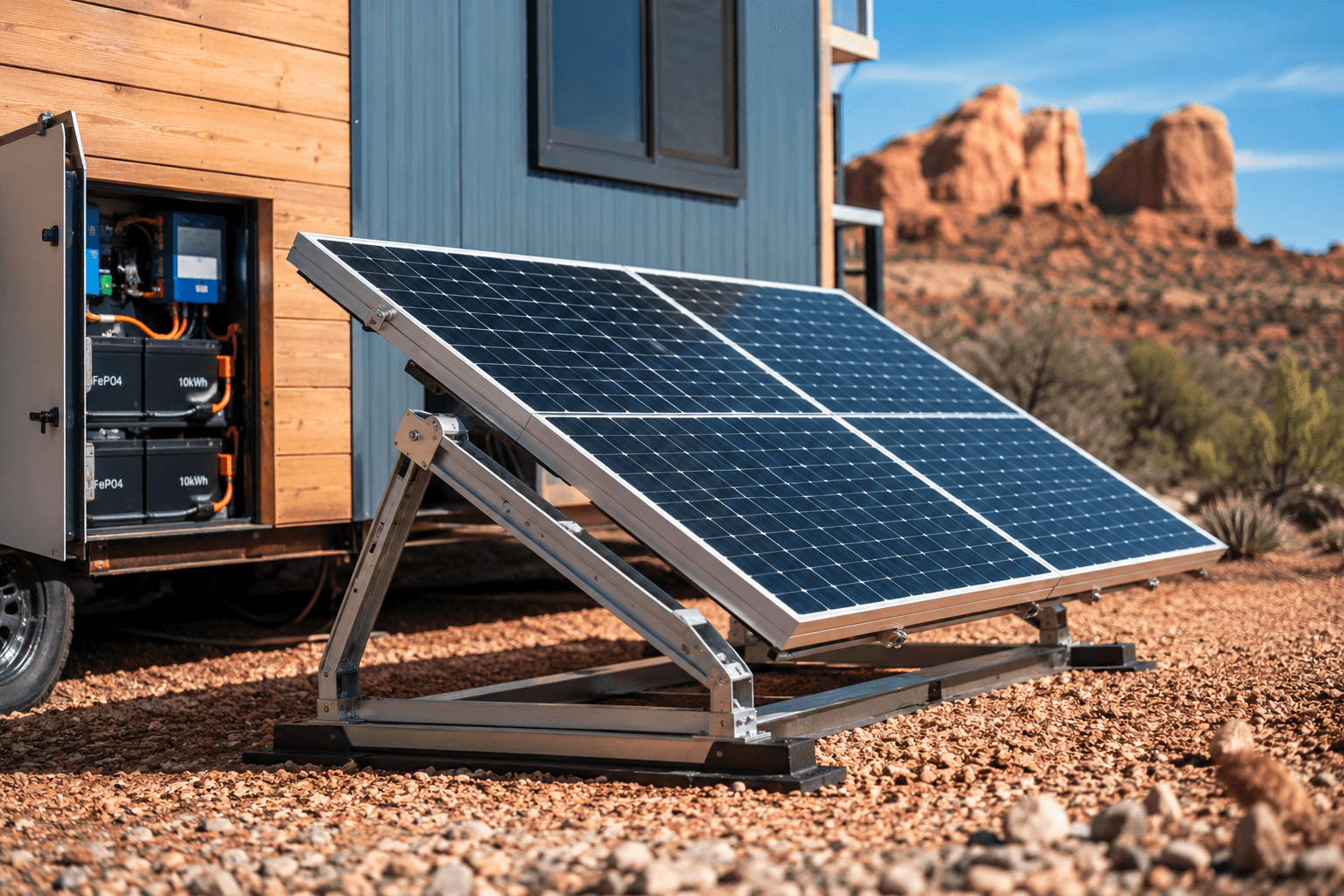
The right mounting choice depends almost entirely on whether your tiny home moves.
Roof-mounted panels are the right call if:
- Your home is a THOW that travels regularly
- You want a self-contained system that works while parked anywhere
- You have enough south-facing roof area to meet your load
Ground-mounted arrays are the right call if:
- Your home is stationary or moves only occasionally
- Your roof has too many obstructions or the wrong orientation
- You want to maximize tilt angle and production
- You need to expand capacity beyond what your roof can hold
Ground mounts cost more to install and require additional land, but they allow you to position panels in the sunniest spot on your property, adjust tilt seasonally, and access them easily for cleaning and maintenance.
Portable ground arrays are a middle-ground option worth knowing about. Foldable or wheeled panel frames let mobile tiny homeowners set up an optimized ground array when parked for extended periods, then stow the system for travel. Several builders listed in our tiny home builders directory can advise on pre-wiring for both roof and ground array connections.
How Shading Affects Off-Grid Tiny Home Solar Panel Placement
Shading is the single most underestimated problem in tiny home solar design. Even one shaded cell on one panel can reduce output across the entire string, depending on how your system is wired.
Common shading sources to audit before placement:
- Nearby trees (account for seasonal leaf coverage and growth over time)
- Neighboring structures or fences
- Your own roof features: vents, stacks, dormers
- Utility poles or overhead lines
The fix is not always moving panels. Microinverters or DC power optimizers allow each panel to operate independently, so a shaded panel does not drag down the rest of the array. This technology costs more upfront but pays back quickly in locations with partial shade.
Trim trees before installation, not after. It is easier to assess true shading impact when you can observe the site across different times of day and seasons.
How Many Panels Does an Off-Grid Tiny Home Actually Need?
A medium-load off-grid tiny home consuming 4 to 5 kWh per day typically requires 6 to 8 high-efficiency panels and a 10 to 15 kWh battery bank to cover 100% of energy needs, including nights and overcast days.
Rough sizing by load level:
| Daily Energy Use | Panels Needed | Battery Bank |
|---|---|---|
| Low (2 to 3 kWh) | 4 to 5 panels | 6 to 10 kWh |
| Medium (4 to 5 kWh) | 6 to 8 panels | 10 to 15 kWh |
| High (6 to 8 kWh) | 9 to 12 panels | 15 to 20 kWh |
These estimates assume monocrystalline panels rated at 400W each and average peak sun hours of 4 to 5 per day. Locations with fewer peak sun hours — think the Pacific Northwest or Alaska — need more panels or more storage to compensate.
If you are still designing your tiny home and want to build solar capacity into the structure from day one, builders like Liberation Tiny Homes and Sprout Tiny Homes offer solar-ready builds worth exploring.
Battery Storage: What Pairs With Your Solar Setup
Lithium iron phosphate (LFP) batteries are now the standard for off-grid tiny home systems. They offer 80 to 90% usable depth of discharge and a lifespan of 3,000 to 6,000 charge cycles — roughly 8 to 15 years of daily use.
Lead-acid batteries cost less upfront but deliver only 50% usable capacity and last a fraction as long. For a permanent off-grid setup, LFP wins on total cost over time.
Size your battery bank to cover at least two to three days of energy use without solar input. That buffer handles cloudy stretches without forcing you to run a backup generator.
Location-Specific Considerations Across the US
Off-grid tiny home solar panel placement is not one-size-fits-all. Your state and climate zone change the math significantly.
- Desert Southwest (Arizona, Nevada, New Mexico): High peak sun hours (6 to 7 per day) mean smaller systems go further. Heat can reduce panel efficiency slightly, so leave airflow space under roof-mounted panels. See our Arizona tiny homes guide for regional specifics.
- California: Coastal fog and marine layer reduce morning production in many areas. Ground mounts that can track the sun or be adjusted seasonally are especially useful. Our California tiny homes guide covers local zoning and solar incentives.
- Pacific Northwest and Alaska: Low winter sun angles and frequent overcast conditions demand larger arrays and more battery storage. Tilt angles should lean toward the higher end of the recommended range. The Alaska tiny homes guide covers cold-weather system design in detail.
- Southeast (Alabama, Arkansas, Tennessee): Good sun hours but high summer humidity can affect equipment longevity. Sealed enclosures for inverters and battery banks matter here. Check our state-by-state tiny homes directory for regional builder and zoning resources.
FAQ
What direction should solar panels face on a tiny home? South-facing is optimal for the northern hemisphere. Panels oriented true south (not magnetic south) at an angle matching your latitude will produce the most energy year-round.
Can I add solar panels to a tiny home on wheels while it is moving? No. Panels should be secured flat or removed from tilt mounts before travel. Some THOW owners carry portable ground arrays that fold down for transport and deploy when parked.
How many solar panels fit on a standard tiny home roof? Most THOWs can fit 6 to 8 standard 400-watt panels after accounting for vents, curvature, and obstructions. That is roughly 2,400 to 3,200 watts of installed capacity.
What is the best panel type for a tiny home with limited roof space? Monocrystalline panels with 21 to 23% efficiency ratings. They produce more power per square foot than polycrystalline or thin-film alternatives, which matters when roof space is tight.
Do I need a battery bank if I have solar panels? For a fully off-grid setup, yes. Without battery storage, you have no power after dark or during cloudy periods. Lithium iron phosphate (LFP) batteries are the most practical choice for tiny home systems in 2026.
What happens if a tree partially shades my panels? Partial shading can reduce output significantly across the whole array if panels are wired in series. Microinverters or power optimizers allow each panel to perform independently, minimizing the shading penalty.
Is a ground-mounted array better than roof-mounted for off-grid use? For stationary tiny homes, usually yes. Ground mounts allow better tilt adjustment, easier maintenance, and placement in the sunniest spot on your property. For mobile homes, roof mounts are more practical.
How do I calculate my daily energy needs before sizing a solar system? List every appliance, its wattage, and average daily hours of use. Multiply watts by hours to get watt-hours, then add 20% for inefficiencies. That total is your daily load, which determines how many panels and how much battery storage you need.
Conclusion
Getting off-grid tiny home solar panel placement right is one of the highest-leverage decisions you will make in your tiny home build. The good news: the fundamentals are straightforward. Face panels south, tilt them to match your latitude, choose high-efficiency monocrystalline panels, and size your battery bank for at least two to three days of autonomy.
Your next concrete steps:
- Audit your site or roof — walk the space at different times of day and note shading sources
- Calculate your daily energy load — appliance by appliance, before you buy a single panel
- Decide: roof or ground mount — based on whether your home will move regularly
- Talk to your builder — ask specifically about solar-ready rooflines and pre-wiring options
- Check your state's incentives — federal and state tax credits can meaningfully reduce system costs
Small footprint. Full life. A well-placed solar array is what makes that possible without compromise.