
Last updated: June 24, 2026
Quick Answer: Off-grid solar kits for tiny homes cost between $2,500 and $20,000 in 2026, depending on system size, battery storage, and whether you install it yourself or hire a professional. A modest DIY setup for a typical tiny home running 2,000–3,000 watt-hours per day can come in under $4,500. Larger, professionally installed systems with robust battery banks push toward $15,000–$20,000.
Key Takeaways
- DIY off-grid solar kits for tiny homes cost $2,500–$8,000; professional installation runs $8,000–$20,000
- Battery storage is the biggest cost variable — lithium iron phosphate (LiFePO4) batteries run roughly $800–$1,200 per kWh of usable capacity
- The federal 30% Investment Tax Credit (ITC) for residential solar expired December 31, 2025 — but some states still offer rebates and property-tax exemptions
- Your location matters: sunnier states like Arizona and California need smaller (cheaper) systems than cloudier regions
- Renogy, Goal Zero, and EcoFlow each offer packaged kits suited to different budgets and use cases
- Most tiny homes need 600W–1,200W of solar panels paired with a 5–10 kWh battery bank
- LiFePO4 batteries last 8–16 years with daily cycling, making them the most cost-effective long-term choice
Table of Contents
- What Does Off-Grid Solar for a Tiny Home Actually Cost?
- How Much Power Does a Tiny Home Need?
- What's Inside an Off-Grid Solar Kit?
- Renogy vs. Goal Zero vs. EcoFlow: Which Kit Fits Your Budget?
- DIY vs. Professional Installation: What's the Real Cost Difference?
- How Location Affects Your Off-Grid Solar Kit Cost
- Battery Storage: The Biggest Cost You Can't Skip
- Are There Still Tax Credits or Incentives in 2026?
- Which Tiny Home Builders Offer Off-Grid-Ready Builds?
- FAQ
What Does Off-Grid Solar for a Tiny Home Actually Cost?
Off-grid solar kits for tiny homes cost anywhere from $2,500 on the low end to $20,000 or more for a fully professional setup. The wide range comes down to four factors: system size, battery capacity, brand, and labor.
Here's a practical breakdown by system size:
| System Size | Best For | Estimated Cost (DIY) | Estimated Cost (Installed) |
|---|---|---|---|
| 1 kW | Minimal use, part-time living | $2,500–$5,000 | $5,000–$9,000 |
| 3 kW | Full-time tiny home, moderate use | $8,000–$12,000 | $12,000–$18,000 |
| 5 kW | Larger tiny home or remote property | $12,000–$18,000 | $18,000–$25,000 |
For most full-time tiny home dwellers, a 2–3 kW system with a 5–10 kWh battery bank is the sweet spot. That covers standard appliances without significant lifestyle compromise.
How Much Power Does a Tiny Home Need?
Most tiny homes consume between 2,000 and 3,500 watt-hours (Wh) per day. That's significantly less than the average US household, which uses roughly 30,000 Wh daily — but it still requires a thoughtfully sized system.
Typical daily wattage for common tiny home appliances:
- Mini-split heat pump (2 hours): 600–1,000 Wh
- Refrigerator (24 hours, efficient model): 400–700 Wh
- LED lighting (4 hours, whole home): 40–80 Wh
- Laptop and phone charging: 100–200 Wh
- Induction cooktop (1 hour): 1,000–2,000 Wh
- Water pump: 50–150 Wh
The practical rule: Add up your daily Wh, then size your solar array to produce 25–30% more than that number to account for cloudy days and system inefficiencies. A 600W–800W panel array is a reasonable starting point for a modest-use tiny home.
What's Inside an Off-Grid Solar Kit?
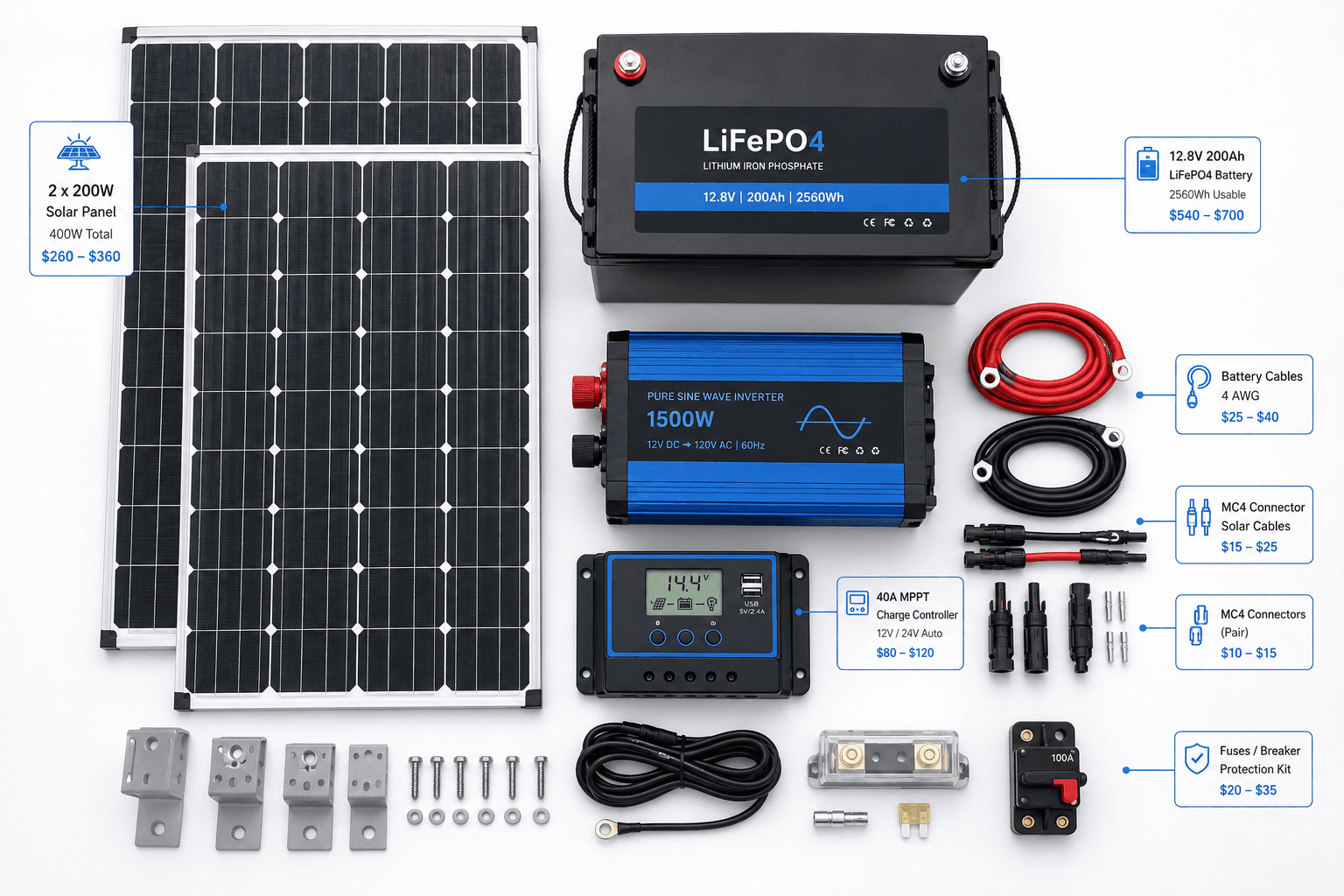
A complete off-grid solar kit for a tiny home includes four core components. Understanding each one helps you compare kits accurately and avoid buying an underpowered setup.
- Solar panels — Monocrystalline panels are the standard for tiny homes. They're more efficient per square foot, which matters when roof space is limited.
- Charge controller — Regulates power flowing from panels to batteries. MPPT (Maximum Power Point Tracking) controllers are more efficient than PWM models and worth the extra cost.
- Battery bank — Stores energy for nights and cloudy days. LiFePO4 (lithium iron phosphate) is the current standard for off-grid tiny homes due to its lifespan and safety profile.
- Inverter — Converts DC power from batteries to AC power for standard appliances. A pure sine wave inverter is essential for sensitive electronics.
Some kits bundle all four. Others sell panels and inverters separately from battery storage. Read the spec sheet carefully before buying.
Renogy vs. Goal Zero vs. EcoFlow: Which Kit Fits Your Budget?
These three brands dominate the packaged solar kit market for small off-grid applications. Each has a distinct niche.
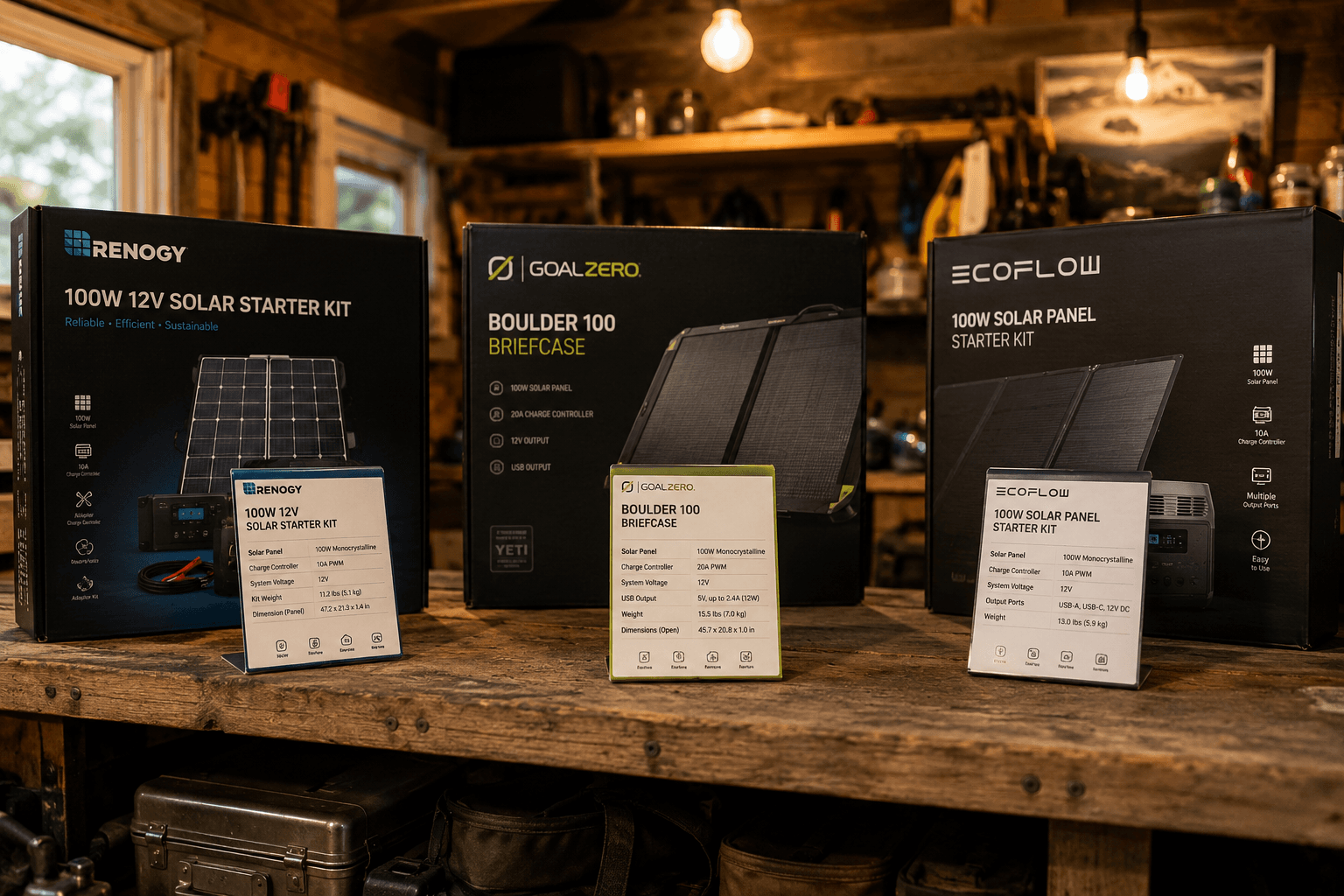
Renogy is the most established option for permanent tiny home installations. Their component-based approach lets you build a custom system — typically 400W to 1,200W panel arrays paired with their Rover MPPT controllers and lithium batteries. A Renogy-based DIY system for a tiny home typically runs $3,000–$7,000 depending on battery capacity. Their parts are widely available and well-documented, which makes DIY troubleshooting easier.
Goal Zero targets the premium portable market. Their Yeti power stations work well for part-time or weekend tiny home use, but their cost-per-watt-hour is higher than Renogy or EcoFlow for permanent setups. A Yeti 3000X with two Boulder 200 panels runs roughly $4,000–$5,000 — reasonable for a cabin or seasonal retreat, less efficient for full-time living.
EcoFlow has moved aggressively into the whole-home off-grid space. Their DELTA Pro Ultra system, paired with their Smart Home Panel, is designed for full-time off-grid use and can scale to 15+ kWh of storage. Entry-level EcoFlow kits start around $3,500, but a full tiny home setup with adequate storage lands closer to $8,000–$12,000 before installation.
Choose Renogy if you want a permanent, customizable system and are comfortable with a moderate DIY build. Choose Goal Zero if you need portability and a simpler setup for part-time use. Choose EcoFlow if you want a scalable, app-connected system and don't mind paying a premium for convenience.
DIY vs. Professional Installation: What's the Real Cost Difference?
DIY installation saves $2,000–$8,000 compared to hiring a solar contractor, depending on system complexity. That's a meaningful number — but it comes with real tradeoffs.
DIY makes sense if:
- You're comfortable with basic electrical work and can follow wiring diagrams
- Your tiny home is on a trailer (THOW) and not subject to building permit requirements
- You have time to research and troubleshoot
Professional installation makes sense if:
- Your tiny home is a permanent structure subject to local electrical codes
- You want a warranty that won't be voided by improper installation
- Your system is 3 kW or larger with a complex battery bank
A mid-range DIY system for a full-time tiny home — 800W of panels, a 10 kWh LiFePO4 battery, MPPT controller, and pure sine wave inverter — typically costs $4,000–$6,500 in components alone. The same system professionally installed adds $3,000–$6,000 in labor, bringing the total to $7,000–$12,500.
How Location Affects Your Off-Grid Solar Kit Cost
Where you park or place your tiny home directly affects how large (and expensive) your solar system needs to be.
Peak sun hours — the number of hours per day when sunlight is strong enough for meaningful solar production — vary significantly across the US:
- Southwest (Arizona, Nevada, New Mexico): 5.5–6.5+ peak sun hours daily
- Southeast and Texas: 4.5–5.5 peak sun hours
- Pacific Northwest and Northeast: 3.5–4.5 peak sun hours
A tiny home in Tucson, Arizona can run the same daily load on a smaller, cheaper panel array than one in Portland, Oregon. In cloudier climates, you'll need either more panels, more battery storage, or a backup generator — all of which add cost.
If you're considering Arizona, our guide to tiny homes in Arizona covers solar considerations alongside zoning and land options. For California, the California tiny homes guide addresses state solar incentives that may still apply in 2026. And if you're weighing colder, cloudier territory, the Alaska tiny homes guide is worth a read before you size your system.
Battery Storage: The Biggest Cost You Can't Skip
Battery storage is where off-grid solar costs get real. In 2026, LiFePO4 batteries cost approximately $800–$1,200 per kWh of usable capacity when professionally installed, or $400–$600 per kWh for quality DIY setups.
A 10 kWh battery bank — enough to power a modest tiny home through one cloudy day — adds $4,000–$6,000 to a DIY system or $8,000–$12,000 installed. That's often 50–60% of the total system cost.
Why LiFePO4 is worth it:
- Lifespan of 3,000–6,000 charge cycles (8–16 years with daily use)
- Safer chemistry than standard lithium-ion — no thermal runaway risk
- Tolerates deeper discharge without degrading capacity
- Lighter than lead-acid alternatives
Lead-acid batteries cost less upfront but need replacement every 3–5 years and can't be discharged below 50% without damage. Over a 10-year period, LiFePO4 almost always wins on total cost of ownership.
Are There Still Tax Credits or Incentives in 2026?
The federal 30% Investment Tax Credit (ITC) for residential solar installations expired on December 31, 2025. Systems placed in service from January 1, 2026 onward no longer qualify for that federal credit.
That's a significant change. On a $10,000 system, the ITC was worth $3,000. Its expiration effectively raises the net cost of going solar for anyone who didn't act before the deadline.
What's still available in 2026:
- State-level solar rebates (varies widely — check your state's energy office)
- Net metering credits (for grid-tied or hybrid systems, not pure off-grid)
- Property-tax exemptions for solar equipment (available in many states)
- Sales-tax exemptions on solar equipment purchases (check your state)
The incentive landscape is genuinely state-dependent now. Before budgeting, spend 20 minutes on your state energy office's website or call a local solar installer for current rebate availability.
Which Tiny Home Builders Offer Off-Grid-Ready Builds?
Some tiny home builders design their homes with solar integration in mind from the start — pre-wired conduit, roof pitch optimized for panels, and battery storage space built into the floor plan. Others treat it as an afterthought.
Our off-grid ready builder listings highlight builders who specifically design for energy independence. A few worth exploring:
- Backcountry Tiny Homes builds for remote, rugged locations with off-grid systems in mind
- Liberation Tiny Homes offers solar-ready builds with flexible energy configurations
- Alpine Tiny Homes focuses on mountain and high-altitude builds where grid access is often limited
- Rocky Mountain Tiny Houses has experience pairing their builds with off-grid solar packages
If you're still in the early stage of choosing a builder, the tiny homes by state directory is a practical starting point — it covers zoning, climate, and builder options across all 50 states.
FAQ
What is the minimum solar setup for a full-time tiny home? For a full-time tiny home using 2,000–3,000 Wh per day, a minimum workable system includes 600W–800W of solar panels, a 5 kWh LiFePO4 battery bank, an MPPT charge controller, and a 2,000W–3,000W pure sine wave inverter. This setup costs roughly $2,500–$4,500 as a DIY build in 2026.
Can I use a solar kit on a tiny home on wheels (THOW)? Yes. THOWs (tiny homes on wheels) are among the most common applications for off-grid solar kits. Because they're classified as recreational vehicles rather than permanent structures, they're generally not subject to building permit requirements for electrical work — which makes DIY installation more straightforward.
How long do off-grid solar batteries last? LiFePO4 batteries rated for 3,000–6,000 cycles will last 8–16 years with daily use before noticeable capacity loss. Lead-acid batteries typically last 3–5 years. The higher upfront cost of lithium pays off over time.
Is a 400W solar kit enough for a tiny home? A 400W system is generally not enough for full-time living. It can work for a part-time cabin or weekend retreat with minimal appliance use. Full-time tiny home residents typically need 600W–1,200W of panels, depending on location and energy habits.
Do I need a generator as backup? In most climates, a generator backup is a practical safety net — especially during extended cloudy periods or winter months in northern states. A small 2,000W–3,500W propane or gas generator adds $400–$1,200 and can prevent you from draining your battery bank below safe levels.
What happened to the federal solar tax credit in 2026? The 30% federal residential Investment Tax Credit (ITC) expired December 31, 2025. New solar installations placed in service in 2026 do not qualify for the federal credit. State-level incentives vary — check your state energy office for current programs.
Conclusion
Off-grid solar kits for tiny homes cost more than most people expect when they first start researching — but they cost less than staying tethered to the grid for the next 15 years. The math works, especially in sun-rich states and for buyers who are willing to do some or all of the installation themselves.
Start where you are. If you're still figuring out your energy needs, spend a week tracking your actual appliance usage before sizing a system. If you're further along, get quotes from at least two solar installers and compare them against a quality DIY kit from Renogy or EcoFlow.
The federal tax credit is gone, but the case for off-grid solar in a tiny home is still strong — lower long-term energy costs, location independence, and a smaller footprint that matches the intentional life you're building.
Your next concrete steps:
- Calculate your daily watt-hour needs using your appliance list
- Check your state's energy office for current solar rebates and exemptions
- Browse off-grid ready builders if you're still in the build-planning phase
- Get component quotes from Renogy, EcoFlow, and a local solar installer to compare
- Use the tiny homes by state directory to factor in your location's sun hours and zoning context
Small footprint. Full life. The path to energy independence in a tiny home is clearer than it looks from the outside.