
Last updated: June 24, 2026
Quick Answer: Getting New Mexico tiny home off-grid permits is not a single application — it is a stack of approvals covering building, wastewater, water supply, and electrical systems. The process varies significantly by county, but since January 2025, a statewide tiny-home building code appendix (Appendix AQ) has standardized many design requirements. Start with your county zoning office before you buy land or break ground.
Key Takeaways
- New Mexico adopted Appendix AQ in January 2025, which defines tiny homes as 400 sq ft or less (excluding lofts) and sets minimum design standards statewide.
- There is no single "off-grid permit" — you need a combination of building, wastewater, water, and electrical permits.
- County zoning rules are the primary gatekeeper; Santa Fe, Taos, and Bernalillo counties each handle tiny homes differently.
- Owner-builders can construct their own foundation tiny home without a contractor license, but permits and inspections are still required.
- Off-grid systems — solar, composting toilets, wells, rainwater harvesting — each carry their own permit and inspection requirements.
- Tiny homes on wheels (THOWs) face stricter limitations as permanent dwellings in most New Mexico jurisdictions.
- Acequia water rights and solar access protections are unique New Mexico factors that can affect your site and system choices.
Table of Contents
- What Does "Off-Grid Tiny Home" Mean Under New Mexico Law?
- Understanding New Mexico Tiny Home Off-Grid Permits: The Full Stack
- How County Zoning Shapes Where You Can Build
- Wastewater Options: Septic, Composting Toilets, and What Gets Approved
- Water Supply: Wells, Rainwater, and Acequia Rights
- Solar and Electrical Permits in New Mexico
- THOWs vs. Foundation Tiny Homes: Which Path Is Simpler?
- The Owner-Builder Route: What You Can and Cannot Skip
- Earthship Influence and Alternative Construction Approvals
- FAQ
What Does "Off-Grid Tiny Home" Mean Under New Mexico Law?
New Mexico does not have a legal definition of "off-grid" in its building code. What it does have, as of January 13, 2025, is Appendix AQ — a statewide tiny-home appendix that defines a tiny house as a dwelling of 400 square feet or less, excluding loft space. If your home sits on a permanent foundation and meets that size threshold, it is treated as a single-family dwelling for permit purposes, regardless of whether it connects to the grid.
That matters because "off-grid" is a lifestyle description, not a permit category. Your home still needs to meet health and safety codes. The off-grid systems you choose (solar, composting toilet, well or rainwater) each trigger their own separate approval processes.
Understanding New Mexico Tiny Home Off-Grid Permits: The Full Stack
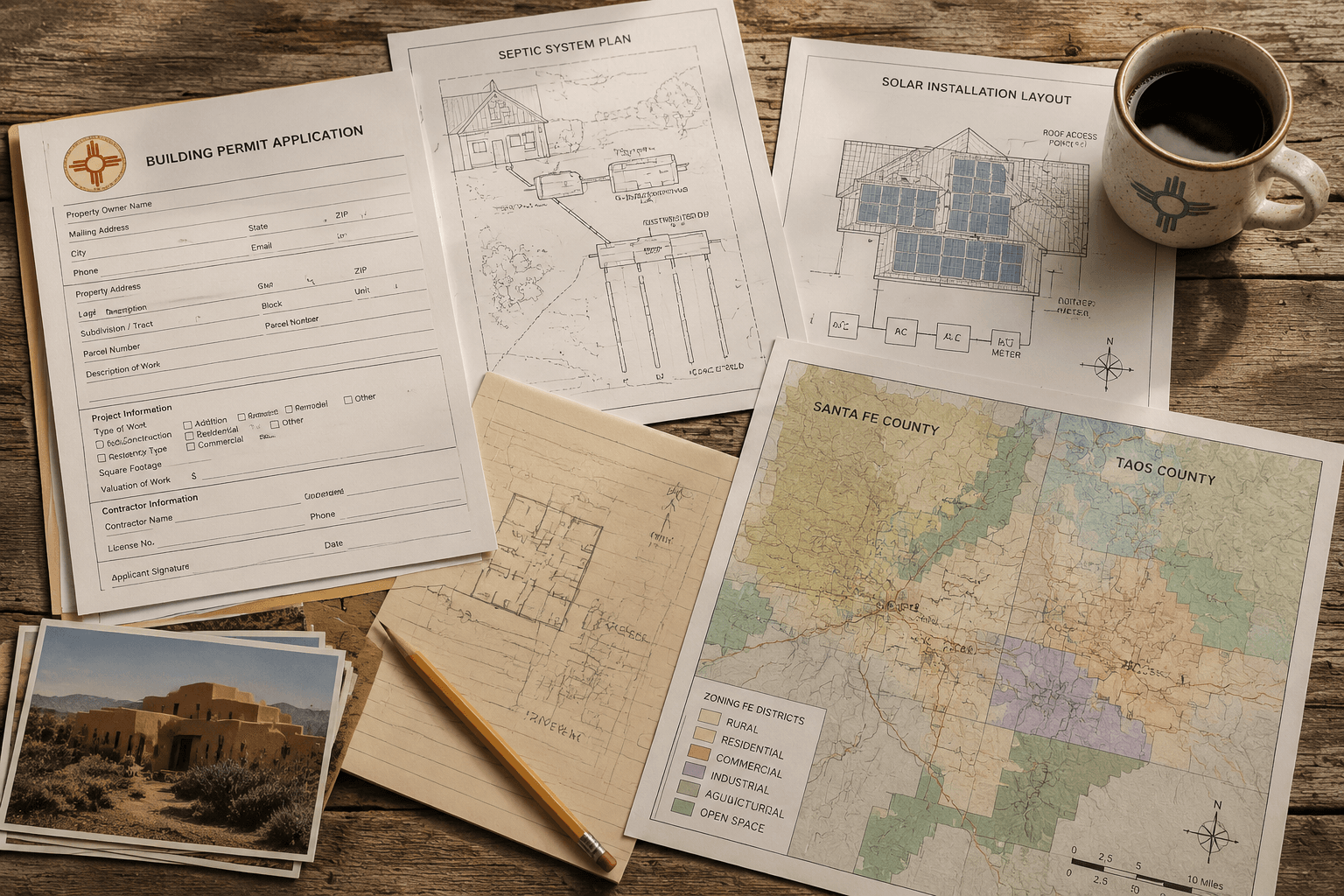
New Mexico tiny home off-grid permits are not one document — they are typically four to six separate approvals, depending on your county and your systems.
Here is what most off-grid tiny home builders need:
| Permit Type | Issuing Authority | Notes |
|---|---|---|
| Building permit | County or municipality | Required for foundation homes; follows Appendix AQ |
| Electrical/solar permit | County building department | Required even for off-grid solar systems |
| Septic or alternative wastewater permit | NM Environment Dept. (NMED) | Covers conventional septic and approved alternatives |
| Well permit | NM Office of the State Engineer | Required for any new domestic well |
| Rainwater harvesting registration | State Engineer's Office | New Mexico allows rainwater collection with registration |
| Zoning/land use approval | County planning department | Must happen before building permit is issued |
Getting these in the right order matters. Zoning approval comes first. Then your building permit. Wastewater and water permits can often run in parallel with building, but you cannot get a certificate of occupancy without them.
How County Zoning Shapes Where You Can Build
County zoning is the single biggest variable in New Mexico tiny home off-grid permits. State code sets the floor; counties set the ceiling on what is actually allowed where.
Bernalillo County (Albuquerque area): Albuquerque now explicitly permits foundation tiny homes in certain residential zones. Tiny homes on wheels as permanent dwellings remain restricted. Minimum lot sizes and setbacks still apply.
Santa Fe County: Santa Fe County has historically been more flexible with alternative and owner-built structures, partly due to the Earthship community near Taos and the broader culture of sustainable building in northern New Mexico. Check the specific zoning district — rural zones often allow more than suburban ones.
Taos County: Taos is home to the Greater World Earthship Community and has real experience with alternative off-grid construction. The county has processed many non-conventional building permits, which means local officials tend to be more familiar with composting toilets, passive solar design, and earthen construction. That experience is an advantage.
Rural and unincorporated areas: Some New Mexico counties have minimal zoning outside incorporated towns. That can mean more flexibility, but it also means fewer resources and longer review timelines.
The practical rule: call the county planning department before you buy land. Ask specifically whether tiny homes on a foundation are a permitted use in that zoning district, and whether off-grid wastewater systems are approvable on that parcel.
Wastewater Options: Septic, Composting Toilets, and What Gets Approved
The New Mexico Environment Department (NMED) regulates onsite wastewater treatment systems. Conventional septic systems are the default approval path, but New Mexico does allow alternatives — including composting toilets — under specific conditions.
Composting toilets are legal in New Mexico, but they do not eliminate the need for a greywater system. NMED requires that liquid waste (greywater from sinks and showers) still be managed through an approved system, even if a composting toilet handles solids. Some counties accept a simple greywater leach field; others require a full engineered system. Get this confirmed in writing before you build.
Conventional septic is the path of least resistance in most counties. It adds cost (typically $8,000–$20,000 depending on soil conditions and system size), but it is well understood by inspectors and rarely causes permit delays.
Taos County's Earthship influence has created a body of local knowledge around alternative wastewater, including indoor greywater planters and constructed wetlands. These are not automatically approved elsewhere in the state, but the precedent exists.
Water Supply: Wells, Rainwater, and Acequia Rights
Water is where New Mexico's unique legal landscape becomes most important. The state follows the prior appropriation doctrine — water rights are separate from land ownership and must be acquired independently.
Domestic wells require a permit from the New Mexico Office of the State Engineer. Processing times vary, but plan for several months. A domestic well permit for a single-family home is generally available, but it does not convey a water right — it is a license to use a limited amount of water for domestic purposes.
Rainwater harvesting is legal and encouraged in New Mexico. The state amended its laws to allow rainwater collection from rooftops without a water rights permit, as long as the water is used on the property where it is collected. Registration with the State Engineer's Office is required for larger systems.
Acequia rights are a critical and often overlooked factor in northern New Mexico. Acequias are traditional community irrigation ditches with legally recognized water rights dating back centuries. If your land is adjacent to or historically served by an acequia, those rights may affect what you can do with surface water on your property. Buying land near an acequia without understanding the associated rights and obligations is a common and costly mistake.
For a broader look at how neighboring states handle these issues, the Arizona tiny homes guide covering desert living and solar offers useful comparisons for arid-climate planning.
Solar and Electrical Permits in New Mexico
Off-grid solar systems still require an electrical permit in New Mexico. This surprises many first-time builders, but the logic is straightforward: the permit process ensures your system is safely installed and will not create a fire hazard.
New Mexico has a strong solar access law that protects your right to sunlight for solar energy systems. If a neighbor's structure or vegetation later shades your panels, you may have legal recourse — but you need to establish that right proactively through a solar easement recorded with the county.
What the electrical permit covers:
- Battery storage systems
- Inverters and charge controllers
- Wiring throughout the home
- Any generator backup connections
Inspections are required at rough-in and final stages. Using a licensed electrician for the solar installation is not required if you are the owner-builder, but the work must still pass inspection.
THOWs vs. Foundation Tiny Homes: Which Path Is Simpler?
A THOW (tiny home on wheels) is built on a trailer and is classified as a vehicle, not a structure, under most New Mexico codes. That distinction has real consequences.
Foundation tiny homes follow the residential building code path, including Appendix AQ. They are more straightforward to permit as permanent dwellings, and they qualify for traditional financing more easily.
THOWs avoid building permits in many cases but face zoning restrictions as permanent residences. Most New Mexico counties do not allow a THOW to serve as a primary dwelling on a residential lot without a variance or special use permit. RV parks and some rural properties are the most common legal placement options.
If you want to stay in one place long-term and build equity, a foundation home is the cleaner path. If mobility is the priority, a THOW makes sense — but plan your parking situation carefully before you commit. You can explore tiny house on wheels builders and resources to compare your options.
For those comparing states before choosing a location, the complete tiny homes by state directory is a useful starting point.
The Owner-Builder Route: What You Can and Cannot Skip
New Mexico allows owner-builders to construct their own primary residence without holding a contractor license. This is a meaningful cost-saving option for off-grid tiny home builders.
What you can do as an owner-builder:
- Pull your own building permit
- Perform your own construction work
- Act as your own general contractor
What you cannot skip:
- Permits and inspections at each required stage
- Licensed subcontractors for certain trades (check current county requirements for electrical and plumbing)
- Compliance with Appendix AQ design standards
The owner-builder exemption applies to your primary residence. If you are building a tiny home to sell or rent, different rules apply and a contractor license is likely required.
Builders like Southwest Tiny Homes and Alpine Tiny Homes have experience navigating the Southwest's permit landscape and can be valuable resources even if you plan to do much of the work yourself.
Earthship Influence and Alternative Construction Approvals
The Earthship Biotecture community near Taos has been building off-grid, earth-sheltered homes in New Mexico for decades. That history has created a real, if informal, body of precedent for alternative construction in the state.
Earthships use rammed earth tires, recycled bottles, and passive solar design — none of which fit neatly into standard building codes. Over time, Taos County developed a process for reviewing these structures on a case-by-case basis, often using a "performance-based" code review rather than a prescriptive one.
If you are planning an unconventional build — cob, adobe, straw bale, or rammed earth — Taos County is worth considering as a location. The local building department has seen these applications before. That does not mean automatic approval, but it does mean a shorter learning curve for everyone involved.
For alternative and custom builds, connecting with a builder experienced in non-standard construction methods is worth the time. The custom build available listings on Tiny Home Sherpa can help you find builders who work outside the cookie-cutter model.
If you want to see how a neighboring state with similar desert conditions approaches alternative builds, the California tiny homes guide covers ADU and alternative construction policy in useful detail.
FAQ
Do I need a building permit for an off-grid tiny home in New Mexico? Yes. If your tiny home sits on a permanent foundation and is used as a dwelling, it requires a building permit regardless of whether it connects to the grid. Appendix AQ, effective January 2025, governs the design requirements.
Can I use a composting toilet in a New Mexico tiny home? Yes, composting toilets are legal in New Mexico, but you still need an approved greywater management system. NMED must approve your overall wastewater plan before you receive a certificate of occupancy.
Is rainwater collection legal in New Mexico? Yes. New Mexico law permits rooftop rainwater collection for on-site use without a water rights permit. Registration with the State Engineer's Office is required for larger systems.
Which New Mexico county is most friendly to off-grid tiny homes? Taos County has the most established track record with alternative and off-grid construction, largely due to the Earthship community. Santa Fe County rural zones are also relatively flexible. Always verify with the specific county planning department before purchasing land.
Do I need a licensed contractor to build my own tiny home in New Mexico? Not if it is your primary residence and you are acting as the owner-builder. You still need permits and must pass all required inspections. Some trades (check current county rules for electrical and plumbing) may require licensed subcontractors.
What is an acequia and why does it matter for my water plan? An acequia is a traditional community irrigation ditch with legally recognized water rights. If your property is adjacent to one, those rights may restrict how you use surface water. Consult a water rights attorney before buying land near an acequia.
How long does the permit process take in New Mexico? It varies widely by county. Rural counties with smaller planning departments can take two to six months for a complete permit stack. Well permits from the State Engineer's Office often take the longest — plan for three to six months or more.
Can I park a THOW permanently on rural land in New Mexico? In many unincorporated rural areas, you may be able to do so with limited enforcement, but it is not legally permitted as a primary dwelling in most zoning codes without a variance. Confirm with the county before you commit.
Conclusion
New Mexico is genuinely one of the more interesting states for off-grid tiny living — between its solar resources, land availability, Earthship precedent, and owner-builder protections, the conditions are favorable. But the permit process rewards preparation. The biggest mistakes people make are buying land before confirming zoning, underestimating the wastewater approval timeline, and overlooking water rights entirely.
Here is a practical sequence to follow:
- Identify your target county and call the planning department to confirm tiny homes are a permitted use in your chosen zoning district.
- Research water rights and acequia obligations for any specific parcel before making an offer.
- Consult NMED early about your wastewater plan — composting toilet plus greywater system or conventional septic.
- Apply for your well permit or rainwater registration as soon as possible, since those timelines are often the longest.
- Submit your building permit application with Appendix AQ-compliant plans.
- Pull your solar/electrical permit before any wiring work begins.
Start where you are. Even if you are months away from breaking ground, making those county phone calls now will save you significant time and money later. The tiny home world in New Mexico is mapped out — you just need to follow the right trail.
For more state-by-state guidance, explore the tiny homes by state directory or browse vetted tiny home builders who know the Southwest permit landscape firsthand.