
Last updated: June 24, 2026
Quick Answer: Insuring a THOW (tiny house on wheels) as a primary residence requires a specialized policy — typically a full-timer RV policy or a tiny home-specific product — because standard homeowners insurance won't cover a home built on a trailer. The right policy depends on how your THOW is classified, whether it carries RVIA or NOAH certification, and how you use it day to day. Expect to pay between $600 and $1,500 per year for solid coverage.
Key Takeaways
- Standard homeowners insurance does not cover THOWs — you need an RV full-timer policy or a specialized tiny home product
- RVIA certification significantly improves your chances of getting covered and may lower your premium
- Full-time residents need a "full-timer" policy, not a basic RV policy designed for recreational use
- Foremost Insurance Group and American Modern are among the most recognized providers offering THOW-specific coverage
- Annual premiums typically range from $600 to $1,500 depending on location, home value, and coverage scope
- Transit coverage is a common gap — confirm your policy covers the home while it's being moved
- Local zoning laws affect where you can park your THOW and can directly impact your insurance eligibility
- Keeping thorough documentation (construction plans, materials list, certification records) speeds up the application process
Table of Contents
- What Is a THOW and Why Does Classification Matter for Insurance?
- What Type of Insurance Policy Do You Actually Need?
- How RVIA and NOAH Certification Affect Insuring a THOW as a Primary Residence
- Which Insurance Providers Cover THOWs?
- What Does a THOW Insurance Policy Actually Cover?
- How Much Does Insuring a THOW as a Primary Residence Cost?
- Common Coverage Gaps to Watch For
- How Zoning Laws Impact Your Insurance Options
- What Documentation Do Insurers Require?
- FAQ
What Is a THOW and Why Does Classification Matter for Insurance?
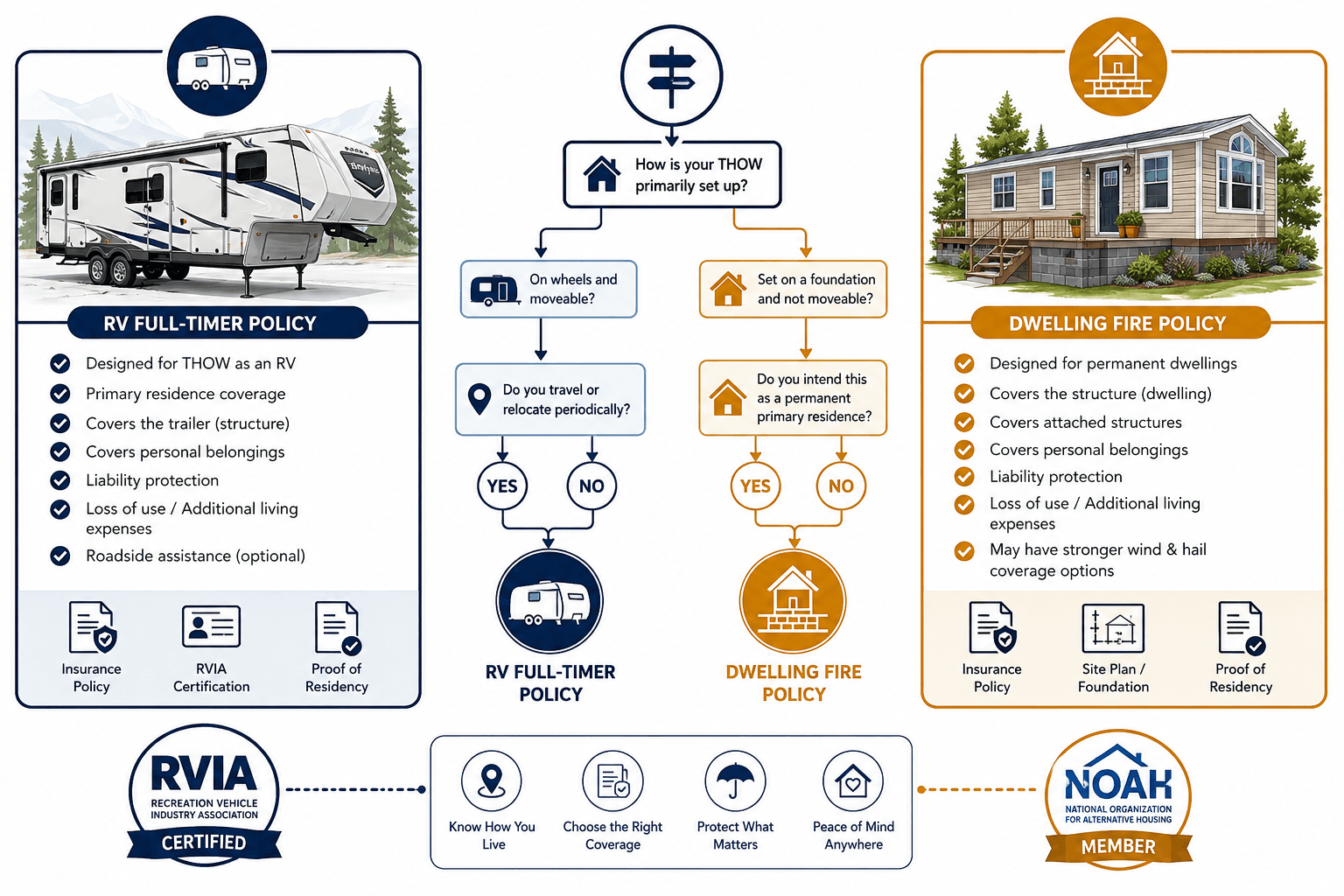
A THOW is a tiny house built on a trailer chassis, designed to be road-legal and movable. How your THOW is classified — as a vehicle, an RV, or a dwelling — determines which type of insurance policy applies to it.
If your THOW sits on wheels and can be towed, most insurers treat it like a recreational vehicle. That means standard homeowners insurance won't apply. If you've permanently affixed your tiny home to a foundation, a dwelling fire policy or a specialized tiny home product may be an option instead.
This classification question isn't just administrative. It determines your coverage options, your premium, and whether a claim gets paid. Getting it wrong from the start is one of the most common — and costly — mistakes THOW owners make.
For a broader look at how state-level rules shape your options, the Tiny Homes by State directory is a useful starting point.
What Type of Insurance Policy Do You Actually Need?
For most full-time THOW residents, a full-timer RV insurance policy is the right fit. A standard RV policy is designed for part-time recreational use. A full-timer policy treats your THOW as your actual home — covering personal property year-round, providing liability protection, and including loss-of-use coverage if your home becomes uninhabitable.
Here's a quick breakdown of the main policy types:
| Policy Type | Best For | Key Limitation |
|---|---|---|
| Full-timer RV policy | Full-time THOW residents | May exclude transit damage |
| Standard RV policy | Part-time or seasonal use | Won't cover full-time living |
| Dwelling fire policy | Foundation-set tiny homes | Requires permanent placement |
| Specialty tiny home policy | THOWs with RVIA/NOAH cert | Availability varies by state |
Choose a full-timer RV policy if you live in your THOW more than six months per year. Using a recreational-use policy while living in your home full-time is a misalignment that can result in denied claims.
How RVIA and NOAH Certification Affect Insuring a THOW as a Primary Residence
RVIA (Recreational Vehicle Industry Association) and NOAH (National Organization of Alternative Housing) certifications are two of the most important factors when insuring a THOW as a primary residence. Insurers use these certifications as proof that your home was built to recognized safety and construction standards.
Without certification, many insurers will decline to cover your THOW outright — or offer only limited coverage at higher rates. With certification, you have access to more providers, better policy terms, and often lower premiums.
RVIA certification is the more widely recognized of the two. Builders who carry RVIA certification build to standards that insurers know and trust. When you're shopping for a builder, it's worth checking whether they're RVIA-certified. Builders like Tumbleweed Tiny House Company and New Frontier Tiny Homes are examples of established builders whose work aligns with the kind of documentation insurers want to see.
NOAH certification is an alternative for builders who construct custom or owner-built homes that don't follow the RV manufacturing process. It's particularly useful for self-built THOWs.
If your THOW isn't currently certified, talk to your builder about the path to certification before you finalize construction. Retrofitting for certification after the fact is possible but more complicated.
Which Insurance Providers Cover THOWs?
A growing number of insurers now offer policies designed for tiny homes and THOWs. The two most commonly cited for THOW coverage are:
- Foremost Insurance Group — One of the longest-standing specialty insurers in this space, offering policies that combine elements of homeowners and RV coverage for full-time tiny home residents.
- American Modern — Offers specialty coverage for non-traditional dwellings including THOWs, with options for personal property, liability, and transit coverage.
Beyond these two, Strategic Insurance Agency has developed products specifically for the tiny home market. It's worth getting quotes from multiple providers, as rates and coverage terms vary considerably.
A few practical notes:
- Not all providers are licensed in every state. Confirm availability in your state before investing time in an application.
- Some providers require RVIA certification as a condition of coverage.
- If you're parked in a tiny home community or RV park, ask whether the park has any insurance requirements that affect your options.
What Does a THOW Insurance Policy Actually Cover?
A well-structured full-timer policy for a THOW typically includes:
- Dwelling coverage — Repairs or replacement of the structure itself after a covered event (fire, storm, vandalism)
- Personal property coverage — Your belongings inside the home
- Liability coverage — Protection if a visitor is injured on your property or you cause damage to a neighboring structure
- Loss of use — Temporary housing costs if your THOW becomes uninhabitable
- Attached structures — Awnings, decks, or additions connected to the home
Liability coverage deserves special attention. If someone is injured visiting your THOW, or if your home rolls loose and damages another vehicle or property, liability coverage is what protects you from out-of-pocket legal and repair costs.
How Much Does Insuring a THOW as a Primary Residence Cost?
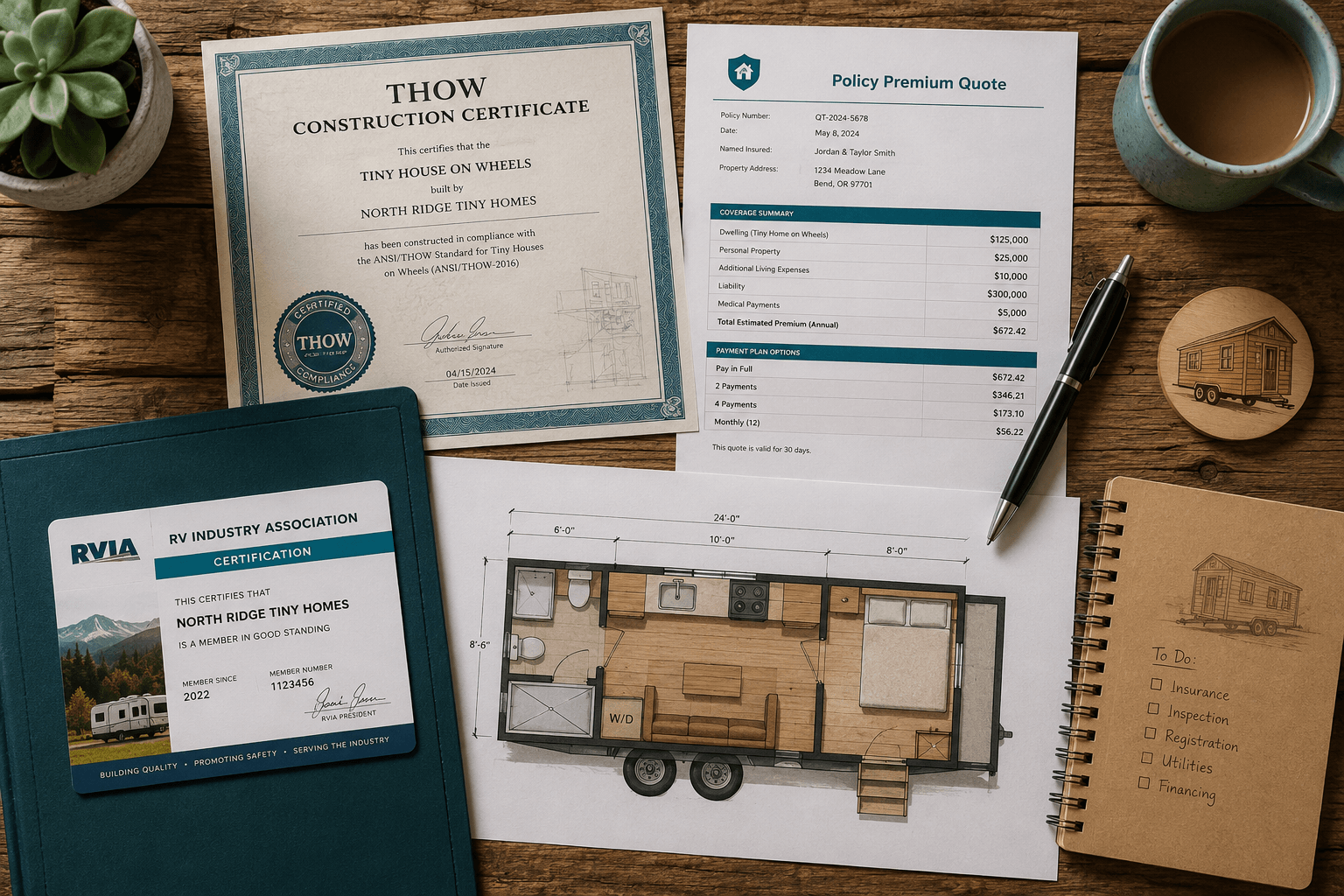
Annual premiums for insuring a THOW as a primary residence generally fall between $600 and $1,500 per year. Where your premium lands within that range depends on several factors:
- Home value — A $90,000 custom build costs more to insure than a $45,000 starter THOW
- Location — States with higher storm, flood, or wildfire risk carry higher premiums
- Certification status — RVIA-certified homes typically cost less to insure
- Coverage limits — Higher personal property and liability limits push premiums up
- Deductible choice — A higher deductible lowers your premium but increases your out-of-pocket cost per claim
Zoning and parking situation also play a role. A THOW parked in a licensed RV park in a low-risk area will generally be cheaper to insure than one parked on raw land in a flood-prone region.
For state-specific context on costs and regulations, guides like Tiny Homes in California and Tiny Homes in Arizona break down local factors that affect both zoning and insurance.
Common Coverage Gaps to Watch For
Even a solid policy can leave you exposed if you don't read the fine print. The most common gaps for THOW owners include:
- Transit damage — Many policies don't cover damage that occurs while your THOW is being towed. If you move your home regularly, confirm this is included or add a rider.
- Flood damage — Standard policies exclude floods. If you're parked in a flood-prone area, you'll need a separate flood policy through the National Flood Insurance Program or a private carrier.
- Earthquake damage — Excluded from most standard policies. Relevant if you're in California, the Pacific Northwest, or other seismic zones.
- Off-grid systems — Solar panels, composting systems, and rainwater collection setups may not be covered under a base policy. Ask specifically about these if your THOW is off-grid.
For more on off-grid living considerations, the off-grid energy systems tag has relevant resources.
How Zoning Laws Impact Your Insurance Options
Where you legally park your THOW affects whether you can get insurance — and what kind. Some insurers won't write a policy for a THOW parked in an area where it isn't legally permitted as a residence.
Before you commit to a location, verify:
- Whether the county or municipality allows THOWs as primary residences
- Whether you need a permit to park on private land
- Whether the area is zoned for RV or tiny home use
States and counties vary enormously on this. The THOW regulations tag and tiny home zoning resources on Tiny Home Sherpa can help you get oriented before you start calling insurers.
What Documentation Do Insurers Require?
Gather these before you apply for coverage:
- Construction plans or builder specifications
- List of materials and finishes used
- RVIA or NOAH certification documents
- Photos of the completed home (interior and exterior)
- Trailer VIN and weight documentation
- Proof of where the THOW is parked (lease, land deed, or park agreement)
- Appraisal or purchase price documentation
The more thorough your documentation, the smoother the application process. Insurers are more confident writing policies for homes with a clear paper trail. If your builder doesn't provide these documents automatically, ask for them at the time of purchase.
FAQ
Do I need RV insurance or homeowners insurance for a THOW? For a THOW used as a primary residence, you need a full-timer RV policy or a specialty tiny home policy — not standard homeowners insurance. Homeowners insurance is designed for homes on permanent foundations.
What happens if I only have a recreational RV policy but live in my THOW full-time? Your insurer could deny a claim if they determine the home is being used as a full-time residence under a recreational policy. Always match your policy type to your actual usage.
Is RVIA certification required to get insurance? Not universally, but many of the best providers require it or strongly prefer it. Without certification, your options narrow and your premiums may be higher.
Can I get coverage if my THOW is parked on private land I own? Yes, in most cases — but the land must be in an area where a THOW is legally permitted as a residence. Confirm local zoning rules first.
Does my policy cover my THOW while it's being towed to a new location? Not automatically. Transit coverage is a common exclusion. Ask your insurer specifically about this and add a rider if needed.
What if I built my THOW myself? Owner-built THOWs can still be insured, but you'll likely need a NOAH certification and a thorough documentation package. Some insurers also require a third-party inspection.
Conclusion
Insuring a THOW as a primary residence takes more legwork than buying a standard homeowners policy, but it's entirely achievable with the right preparation. Start by confirming your THOW's certification status, then match your policy type to how you actually use your home. A full-timer RV policy from a provider like Foremost or American Modern is the right starting point for most full-time residents.
From there, close the gaps: check for transit coverage, ask about flood and off-grid exclusions, and make sure your documentation is complete before you apply.
The tiny home world is still catching up to the insurance industry's traditional categories — but specialized products exist, and they're getting better every year. Your next step is simple: gather your certification documents, photograph your home, and request quotes from at least two specialty providers. Start where you are, with what you have.
For more guidance on builders, zoning, and what to expect state by state, explore the Tiny Home Sherpa builder listings and state guides to keep moving forward with confidence.