
Last updated: June 24, 2026
Quick Answer: Colorado tiny home zoning in mountain counties varies significantly by jurisdiction. Foundation-based tiny homes generally have the clearest path to approval, while tiny homes on wheels (THOWs) face stricter limits — often classified as recreational vehicles and restricted to RV parks. Counties like Summit, Eagle, Pitkin, Grand, and Park each have their own rules, minimum size requirements, and mountain-specific building standards that you need to verify before buying land or ordering a build.
Key Takeaways
- Colorado has adopted IRC Appendix Q, allowing foundation tiny homes as small as 400 square feet statewide — but mountain counties layer their own rules on top
- THOWs are typically classified as recreational vehicles in Colorado mountain counties and are not permitted in standard residential zones
- House Bill 24-1152 (effective June 30, 2025) requires municipalities over 10,000 residents to allow ADUs, opening new doors for tiny home placements
- Summit, Eagle, and Pitkin counties have some of the most restrictive zoning in the state due to high land values and resort-area regulations
- Snow load engineering, septic system standards, and access road requirements are non-negotiable in Colorado's high-altitude counties
- Minimum square footage requirements range from 200 to 800 square feet depending on the county
- Always verify current rules directly with the county planning department — regulations in this space are actively changing
Table of Contents
- Why Colorado Mountain County Zoning Is Its Own Challenge
- How Colorado Tiny Home Zoning in Mountain Counties Actually Works
- County-by-County Breakdown: Summit, Eagle, Pitkin, Grand, and Park
- THOWs vs. Foundation Tiny Homes: Which Path Makes Sense in the Mountains?
- Mountain-Specific Building Requirements You Cannot Skip
- ADUs and the New Opportunities from House Bill 24-1152
- How to Research and Confirm Zoning Before You Commit
- Finding Builders Who Know Colorado Mountain Standards
- FAQ
- Conclusion
Why Colorado Mountain County Zoning Is Its Own Challenge
Colorado's mountain counties operate under a different set of pressures than the rest of the state. Land is expensive, environmental protections are stricter, and the physical conditions — altitude, snowfall, remote access — demand more from any structure you put on the ground.
That combination means Colorado tiny home zoning in mountain counties is not a single set of rules. It's a patchwork of county codes, municipal overlays, state building standards, and physical realities that all have to line up before you can legally live in a smaller home at elevation.
The good news: the path exists. You just need a clear map.
How Colorado Tiny Home Zoning in Mountain Counties Actually Works
The short version: Colorado state law provides a baseline framework, but individual counties and municipalities hold most of the real authority over where and how tiny homes can be placed.
At the state level, Colorado has adopted IRC Appendix Q, which sets building standards for homes as small as 400 square feet on a permanent foundation. The Colorado Department of Local Affairs, Division of Housing, handles inspections for manufactured and tiny homes to confirm they meet state-adopted codes. That's the floor. Everything above it is county-specific.
Key layers of authority to understand:
- State law sets minimum building standards and, through HB 24-1152, mandates ADU allowances in larger municipalities
- County zoning codes determine what types of dwellings are permitted in which zones
- Local design criteria can add requirements beyond state code — especially in mountain areas
- HOA rules (if applicable) may restrict tiny homes entirely, regardless of county zoning
The practical result: two properties five miles apart in different counties can have completely different rules. This is why checking the specific parcel — not just the county — matters.
County-by-County Breakdown: Summit, Eagle, Pitkin, Grand, and Park
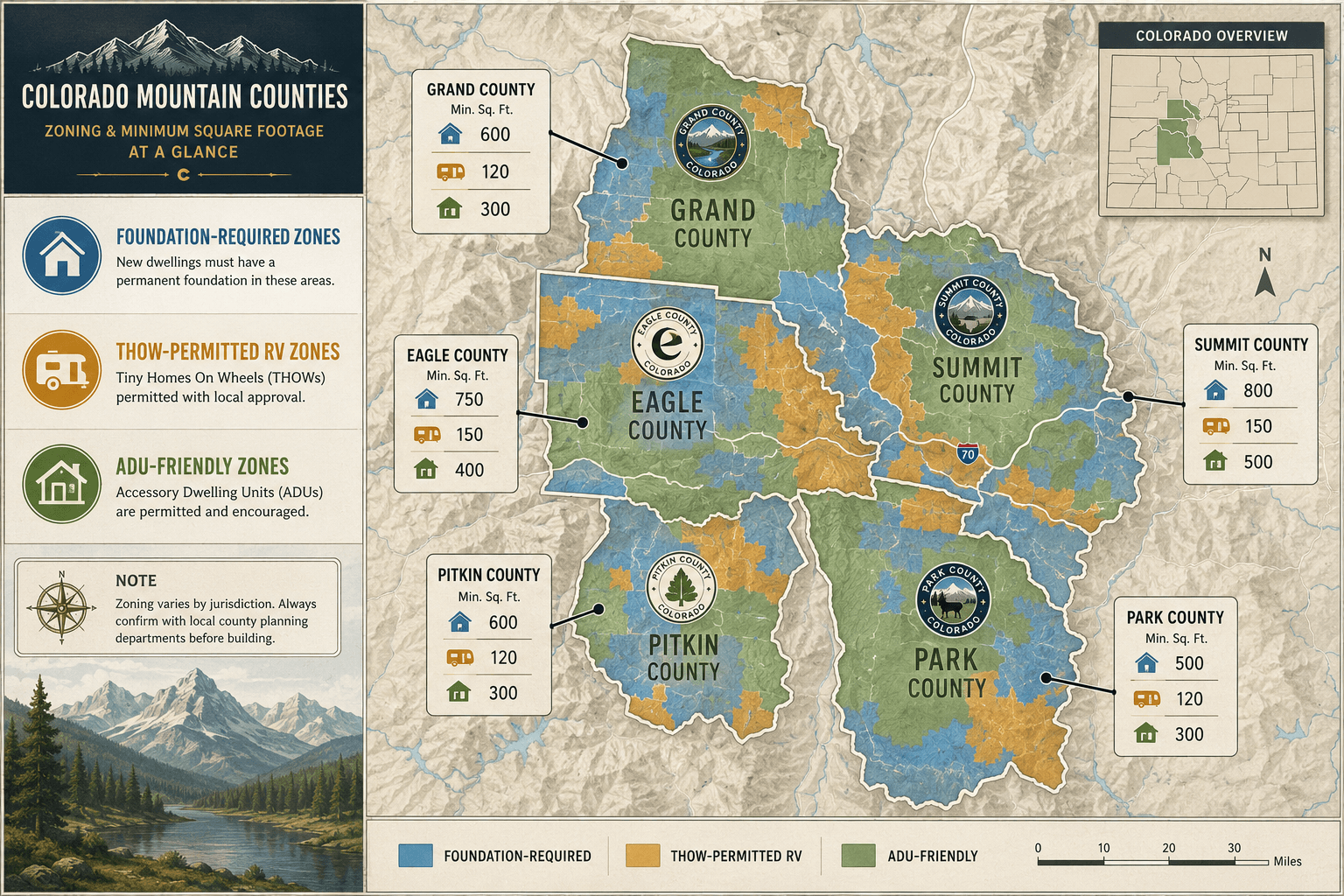
Each of these five mountain counties has a distinct approach to small dwellings. Here's what you need to know as a starting point, with the understanding that you should always confirm current rules directly with each county's planning department.
| County | Foundation Tiny Homes | THOWs | Key Notes |
|---|---|---|---|
| Summit | Permitted with full IRC compliance | Generally restricted to RV parks | High land costs; resort-area overlays apply |
| Eagle | Permitted; ADU rules apply in some zones | Classified as RVs; restricted | Vail-area regulations add complexity |
| Pitkin | Permitted with strict size and design review | Not permitted in residential zones | Aspen-area affordability programs may help |
| Grand | Generally permitted on foundations | RV classification; limited options | More rural flexibility outside Winter Park corridor |
| Park | More flexibility in rural zones | Limited; check specific parcel | Lower land costs; good option for budget-conscious buyers |
Summit County sits in the heart of Colorado ski country. Zoning here is tightly managed, and the county's resort-area character means design standards and minimum size requirements are enforced carefully. Foundation tiny homes that meet full IRC compliance can be permitted, but expect a thorough review process.
Eagle County includes the Vail Valley, where land values and regulatory scrutiny are among the highest in the state. ADU pathways are worth exploring here, particularly given HB 24-1152's requirements for larger municipalities like Avon and Eagle.
Pitkin County (home to Aspen) has some of the most rigorous land use regulations in Colorado. The county has affordable housing programs that sometimes create pathways for smaller dwellings, but standard tiny home placements face significant hurdles. Foundation compliance and design review are mandatory.
Grand County offers more breathing room, particularly in rural areas away from the Winter Park resort corridor. Foundation tiny homes are generally approvable, and the county's lower density makes the process somewhat more straightforward.
Park County is worth serious attention if budget is a factor. Land costs are lower than neighboring resort counties, rural zoning is more flexible, and the county has shown more openness to smaller dwellings on private land. It's one of the more accessible mountain county options for first-time tiny home buyers.
THOWs vs. Foundation Tiny Homes: Which Path Makes Sense in the Mountains?
In Colorado mountain counties, foundation tiny homes have a significantly clearer legal path than THOWs (tiny homes on wheels). This is the single most important distinction to understand before you start planning.
Colorado classifies most THOWs as recreational vehicles or park model trailers. In mountain counties, that classification means they're generally restricted to RV Park (RVP) zoning districts — not standard residential zones. Clear Creek County, for example, explicitly treats mobile tiny homes on wheels as recreational vehicles, limiting their placement accordingly.
Foundation tiny homes, by contrast, fall under residential building codes and can be permitted in residential zones when they meet IRC Appendix Q standards and any local minimums.
Choose a THOW if:
- You want mobility and plan to move seasonally
- You've identified an RV park or resort community that permits full-time residency
- You're not planning to use the home as a permanent primary residence in a residential zone
Choose a foundation tiny home if:
- You want a permanent primary residence in a mountain county
- You're purchasing land and want a clear path through the permitting process
- You need financing options (foundation homes are far easier to finance)
For buyers researching builders who work in Colorado's mountain terrain, Rocky Mountain Tiny Houses and Free Range Tiny Homes are two builders with regional experience worth reviewing.
Mountain-Specific Building Requirements You Cannot Skip
Altitude and weather create building requirements in Colorado mountain counties that don't exist in lower-elevation areas. These aren't optional upgrades — they're code requirements that affect your design, your budget, and your timeline.
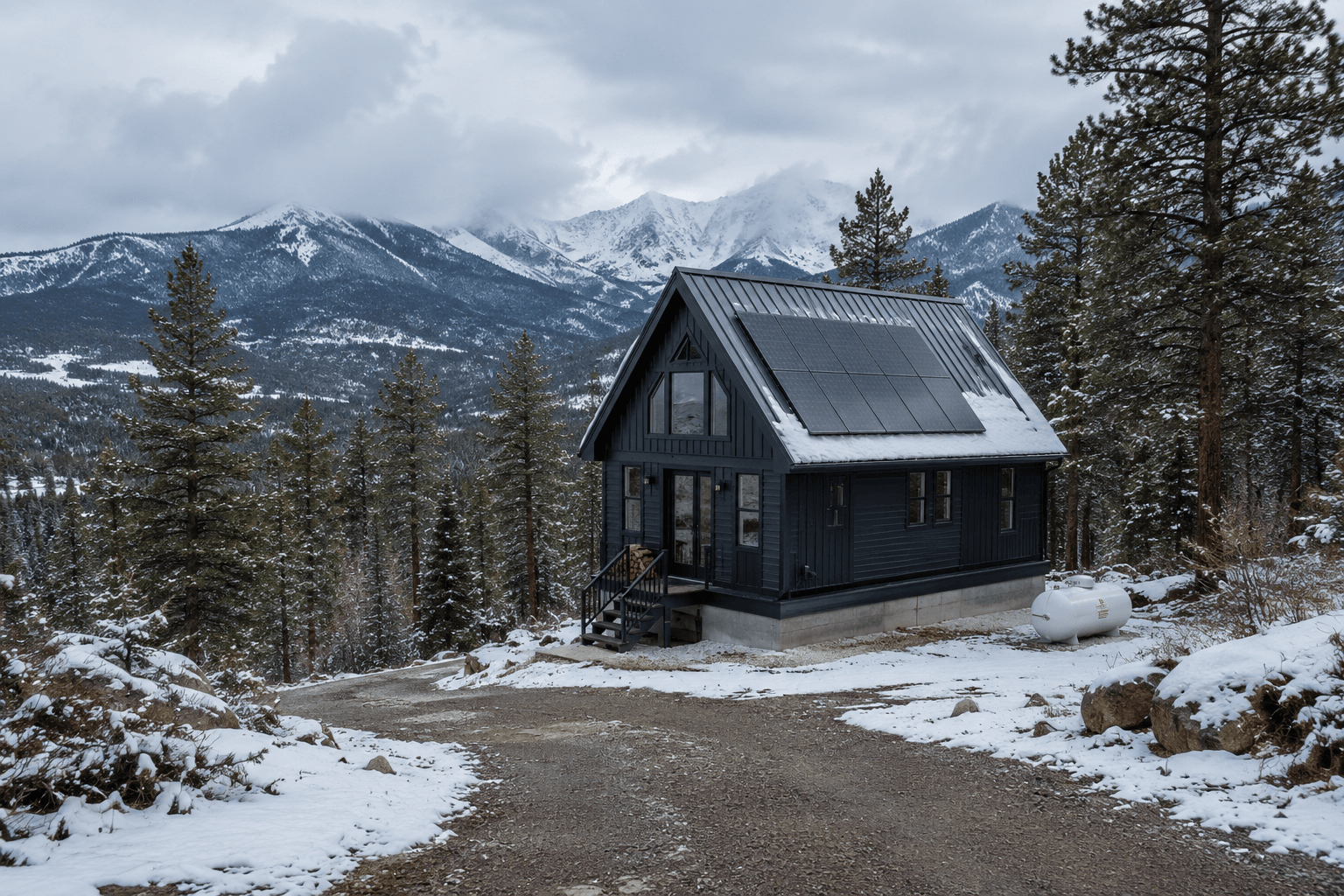
Snow load engineering is the most critical factor. Colorado mountain counties require structures to be engineered for specific ground snow loads, which vary by elevation and location. A tiny home designed for Tennessee or Texas will not meet Colorado mountain standards without significant structural modification. Always confirm the design snow load for your specific parcel.
Septic and water systems in unincorporated mountain areas typically require individual septic systems approved by the county health department. Many mountain parcels are not on municipal water or sewer, so off-grid or alternative systems need to be engineered and permitted separately.
Access road standards matter more than most buyers expect. Counties often require year-round emergency vehicle access to any permitted dwelling. If your dream parcel has a seasonal road or a steep driveway, you may need to invest in road improvements before a certificate of occupancy is issued.
Additional mountain-specific requirements to budget for:
- Wind load engineering (especially above treeline or on exposed ridges)
- Radon mitigation systems (Colorado has elevated radon levels in many areas)
- Wildfire mitigation compliance (defensible space requirements are active in most mountain counties)
- Energy code compliance for high-altitude insulation and heating standards
Custer County, as one example, explicitly requires tiny homes to meet mountain-specific engineering standards for snow loads and wind exposure before any permit is issued. The same logic applies across Summit, Eagle, Pitkin, Grand, and Park.
ADUs and the New Opportunities from House Bill 24-1152
House Bill 24-1152, effective June 30, 2025, changed the ADU landscape in Colorado significantly. Any municipality with a population over 10,000 must now allow accessory dwelling units on lots zoned for single-family homes. For tiny home buyers, this creates a legitimate pathway to place a small, foundation-based home as a secondary dwelling on an existing residential lot.
In mountain counties, this matters most in incorporated towns and cities — places like Breckenridge, Frisco, Eagle, and Granby — where the population threshold applies. Unincorporated county land is not covered by this mandate, so rural parcels still operate under county-specific rules.
ADUs in mountain communities typically still need to meet all the same mountain-specific building requirements: snow load engineering, septic compliance, access standards, and energy codes. The ADU pathway removes the zoning barrier but doesn't eliminate the engineering requirements.
For a broader look at how ADU laws are shaping tiny home options across the country, the Tiny Homes by State directory is a useful reference point.
How to Research and Confirm Zoning Before You Commit
Never rely on secondhand information when it comes to Colorado mountain county zoning. Rules change, parcels have unique overlays, and what applied to a neighboring property may not apply to yours.
Here's a practical sequence for confirming zoning before you buy land or sign a builder contract:
- Identify the parcel's jurisdiction. Is it in an incorporated town or unincorporated county land? The answer determines which set of rules applies.
- Pull the parcel's zoning designation. County GIS portals typically show this. Look for the zone district (residential, agricultural, mixed-use, RVP, etc.).
- Read the county's land use code for that zone. Look specifically for minimum dwelling size, permitted uses, and any tiny home or ADU provisions.
- Call the county planning department. Confirm what you've read and ask directly: "Can I place a [foundation tiny home / THOW / ADU] on this parcel?" Get the answer in writing if possible.
- Check for HOA restrictions. If the parcel is in a subdivision or planned community, the HOA documents may restrict tiny homes regardless of county zoning.
- Consult a local land use attorney if the answer is unclear or if significant money is on the line.
For more context on how zoning laws vary across state lines, the tiny home zoning laws resource covers the broader regulatory landscape.
Finding Builders Who Know Colorado Mountain Standards
Working with a builder who understands Colorado's mountain-specific requirements saves time, money, and significant frustration. A builder unfamiliar with high-altitude snow loads or county-specific permitting processes can produce a home that fails inspection or requires costly redesign.
When evaluating builders for a Colorado mountain project, ask these questions directly:
- Have you built in [specific county] before?
- Can you engineer to the local ground snow load requirement?
- Do you handle permitting, or is that the owner's responsibility?
- Are your homes built to IRC Appendix Q standards?
- Can you provide references from completed mountain-area projects?
Builders worth exploring for Colorado-adjacent or mountain-capable work include Rocky Mountain Tiny Houses, Alpine Tiny Homes, and Backcountry Tiny Homes. For a broader search, the Tiny Home Builders directory is a good starting point for vetting options.
If you're comparing Colorado's mountain regulations to other western states, the Tiny Homes in California guide offers useful context on how neighboring states handle similar terrain and zoning challenges.
FAQ
Q: What is the minimum square footage for a tiny home in Colorado mountain counties? A: It depends on the county. Colorado's adoption of IRC Appendix Q allows foundation homes as small as 400 square feet statewide, but individual counties set their own minimums. Ouray County, for example, allows dwellings up to 800 square feet on permanent foundations with specific room requirements. Some counties allow as little as 200 square feet. Always confirm with the specific county planning department.
Q: Can I live in a THOW full-time in a Colorado mountain county? A: In most mountain counties, no — not in a standard residential zone. THOWs are typically classified as recreational vehicles and restricted to RV park zoning districts. Some jurisdictions in Colorado have created exceptions for certified THOWs, but mountain counties have generally not been among them. Confirm with the specific county before assuming this is possible.
Q: Does Colorado's ADU law apply to unincorporated mountain county land? A: No. House Bill 24-1152 applies to municipalities with populations over 10,000. Unincorporated county land is not covered by this mandate. Rural mountain parcels still operate under county-specific zoning rules.
Q: Do I need a special engineer for a tiny home in a Colorado mountain county? A: Almost certainly yes. Mountain counties require structures to meet specific ground snow load and wind load standards. A standard tiny home plan not engineered for Colorado mountain conditions will not pass inspection. You'll need a licensed structural engineer to certify or modify the design for the specific parcel's requirements.
Q: Are there any Colorado mountain counties that are more tiny-home-friendly than others? A: Park County is generally considered more accessible for tiny home buyers among the mountain counties, with lower land costs and more flexibility in rural zones. Grand County also offers more options outside its resort corridors. Summit, Eagle, and Pitkin counties are the most restrictive due to resort-area regulations and high land values.
Q: How does Boulder County compare to mountain counties for tiny home zoning? A: Boulder County permits tiny homes and modular structures in unincorporated areas on permanent foundations compliant with the 2015 IRC, but does not permit homes on wheels or trailers. It's more permissive than Pitkin or Summit for foundation homes, but still requires full code compliance.
Conclusion
Colorado tiny home zoning in mountain counties is genuinely complex — but it's not impenetrable. The clearest path forward is almost always a foundation-based tiny home that meets IRC Appendix Q standards and the specific engineering requirements of the county where you're building.
Start by identifying whether your target parcel is in an incorporated municipality or unincorporated county land. Then pull the zoning designation, read the land use code, and call the planning department directly. Don't skip the mountain-specific engineering questions — snow load, septic, and access road standards are where many mountain tiny home projects run into unexpected costs.
If you're still in the early research phase, that's exactly the right place to be. Start where you are, gather county-specific information, and work with builders who have real experience in Colorado's high-altitude terrain. Small footprint. Full life. The mountain version of that is absolutely achievable — it just takes a more careful map.