Last updated: June 24, 2026
Quick Answer: Alabama park model tiny homes are factory-built dwellings, typically 400 square feet or less, designed for semi-permanent or seasonal placement in RV parks, campgrounds, or on private land. In Alabama, they're regulated differently from traditional tiny homes on wheels, and the rules vary significantly by county. Prices generally start in the $90,000s for a new park model, with lot rent averaging around $360 per month across the state's roughly 1,300 mobile home parks.
Key Takeaways
- Park model homes in Alabama max out at 400 square feet and are classified as recreational vehicles by the HUD and most Alabama counties, not as permanent dwellings
- Alabama has no uniform statewide tiny home law — regulations are set county by county and municipality by municipality
- The Alabama Department of Revenue classifies tiny homes into four categories, each with different building codes, tax treatment, and placement rules
- New park model homes from Alabama-based builders start in the $90,000s; used models can be found for significantly less
- Gulf Shores, Mentone, and communities near Huntsville and Birmingham are among the most active areas for park model placement in 2026
- Lot rent in Alabama mobile home parks averages around $360 per month, making total monthly costs competitive with apartment renting in many cities
- RVIA certification (Recreational Vehicle Industry Association) matters — it affects where your home can legally be placed and how it's financed
- Always verify local zoning before purchasing; some Alabama counties still restrict park models on rural residential land
Table of Contents
- What Are Alabama Park Model Tiny Homes?
- Park Model vs. THOW: What's the Difference in Alabama?
- Alabama Zoning and Regulations: What You Actually Need to Know
- Where Can You Place Alabama Park Model Tiny Homes?
- How Much Do Alabama Park Model Tiny Homes Cost?
- The Best Builders and Communities for Alabama Park Model Tiny Homes
- Financing Your Park Model in Alabama
- Pros and Cons of Park Model Living in Alabama
- FAQ
What Are Alabama Park Model Tiny Homes?
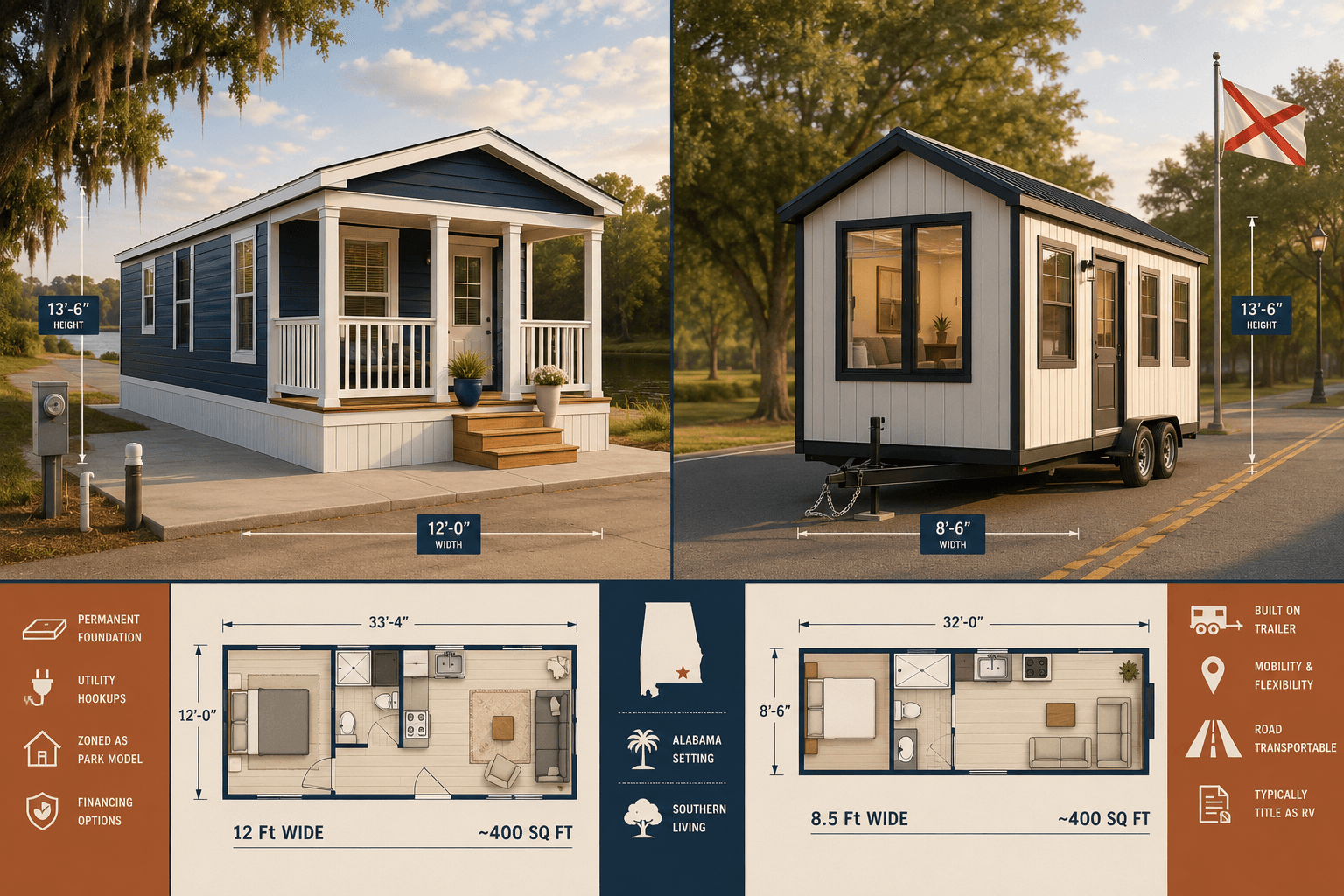
A park model home is a factory-built unit that lives in a specific regulatory category: larger than a travel trailer, smaller than a manufactured home. The Recreation Vehicle Industry Association (RVIA) defines them as recreational vehicles with a living area of 400 square feet or less. That distinction shapes everything from where you can park one to how you'll finance it.
In Alabama, park models are popular for a few clear reasons: the climate supports year-round living in much of the state, land costs are relatively low compared to coastal markets, and the state's growing network of RV parks and campgrounds makes placement more accessible than in many other states.
Key features of a park model home:
- Built on a permanent steel chassis (not designed for frequent moving)
- Typically 12 to 14 feet wide (wider than a THOW, which is road-limited to 8.5 feet)
- Fully finished interiors with residential-grade appliances, full bathrooms, and sleeping lofts
- RVIA-certified models carry a certification plate, which matters for placement and financing
- Designed for utility hookups (water, sewer, electric) rather than off-grid systems
Park Model vs. THOW: What's the Difference in Alabama?
This is one of the most common points of confusion for buyers. A tiny home on wheels (THOW) is built on a trailer and designed to move. A park model is also built on a chassis, but it's intended to stay put once placed. In Alabama, that difference has real regulatory consequences.
| Feature | Park Model | THOW |
|---|---|---|
| Max width | 12–14 feet | 8.5 feet (road limit) |
| Max living area | 400 sq ft | Typically 100–300 sq ft |
| Classification | Recreational vehicle (RVIA) | Often unclassified or RVIA |
| Placement options | RV parks, some private land | RV parks, some rural land |
| Financing | Chattel loans, RV loans | Personal loans, RV loans |
| Alabama tax treatment | Varies by county | Varies by county |
The practical takeaway: if you want more space and plan to stay in one place long-term, a park model usually makes more sense. If mobility is the point, a THOW is the better fit. For a deeper look at THOW regulations, the Tiny Homes in Alabama guide covers both categories in detail.
Alabama Zoning and Regulations: What You Actually Need to Know
Alabama does not have a single statewide tiny home law. That's the most important thing to understand before you buy. The Alabama Department of Revenue categorizes tiny homes into four types, and each carries different building codes, tax obligations, and placement rules. Your county and municipality set the actual ground rules.
What this means practically:
- Jefferson County (Birmingham area) and Madison County (Huntsville) tend to have more defined zoning frameworks
- Rural counties in central and south Alabama often have fewer restrictions but also fewer established parks
- Coastal Baldwin County, which includes Gulf Shores, has seen increased regulatory activity as park model communities have grown
Steps to verify your placement is legal:
- Identify the specific parcel you're considering (address and parcel number)
- Contact the county zoning office and ask specifically about park model RVs
- Ask whether the land is zoned for RV or recreational vehicle use
- Confirm utility connection requirements and setback rules
- Check whether an HOA or deed restriction applies (these can override county zoning)
- If placing in an RV park, get the park rules in writing before signing a lot lease
Common mistake: buyers assume that because a park model is classified as an RV, it can go anywhere an RV can park. That's not always true. Some Alabama counties have minimum square footage requirements for permanent dwellings that effectively exclude park models on residential lots.
Where Can You Place Alabama Park Model Tiny Homes?
Alabama offers several realistic placement options, depending on your goals and budget.
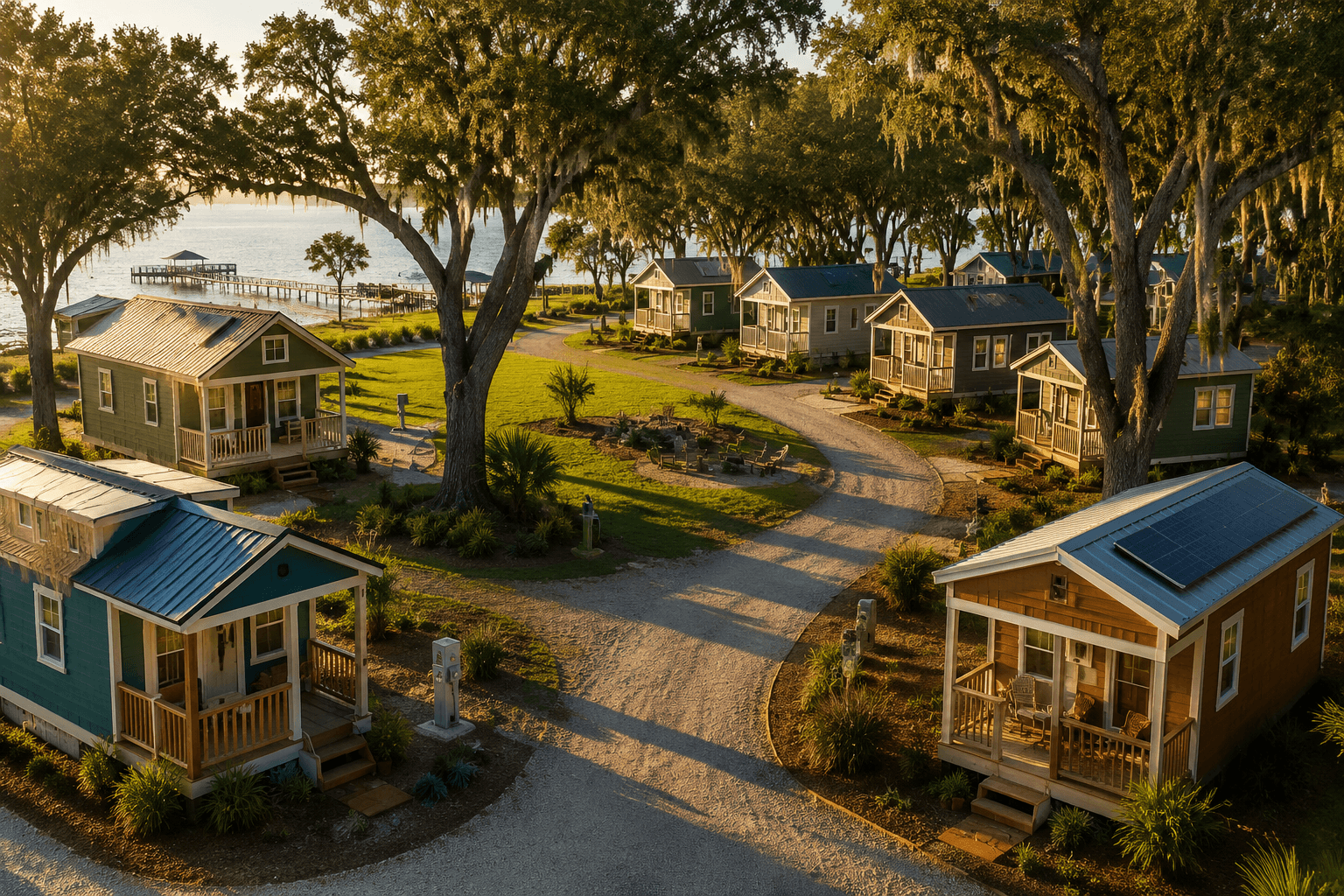
Gulf Shores and Baldwin County: The most active market for park model communities in 2026. Gulf State Park opened a major new RV resort in May 2026 with 103 premium campsites, reflecting strong demand for compact living near the coast. Baldwin County has a growing number of private parks that accept park models on long-term leases.
Mentone and DeKalb County: A scenic mountain setting in northeast Alabama. A 592-square-foot park model on nearly half an acre in Mentone demonstrates what's possible in this area — wooded lots, cooler summers, and a tight-knit community of small-home enthusiasts.
Spanish Fort and Mobile Bay area: Meaher State Park unveiled four new tiny cabins and an expanded campground in August 2025, signaling that the state itself is investing in compact living infrastructure along the bay.
Birmingham and Huntsville suburbs: Urban-adjacent placement is harder to find but not impossible. Some outer-ring communities in Jefferson and Madison counties have begun allowing park models in designated zones. Check with individual municipalities rather than relying on county-wide rules.
Enterprise and the Wiregrass region: Country artist Darryl Worley is developing a 75-unit luxury tiny home resort near Fort Rucker, scheduled to open in spring 2026. This kind of development signals growing investor and community interest in park model living across south Alabama.
How Much Do Alabama Park Model Tiny Homes Cost?
Costs break down into three buckets: the home itself, site prep and delivery, and ongoing lot or land costs.
New park model homes: Starting in the $90,000s for a basic model from a local builder like Tiny Homes South in Theodore, Alabama. Custom floor plans and premium finishes push prices toward $150,000 to $200,000 or more.
Used park models: Prices vary widely, but well-maintained units from the past five to ten years can be found in the $40,000 to $75,000 range through private sales and dealer lots.
Site prep and delivery: Budget $5,000 to $15,000 for delivery, setup, skirting, and utility connections. Concrete pads, if required by the park or county, add another $3,000 to $8,000.
Ongoing costs:
- Lot rent: approximately $360 per month on average across Alabama's 1,300-plus mobile home parks
- Utilities: typically $100 to $200 per month depending on season and usage
- Insurance: park model-specific RV insurance runs $500 to $1,500 per year
Total monthly cost for a paid-off park model with lot rent and utilities: roughly $600 to $800. That's a meaningful difference from median apartment rents in Birmingham or Huntsville.
The Best Builders and Communities for Alabama Park Model Tiny Homes
Several builders serve the Alabama market directly or ship to the state.
Alabama-based builders:
- Tiny Homes South (Theodore, AL): Specializes in luxury park models with customizable designer floor plans, starting in the $90,000s
- Alabama Tiny Homes (Warrior, AL): NOAH-certified builder offering five styles from 24 to 30 feet, fully customizable and deliverable across the continental US
- Phoenix Building Solutions (Greenville, AL): Operates a 75,000-square-foot facility certified to ANSI A119.5 standards, manufacturing park models and tiny homes with an emphasis on durability
Regional builders worth considering:
Builders like Southeastern Tiny Homes and Tennessee Tiny Homes serve the broader Southeast and regularly deliver to Alabama. For a wider search, the Tiny Home Sherpa builder directory lists vetted builders by region.
When evaluating any builder, ask specifically:
- Is the home RVIA-certified?
- What warranty covers the structure, systems, and appliances?
- Can you visit the factory or a completed model?
- Do they handle delivery and setup, or is that a separate contractor?
Financing Your Park Model in Alabama
Financing a park model is different from financing a traditional home, and it's one area where buyers get tripped up.
Common financing options:
- RV loans: The most common route for RVIA-certified park models. Terms typically run 10 to 20 years with rates that vary based on credit and loan size. Several national lenders specialize in this.
- Chattel loans: Loans secured by the home itself (not the land). Common when you're leasing a lot rather than owning land. Rates are generally higher than traditional mortgages.
- Personal loans: An option for lower-priced units, but rates are usually the least favorable.
- Land-home packages: If you're buying land and placing a park model on it, some lenders will package both into a single loan, though this is less common in Alabama than in states with clearer tiny home statutes.
One thing to verify early: whether the park or community you're considering will allow a financed unit. Some parks require that homes be owned free and clear before placement.
For comparison, buyers in neighboring states face similar dynamics. The Tiny Homes in Arkansas guide and the Tiny Homes by State directory offer useful context on how financing and zoning differ across the region.
Pros and Cons of Park Model Living in Alabama
Pros:
- Lower total cost of ownership compared to a traditional home in most Alabama markets
- Warm climate supports year-round living with lower heating costs than northern states
- Growing number of established parks and communities, especially along the Gulf Coast
- Alabama's relatively low land costs make private placement more accessible than in coastal states
- Strong builder presence in-state means shorter delivery timelines and easier service
Cons:
- No uniform statewide zoning framework means significant research is required before committing
- Lot rent is an ongoing cost with no equity return
- Financing options are more limited and often carry higher interest rates than conventional mortgages
- Some counties still have minimum square footage requirements that complicate placement
- Resale market for park models is thinner than for traditional homes
FAQ
What is the maximum size for a park model home in Alabama? RVIA guidelines set the living area limit at 400 square feet. Alabama counties generally follow this classification, though some have additional local requirements. Always confirm with the specific county where you plan to place the home.
Can I place a park model on my own land in Alabama? Sometimes. It depends on how your land is zoned. Some rural Alabama counties allow it with minimal restrictions. Others require the land to be zoned for RV or manufactured housing use. Contact your county zoning office before purchasing.
Do Alabama park model tiny homes require a building permit? In most cases, yes — for site prep, utility connections, and sometimes the home placement itself. Requirements vary by county. Some parks handle permitting as part of their setup process; others leave it to the buyer.
Is a park model the same as a manufactured home in Alabama? No. A manufactured home is built to HUD standards and classified as real property in many cases. A park model is classified as a recreational vehicle and follows different rules for placement, taxation, and financing.
What's the difference between an RVIA-certified park model and a non-certified one? RVIA certification means the home was built to a recognized industry standard for safety and construction. Non-certified homes may be harder to finance, insure, and place in established parks. Prioritize RVIA-certified models unless you have a specific reason not to.
Are there park model communities near Birmingham or Huntsville? Options are more limited than on the Gulf Coast, but they exist. Some outer-ring municipalities in Jefferson and Madison counties have begun accommodating park models in designated zones. The market is growing, but you'll need to do more legwork in these areas than in Baldwin County.
How long does it take to get a park model delivered and set up in Alabama? From order to move-in, expect four to twelve weeks for a new build from an Alabama-based manufacturer, depending on customization level and builder backlog. Delivery and setup typically add one to two weeks to that timeline.
Conclusion
Alabama park model tiny homes offer a genuinely viable path to lower-cost, lower-footprint living — but only if you go in with clear eyes about the regulatory landscape. The lack of a uniform state law means your experience in Baldwin County will look very different from your experience in a rural north Alabama county. That's not a dealbreaker. It just means the research phase matters.
Your next steps:
- Decide whether a park model or a THOW better fits your mobility and space needs
- Identify two or three target areas in Alabama and contact each county's zoning office
- Get pre-qualified for RV financing before you fall in love with a specific model
- Visit at least one Alabama-based builder in person before committing
- Read the full Tiny Homes in Alabama guide for deeper coverage of zoning, costs, and community options across the state
Start where you are. The path to a smaller, more intentional life in Alabama is clearer than it might seem from the outside — and the tiny home world, mapped out for you, is a good place to begin.