Last updated: June 24, 2026
Quick Answer: Several US tiny house builders hold recognized green certifications — including RVIA green ratings, NOAH, Passive House, and Energy Star standards. Companies like Tumbleweed Tiny House Company, TruForm Tiny, and RoamHaus lead the field. Choosing a certified builder means your home has been independently verified for energy efficiency, material safety, and structural quality — not just marketed as "eco-friendly."
Key Takeaways
- Green certifications for tiny homes come from multiple bodies: RVIA, NOAH, Passive House Institute US, Energy Star, and TRA Certification, Inc. are the most credible
- Certified builders typically use energy-efficient appliances, LED lighting, advanced insulation, and Heat Recovery Ventilation (HRV) systems
- RVIA certification covers safety and construction standards; green-specific add-ons evaluate resource use, water efficiency, and indoor air quality
- Expect to pay a modest premium for certified builds — but long-term utility savings and resale value often offset the difference
- Not every builder who uses the word "sustainable" holds a third-party certification — always ask for documentation
- The US has certified tiny home builders in every region, from the Pacific Northwest to the Southeast and Midwest
- Certification also affects financing and insurance options — some lenders and insurers require it
Table of Contents
- What Does "Green Certified" Actually Mean for a Tiny House?
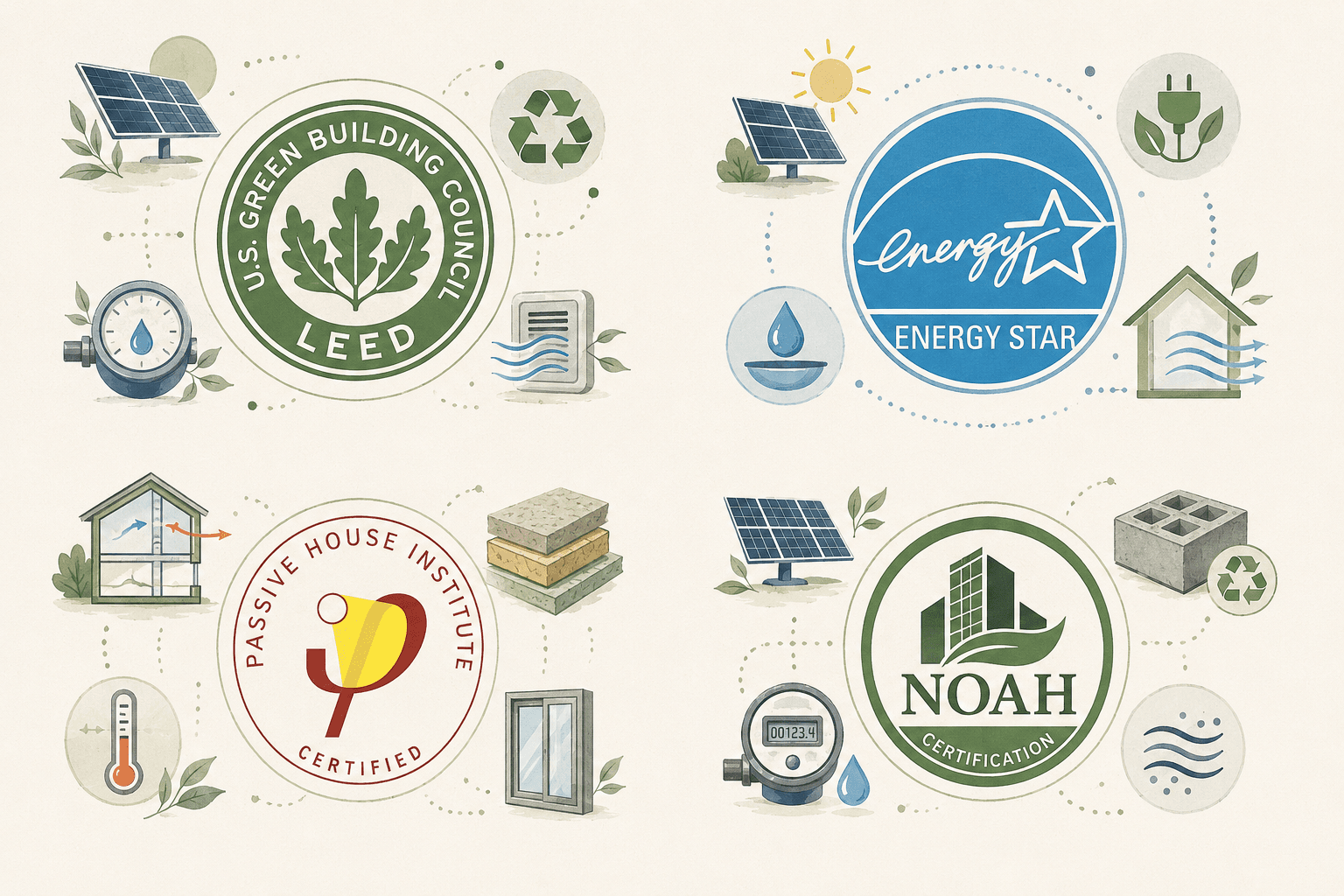
- The Main Green Certifications to Know
- Top Green Certified Tiny House Companies USA
- How to Verify a Builder's Green Credentials
- Does Certification Affect Cost?
- Sustainable Materials: What Certified Builders Actually Use
- Regional Guide: Finding Green Certified Tiny House Companies USA Near You
- Certification and Your Financing or Insurance Options
- FAQ
What Does "Green Certified" Actually Mean for a Tiny House?
A green-certified tiny house has been evaluated by an independent third party against measurable standards for energy use, material sourcing, water efficiency, and indoor air quality. It's not a marketing label a builder applies themselves.
This distinction matters more than it might seem. The tiny home industry has plenty of builders who describe their work as "eco-friendly" or "sustainable" without any outside verification. A certification means someone other than the builder checked the work.
For buyers, that verification does three things:
- It confirms the home performs as advertised
- It creates a paper trail useful for insurance and financing
- It signals the builder has invested in quality processes, not just good copy
The Main Green Certifications to Know
When researching green certified tiny house companies in the USA, you'll encounter several different certification bodies. Here's what each one actually covers.
| Certification | Issuing Body | What It Evaluates |
|---|---|---|
| RVIA Green | RV Industry Association | Safety, construction, energy efficiency for THOWs (tiny houses on wheels) |
| NOAH | National Organization for Alternative Housing | Structural safety, energy efficiency, insurance readiness |
| Passive House (PHIUS) | Passive House Institute US | Airtightness, insulation, mechanical ventilation, energy load |
| Energy Star | US EPA | Appliance and building energy performance |
| TRA Green | TRA Certification, Inc. | Resource efficiency, water use, indoor air quality, energy |
| NGBS Green | Home Innovation Research Labs | Sustainable site, water, energy, materials, indoor environment |
RVIA is the most common certification for tiny houses on wheels (THOWs). It covers structural and safety standards, and some RVIA builders pursue additional green ratings on top of it.
NOAH is worth knowing if you're buying a THOW and need insurance or financing — many providers require it.
Passive House is the most rigorous standard for energy performance. Very few tiny home builders hold this certification, which makes those that do stand out.
Top Green Certified Tiny House Companies USA
Several builders have gone beyond marketing claims and earned verifiable credentials. Here are the most notable ones as of 2026.
Tumbleweed Tiny House Company is the largest manufacturer of tiny house RVs in North America, operating since 1999. Their models — including the Elm, Cypress, Farallon, and Aspen — are RVIA-certified and built to green standards verified by TRA Certification, Inc., the highest level available through that program. Tumbleweed uses energy-efficient appliances, LED lighting, HRV systems, and environmentally responsible insulation. They deliver to all 50 states. Custom builds typically take about 12 months. You can explore their profile on Tumbleweed Tiny House Company's listing on Tiny Home Sherpa.
TruForm Tiny holds dual certification from both RVIA and the Passive House Institute US — a rare combination. They've built over 150 homes using local, high-end, green materials, with styles ranging from urban modern to rustic craftsman. Their Passive House certification means their builds meet strict airtightness and energy load standards that most tiny home builders don't attempt.
RoamHaus, based in St. Petersburg, Florida, builds NOAH-certified tiny homes with an emphasis on quality materials and modern finishes. NOAH certification means their homes meet independent safety, structural, and energy efficiency standards — and are easier to insure.
Mainefactured USA focuses on high-end, NOAH-certified tiny homes designed for real estate investors and those wanting turnkey solutions. Their homes come with full manufacturer warranties and are built for durability and low maintenance.
B&B Tiny Houses offers the Hoosic model, an RVIA-certified handcrafted tiny house on wheels starting around $62,000. At 170 square feet, it sleeps up to four people and reflects the sustainable craftsmanship approach common among smaller certified builders.
For builders with a strong sustainability focus, also check out Tiny Green Cabins, Greenpod Development, and Unplugged Houses in the Tiny Home Sherpa directory.
How to Verify a Builder's Green Credentials
Ask directly, and ask for documentation. A reputable certified builder will have no hesitation providing their certification number, the certifying body's name, and the year the certification was issued or last renewed.
Here's a simple checklist:
- Ask for the certification name and issuing organization
- Request the certificate number so you can verify it independently
- Check the certifying body's website for a builder registry (TRA, NOAH, and RVIA all maintain them)
- Confirm whether the certification applies to all models or specific ones
- Ask whether the certification is current — some expire and require renewal
Common mistake: Assuming "RVIA-certified" automatically means green-certified. Standard RVIA certification covers safety and construction. Green certification through RVIA or TRA is a separate, additional evaluation. Always ask which specific standard applies.
Does Certification Affect Cost?
Yes, but usually less than buyers expect. Certified builds typically cost 5–15% more than comparable non-certified homes, depending on the certification level and the materials involved.
Passive House certification commands the largest premium because it requires tighter construction tolerances, specialized mechanical systems, and third-party testing. RVIA and NOAH certifications add less to the sticker price but still reflect higher process costs for the builder.
The offset to consider: certified homes tend to have lower utility costs, better indoor air quality, and stronger resale or rental value. For buyers in states with active tiny home markets — like California or Arizona — certification can also smooth the path through local permitting. See the Tiny Homes in California guide and Tiny Homes in Arizona guide for state-specific context.
Sustainable Materials: What Certified Builders Actually Use
Certified builders don't just swap in a few LED bulbs and call it green. The material choices run deeper than that.
Common sustainable materials and systems in certified tiny homes:
- SIPs (Structural Insulated Panels): Pre-engineered panels that provide superior insulation with less material waste than traditional framing
- Reclaimed or FSC-certified wood: Sourced from responsibly managed forests or salvaged from existing structures
- Low-VOC finishes: Paints, stains, and adhesives with minimal volatile organic compounds, which improves indoor air quality
- HRV systems: Heat Recovery Ventilation maintains fresh air without losing conditioned air — critical in tight, well-insulated builds
- Composting toilets and greywater systems: Reduce water consumption and support off-grid capability
- Solar-ready or solar-integrated roofs: Enables grid independence or reduced utility dependence
Builders like Harmony Tiny Homes and Rocky Mountain Tiny Houses are known for incorporating these features. For off-grid-focused builds, Molecule Tiny Homes is worth exploring.
Regional Guide: Finding Green Certified Tiny House Companies USA Near You
Green certified tiny house companies in the USA operate in every region, though concentration varies.
Pacific Northwest: Strong cluster of certified builders, partly driven by Washington and Oregon's progressive building codes and environmental culture. Tumbleweed and TruForm Tiny both serve this region.
Southeast: Growing market with builders like RoamHaus (Florida) and Tiny House Chattanooga serving buyers across Tennessee, Georgia, and the Carolinas.
Mountain West: Colorado and Utah have active tiny home communities. Rocky Mountain Tiny Houses operates in this region with sustainability-focused builds.
Midwest: Builders like Tiny Midwest serve buyers in states where land costs are lower and off-grid living is increasingly popular.
Southwest: Arizona and New Mexico buyers can explore options through the Tiny Homes in Arizona guide and builders like Tiny House AZ.
Use the Tiny Home Sherpa sustainable housing directory to filter builders by location and feature set.
Certification and Your Financing or Insurance Options
Certification status directly affects what financing and insurance products are available to you. This is one of the most practical reasons to prioritize certified builders.
Many lenders who offer personal property loans or RV loans for tiny homes require RVIA or NOAH certification as a baseline condition. Without it, you may be limited to personal loans at higher interest rates.
On the insurance side, NOAH certification was specifically designed with insurability in mind. Builders like RoamHaus and Mainefactured USA market this explicitly because their buyers often need insurance coverage before placing or renting their homes.
Choose a certified builder if: you plan to finance the purchase, need insurance coverage, intend to place the home in a community or RV park with standards requirements, or want documentation for resale.
Certification may matter less if: you're paying cash, building on private land with no HOA or community requirements, and plan to stay long-term without resale considerations.
FAQ
What is the most recognized green certification for tiny houses in the USA? RVIA certification combined with a TRA green rating is the most widely recognized combination for tiny houses on wheels. NOAH is also well-regarded, particularly for insurability. Passive House certification from PHIUS is the most rigorous energy standard but is held by very few tiny home builders.
Does a green-certified tiny house cost significantly more? Typically 5–15% more than a comparable non-certified build, depending on the certification level. Passive House-certified homes sit at the higher end of that range. The premium is often offset by lower utility costs and better financing or insurance access.
Can I get a mortgage on a green-certified tiny house? Traditional mortgages generally don't apply to tiny houses on wheels. However, RVIA or NOAH-certified THOWs often qualify for RV loans or personal property loans. Foundation-built tiny homes may qualify for conventional or FHA financing depending on local zoning.
What does RVIA certification actually cover? RVIA (RV Industry Association) certification covers safety, structural integrity, electrical, plumbing, and mechanical systems. A separate green rating — through TRA Certification or a similar body — is required for environmental performance standards. The two are related but distinct.
How do I find green certified tiny house companies USA near my state? The Tiny Home Sherpa directory lets you filter builders by location and features. Start with the sustainable housing tag or browse by state. You can also check the RVIA, NOAH, and TRA websites directly for their builder registries.
Is "eco-friendly" the same as green certified? No. "Eco-friendly" is a marketing term with no standardized definition. Green certification requires independent third-party evaluation against documented criteria. Always ask which certifying body issued the certification and request the certificate number.
What is a THOW? THOW stands for Tiny House on Wheels — a tiny home built on a trailer frame rather than a permanent foundation. Most RVIA and NOAH certifications apply to THOWs specifically. Foundation-built tiny homes fall under different building codes and certification pathways.
Conclusion
Sorting through the tiny home market takes patience, and the green certification piece adds another layer to research. But it's worth getting right.
Start with what matters most to you: Is it energy performance? Insurability? Long-term resale value? Each certification addresses different priorities, and the best builder for your situation depends on which of those you're optimizing for.
From Tumbleweed's nationwide reach to TruForm Tiny's Passive House credentials, the green certified tiny house companies operating across the USA in 2026 give you real options at multiple price points. The Tiny Home Sherpa directory is mapped out to help you find vetted builders by region, certification type, and build style — so you spend less time second-guessing and more time moving forward.
Start where you are. The path to a smaller, more intentional home is clearer than it looks from the outside.