
Last updated: June 24, 2026
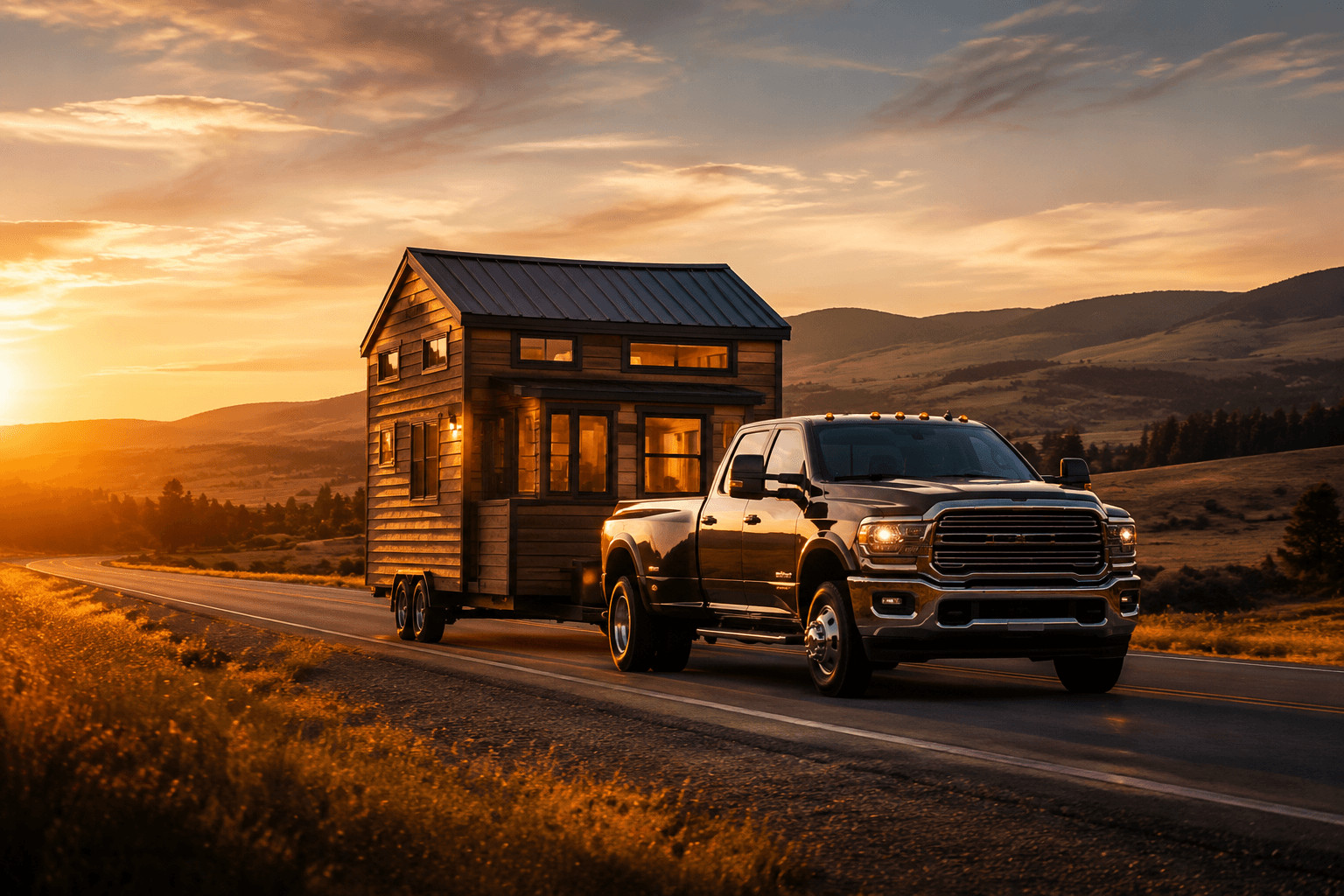
Quick Answer: Towing a tiny house on wheels (THOW) safely requires matching your tow vehicle's rated capacity to your home's loaded weight, using the right hitch and brake controller setup, and checking state permit requirements before you hit the road. Most beginners underestimate the weight involved — a fully loaded tiny house commonly falls between 10,000 and 15,000 pounds, which means a one-ton pickup truck is the minimum for most builds.
Key Takeaways
- Most tiny houses on wheels weigh between 8,000 and 15,000 pounds fully loaded — always verify your specific build's weight before choosing a tow vehicle
- A one-ton pickup truck (Ford F-350, GMC Sierra 3500, or Ram 3500) is the standard recommendation for homes between 20 and 28 feet
- Tongue weight should fall between 10 and 15 percent of the trailer's gross weight for safe, stable towing
- A weight distribution hitch and an electric brake controller are not optional accessories — they are safety essentials
- State towing laws vary significantly; permits are often required for homes exceeding certain width, height, or weight thresholds
- Secure every loose item inside your home before moving — unsecured furniture and appliances cause real damage in transit
- Adverse weather conditions (high winds, heavy rain) are valid reasons to delay a move, even a short one
- Many reputable builders include towing consultation or delivery coordination as part of their service — ask before you sign
Table of Contents
- How Much Does a Tiny House Actually Weigh?
- What Tow Vehicle Do You Need?
- Essential Towing Equipment for a Tiny House
- Understanding State Towing Laws and Permits
- Pre-Tow Safety Checklist
- Securing the Interior Before You Move
- Planning a Long-Distance Tiny House Move
- Should You Hire a Professional Towing Service?
- FAQ
How Much Does a Tiny House Actually Weigh?
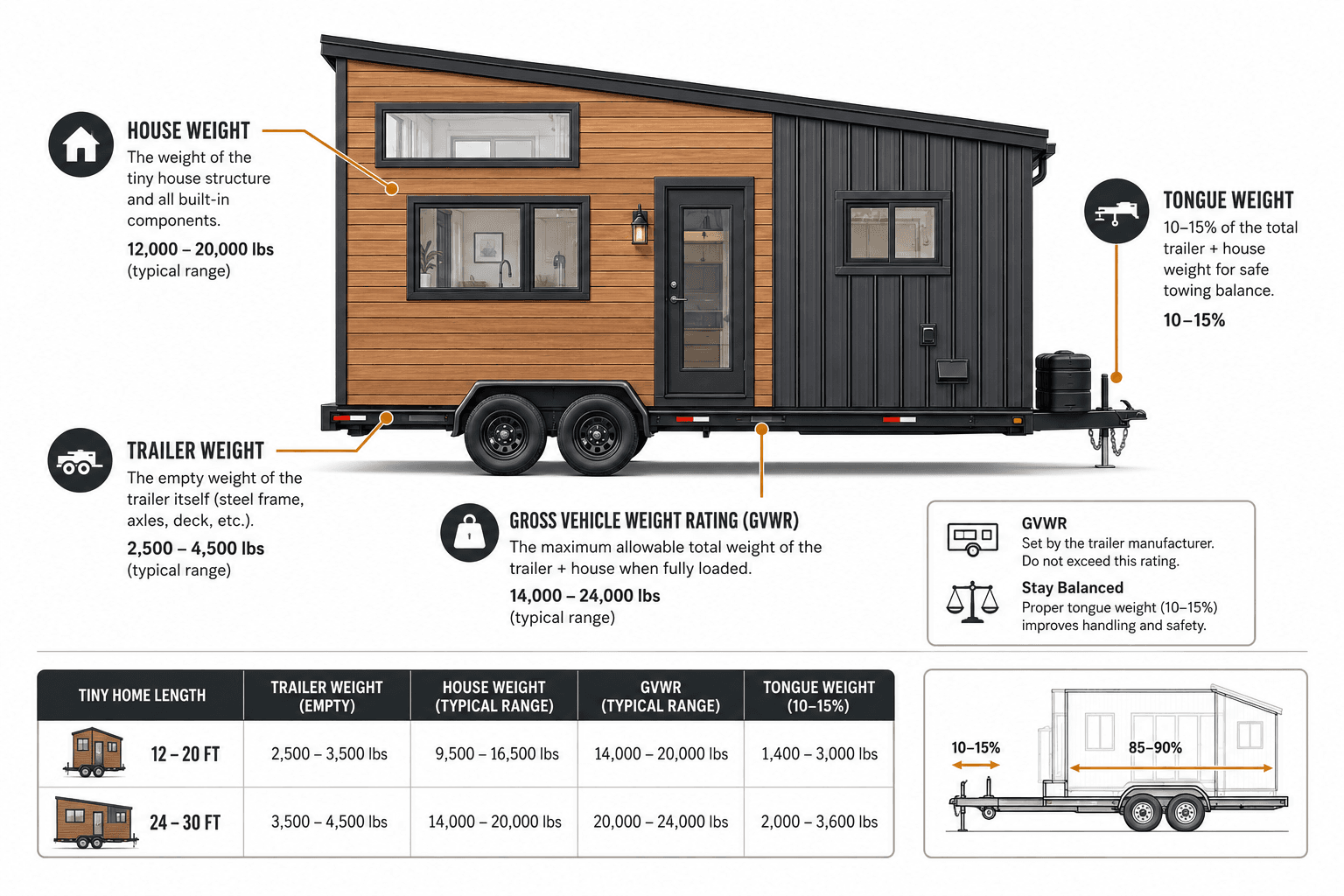
Before anything else in this tiny house towing guide for beginners, you need a real number for your home's weight. Guessing here is genuinely dangerous.
Tiny houses on wheels vary widely. Smaller builds in the 12 to 20-foot range typically weigh between 5,000 and 8,000 pounds. Larger models in the 24 to 30-foot range can exceed 13,000 pounds — and that's before you load in furniture, appliances, water, and personal belongings. A fully loaded home can easily push past 15,000 pounds.
What affects weight most:
- Trailer type and steel gauge (the trailer alone often weighs 3,000 to 5,000 pounds)
- Roofing material (metal vs. asphalt shingles)
- Siding material (cedar, fiber cement, or metal)
- Full water tanks vs. empty
- Appliances, furniture, and stored gear
The practical rule: always calculate your loaded weight, not just the builder's listed dry weight. Add at least 1,500 to 2,000 pounds for personal belongings and full tanks.
Common mistake: Buyers focus on the house weight listed in builder specs, which is typically the empty, unfurnished weight. Your real towing weight will be higher — sometimes significantly so.
What Tow Vehicle Do You Need?
For most tiny houses between 20 and 28 feet, a one-ton pickup truck is the minimum appropriate vehicle. The Ford F-350, GMC Sierra 3500, and Ram 3500 are the most commonly recommended options. These trucks are purpose-built for heavy towing and can handle the weight ranges most tiny homes fall into.
Matching vehicle to home size:
| Tiny House Length | Estimated Loaded Weight | Minimum Tow Vehicle |
|---|---|---|
| 12–18 ft | 5,000–8,000 lbs | 3/4-ton pickup (F-250, Ram 2500) |
| 18–24 ft | 8,000–12,000 lbs | 1-ton pickup (F-350, Ram 3500) |
| 24–30 ft | 12,000–15,000+ lbs | 1-ton dually or commercial truck |
Two numbers matter most when evaluating a tow vehicle: the Gross Vehicle Weight Rating (GVWR) and the towing capacity. Both are listed in your truck's owner manual and on the door jamb sticker. Your loaded tiny house weight must fall below both figures — with a comfortable margin, not right at the limit.
Choose a one-ton dually if your home exceeds 14,000 pounds loaded, or if you're towing through mountainous terrain where the extra stability and braking power genuinely matter.
Essential Towing Equipment for a Tiny House
Getting the right equipment is where this tiny house towing guide for beginners gets specific. The truck alone isn't enough.
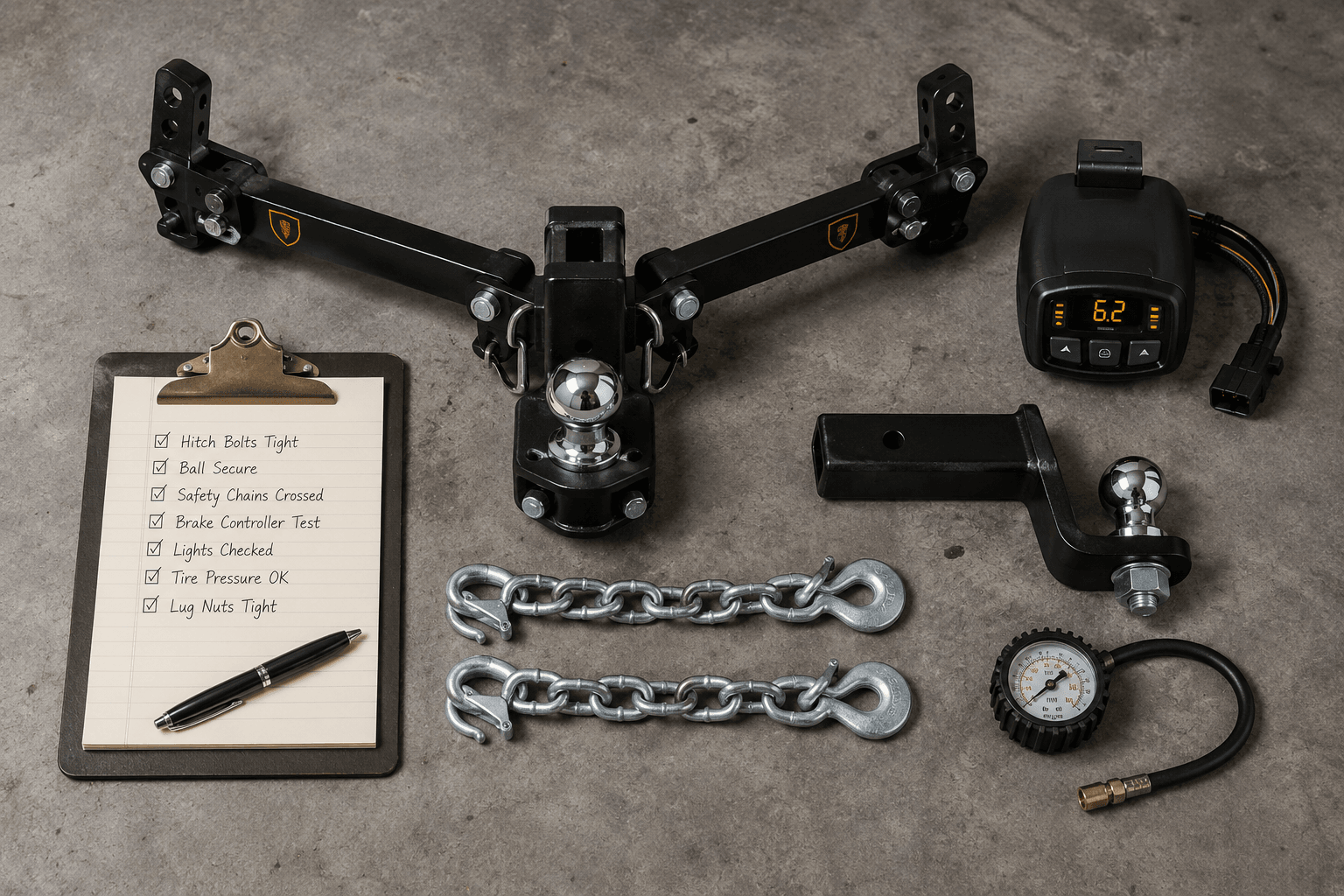
The four pieces of equipment you need:
Weight distribution hitch — This device redistributes the tongue weight across all axles of both the truck and trailer. Without it, heavy tongue weight pushes the rear of your truck down and lifts the front wheels, reducing steering control. Required for most tiny house tows.
Electric brake controller — Tiny house trailers have electric brakes built in. A brake controller (mounted inside the cab) communicates with those trailer brakes so they engage in sync with your truck's brakes. This is a legal requirement in most states and a critical safety feature.
Breakaway kit — If the trailer ever separates from the truck, a breakaway kit automatically applies the trailer brakes. Most states require this for trailers above a certain weight threshold.
Safety chains — Always cross them under the hitch coupler in an X pattern. They're your last line of defense if the coupler fails.
On tongue weight: The ideal tongue weight is 10 to 15 percent of the trailer's total gross weight. If your trailer weighs 12,000 pounds, your tongue weight should fall between 1,200 and 1,800 pounds. Too little tongue weight causes trailer sway; too much overloads your truck's rear axle.
Understanding State Towing Laws and Permits
State laws on towing a tiny house vary considerably, and skipping this step can result in fines, forced stops, or worse.
Most states require an oversize load permit when a towed structure exceeds:
- 8 feet 6 inches wide (some states allow up to 10 feet with a permit)
- 13 feet 6 inches tall (measured from road surface)
- A specific weight threshold (varies by state, often 80,000 lbs combined, but single-axle limits apply too)
What to do before you move:
- Contact the Department of Transportation (DOT) in every state you'll pass through
- Check whether your route has any low bridges, weight-restricted roads, or tunnel restrictions
- Obtain permits in advance — some states require 48 to 72 hours notice
- Some states require a pilot car or escort vehicle for oversized loads
If you're planning a move across multiple states, route planning becomes a real project. Our Tiny Homes by State guide covers state-specific regulations that can help you anticipate what each jurisdiction requires.
Pre-Tow Safety Checklist
Run through this before every move, whether you're going two miles or two hundred.
Vehicle and hitch:
- Verify hitch ball size matches trailer coupler (commonly 2-5/16 inch for tiny houses)
- Confirm coupler is fully seated and locked
- Safety chains crossed and attached
- Breakaway cable connected to truck frame (not the hitch ball)
- Brake controller calibrated and tested
Tires:
- Check inflation on all truck tires and all trailer tires (cold pressure)
- Inspect for visible damage, sidewall cracking, or uneven wear
- Confirm all lug nuts are torqued correctly
Lights and signals:
- Test brake lights, turn signals, and running lights on the trailer
- Confirm 7-pin connector is fully seated
Mirrors:
- Extended towing mirrors should give you a clear view of the full trailer width
Securing the Interior Before You Move
A tiny house in transit is not a stationary structure. Everything inside will shift, slide, or fall unless you prepare it properly.
Interior prep steps:
- Latch all cabinet doors and drawers (add child-proof latches if standard hardware is loose)
- Remove or strap down anything on countertops
- Secure the refrigerator door with a travel latch
- Drain water tanks if possible — water weight shifts and adds stress to the trailer frame
- Wrap fragile items and store them low and centered
- Disconnect propane at the tank before moving
Many builders who specialize in homes designed for mobility build these considerations into their designs from the start. Builders like Rocky Mountain Tiny Houses and Tumbleweed Tiny House Company have long track records building THOWs with towing practicality in mind.
Planning a Long-Distance Tiny House Move
Long-distance towing requires more than a full tank of gas. It requires a plan.
Key steps for a long-distance move:
- Map your route carefully. Use a routing tool that accounts for height and weight restrictions. Google Maps does not do this reliably for oversized loads.
- Identify fuel stops. One-ton trucks pulling 12,000+ pounds get significantly reduced fuel economy — plan for roughly 8 to 10 MPG under load.
- Book overnight stops in advance. Not every campground or RV park can accommodate a 30-foot tiny house.
- Check weather along the entire route. High crosswinds (above 30 mph) make towing a tall, wide structure genuinely hazardous. Delay if needed.
- Carry emergency contacts. Have the number of a heavy-duty roadside assistance service that can handle a trailer of your size.
If your destination is in a state with specific tiny home regulations, check our state-specific guides. For example, the Tiny Homes in California guide and the Tiny Homes in Arizona guide both cover transport and placement rules that affect long-distance moves into those states.
Should You Hire a Professional Towing Service?
If you've never towed anything heavier than a utility trailer, towing a 12,000-pound tiny house on your first attempt is a significant risk. There's no shame in hiring professionals for the first move — or every move.
Professional tiny house transport companies have the right trucks, the permits experience, and the route knowledge to move your home safely. Costs vary by distance and home size, but a professional move typically runs between $1,000 and $5,000 for regional distances.
Hire a professional if:
- You don't own a qualifying tow vehicle
- Your route crosses multiple states with permit requirements
- Your home is wider than 8 feet 6 inches
- You're moving more than 500 miles
Consider doing it yourself if:
- You already own or can borrow a qualified one-ton truck
- You have prior towing experience with heavy trailers
- Your move is local and on familiar roads
Some builders include delivery and towing consultation as part of their package — worth asking about before you buy. Builders like Slabtown Customs, Tahoe Tiny Houses and Trailers, and Preservation Tiny House Company are among those worth exploring for delivery support.
FAQ
What is the minimum truck needed to tow a tiny house? For most tiny houses between 20 and 28 feet, a one-ton pickup truck (Ford F-350, Ram 3500, or GMC Sierra 3500) is the standard minimum. Smaller builds under 18 feet may be manageable with a 3/4-ton truck, provided the loaded weight stays within that vehicle's rated towing capacity.
Do I need a special driver's license to tow a tiny house? In most US states, a standard Class C driver's license is sufficient for towing a tiny house on wheels, provided the combined vehicle weight stays below 26,000 pounds. Some states require a Class A CDL for heavier combinations. Check your specific state's DMV requirements before moving.
How do I know if my tongue weight is correct? Tongue weight should be 10 to 15 percent of the trailer's total gross weight. You can measure it with a tongue weight scale (available at most trailer supply stores) or have a dealer check it. If the rear of your truck squats noticeably when hitched, your tongue weight is likely too high.
Can I tow a tiny house in the rain? Light rain is generally manageable, but heavy rain reduces visibility and road grip significantly. High winds are the bigger concern — crosswinds above 25 to 30 mph can cause dangerous trailer sway on a tall, wide structure like a tiny house. Check the full route forecast before departing.
How often should I stop to check the trailer during a long move? Stop and do a walk-around inspection every 50 to 100 miles on a long-distance move. Check hitch connection, safety chains, tire condition, and lights. This is especially important in the first 30 miles after departing, when any setup issues tend to reveal themselves.
Do tiny house builders help with towing and delivery? Many do, yes. Some builders offer delivery as a paid service, and others provide towing consultations as part of the purchase process. When comparing builders, ask directly whether delivery is available and whether they'll walk you through towing requirements for your specific build.
Conclusion
This tiny house towing guide for beginners covers the core of what you need to know: weight matters more than most people expect, the right truck is non-negotiable, and the equipment and permit details are worth getting right before you move — not after something goes wrong.
Your next steps:
- Get the actual loaded weight of your specific build from your builder or trailer manufacturer
- Verify your tow vehicle's GVWR and towing capacity against that number
- Research permit requirements for every state on your planned route
- Assemble your towing equipment: weight distribution hitch, brake controller, breakaway kit, and safety chains
- Run through the pre-tow checklist before every move
If you're still in the builder selection phase, use our Tiny Home Sherpa builder directory to find vetted builders who build with mobility in mind. Small footprint. Full life. And a safe trip to get there.