
Last updated: June 24, 2026
Quick Answer: HOA rules for tiny homes in backyards are often stricter than local zoning laws, and they can block your plans even when the city says yes. Most HOA governing documents impose minimum square footage requirements, architectural standards, and secondary structure restrictions that effectively prohibit tiny homes. Before buying a structure or hiring a builder, you need to read your HOA's CC&Rs and get any approval in writing.
Key Takeaways
- HOA covenants (CC&Rs) can prohibit backyard tiny homes even if local zoning permits them as ADUs
- Minimum home size requirements in HOA communities often range from 1,000 to 3,500 square feet, far exceeding typical tiny home dimensions
- Tiny homes on wheels (THOWs) face an additional classification hurdle: most HOAs treat them as recreational vehicles, which are banned in residential zones
- Some states are passing laws that limit HOA authority over ADUs, particularly California and Florida
- You can petition your HOA for a variance or CC&R amendment, and it works more often than people expect
- Always get written approval before ordering or placing any structure
- Working with builders experienced in HOA negotiations can save you months of back-and-forth
Table of Contents
- What HOA Rules for Tiny Homes in Backyards Actually Cover
- How to Read Your CC&Rs Before You Plan Anything
- Common HOA Restrictions That Block Backyard Tiny Homes
- Does Your State Override HOA Rules for ADUs?
- How to Petition Your HOA for a Tiny Home Variance
- Tiny Homes on Wheels vs. Foundation-Built: Which Faces Less HOA Resistance?
- Real Examples: How HOA Rules Play Out Across Different States
- Finding Builders Who Understand HOA Negotiations
- FAQ
What HOA Rules for Tiny Homes in Backyards Actually Cover
HOA rules for tiny homes in backyards operate through a private legal document called the CC&Rs, short for Covenants, Conditions, and Restrictions. These are binding contracts that every homeowner in the community agrees to when they purchase their property.
CC&Rs cover a wide range of property decisions, and tiny homes touch nearly all of them:
- Permitted structures: What can and cannot be built on a lot
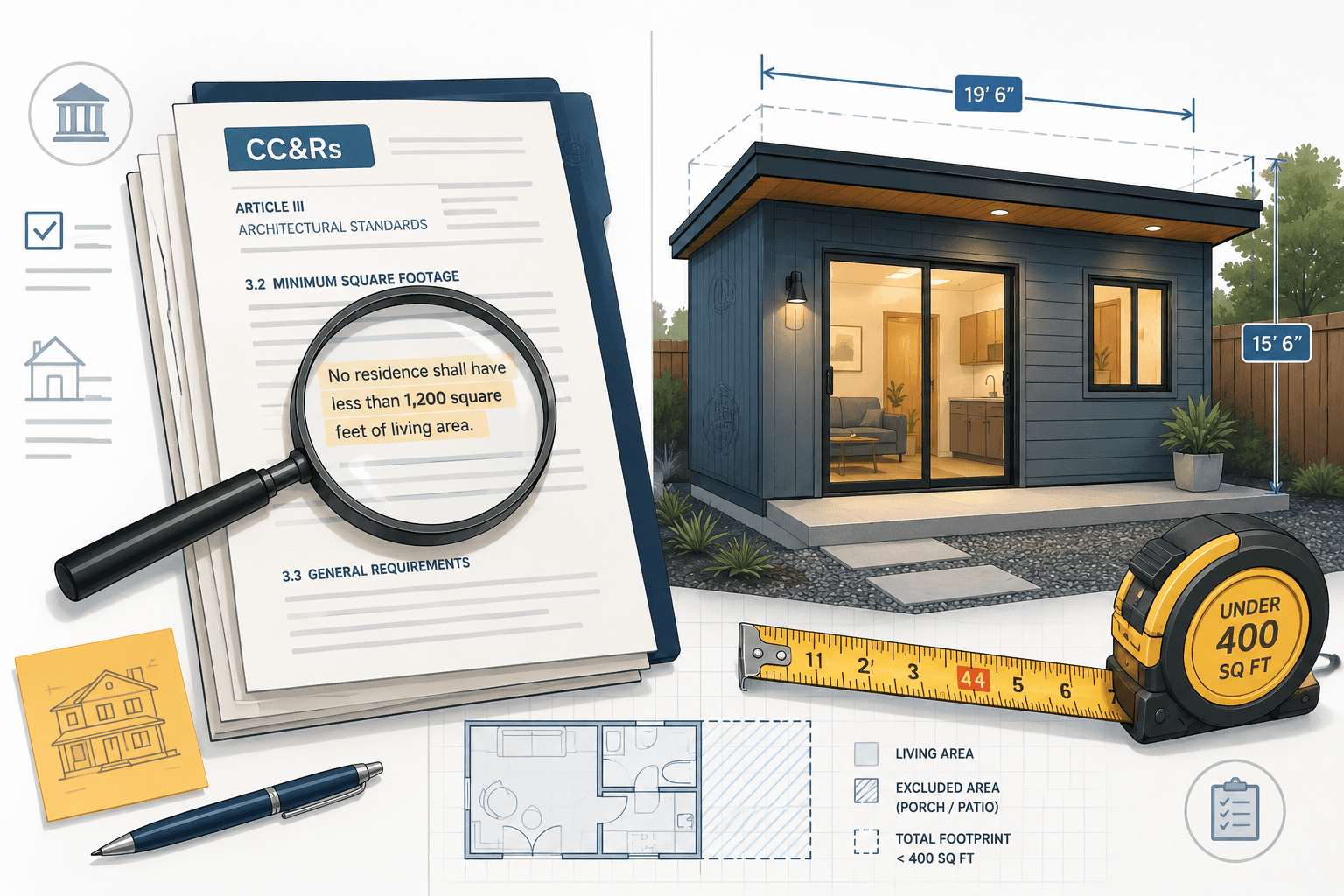
- Minimum square footage: Often applied to all residential structures, not just the primary home
- Architectural standards: Exterior materials, roof pitch, siding color, and visual compatibility with neighboring homes
- Rental and occupancy rules: Whether a secondary dwelling can be rented or occupied full-time
- Setback and lot coverage limits: How much of your lot a structure can occupy and how close it can sit to property lines
The key thing to understand: CC&Rs are not the same as zoning laws. Your city might fully permit a backyard ADU (accessory dwelling unit), but your HOA can still say no. Both sets of rules apply, and the stricter one wins.
How to Read Your CC&Rs Before You Plan Anything
Your CC&Rs are the first document to pull before you spend a dollar on a tiny home project. Most homeowners received a copy at closing, but you can also request one from your HOA management company or find it filed with your county recorder's office.
When you read through the document, look specifically for:
- Any language about "accessory structures," "secondary dwellings," or "guest houses"
- Minimum square footage clauses (these are often buried in definitions sections)
- Architectural review committee (ARC) requirements, which typically require pre-approval for any new structure
- Language about recreational vehicles, since THOWs often fall into this category
- Rental restrictions that could prevent someone from living in a backyard unit
Common mistake: Assuming silence means permission. If your CC&Rs don't mention tiny homes specifically, that doesn't mean they're allowed. Broad language like "no structure other than the primary residence shall be used for habitation" can be enough to block a backyard unit.
If the language is ambiguous, consult a real estate attorney familiar with HOA law in your state before proceeding.
Common HOA Restrictions That Block Backyard Tiny Homes
Several standard HOA provisions consistently create problems for tiny home plans. Knowing them in advance helps you assess your situation quickly.
Minimum size requirements are the most common barrier. In many suburban HOA communities, minimum square footage rules apply to all habitable structures on a lot. In areas like Flower Mound, Texas, HOA minimums often run between 2,000 and 3,500 square feet, which rules out virtually every tiny home design.
Architectural review requirements are nearly universal. Even if a tiny home is technically permitted, it must pass an aesthetic review. That means the structure needs to match the neighborhood's visual character, including roofline, siding material, and sometimes window placement.
RV and vehicle prohibitions catch most tiny homes on wheels. THOWs are built on trailer chassis and are legally classified as recreational vehicles in most jurisdictions. HOAs almost universally prohibit RVs from being parked or occupied on residential lots.
Rental and occupancy bans can prevent a backyard tiny home from being used as a full-time residence, even if the structure itself is allowed. Some CC&Rs prohibit any non-family member from occupying a secondary structure.
Does Your State Override HOA Rules for ADUs?
A growing number of states are stepping in to limit HOA authority over accessory dwelling units, and this is one of the most important developments in the tiny home space right now.
California has been the most aggressive. State law now requires HOAs to allow ADUs that comply with state and local ADU regulations. HOAs cannot use CC&Rs to prohibit a qualifying ADU outright. Placer County, for example, amended its housing codes in early 2026 to allow movable tiny homes as ADUs, requiring DMV licensing, utility connections, and design standards that conceal wheels and hitches. Our California tiny homes guide covers these rules in detail.
Florida is moving in a similar direction. As of mid-2026, pending legislation would require local governments to permit ADUs in single-family zones statewide by December 1, 2026. If passed, this could limit HOA authority to block compliant backyard units across the state.
Colorado adopted administrative rules for tiny homes in Larimer County as of July 2023, defining tiny homes as structures on a vehicle chassis under 400 square feet, distinct from RVs, and subject to specific habitability standards.
Georgia takes a classification-based approach. Whether a tiny home is treated as an RV, manufactured home, modular dwelling, or site-built structure determines which rules apply, and HOA restrictions follow that classification.
For state-specific zoning details, the Tiny Homes by State directory is a solid starting point.

How to Petition Your HOA for a Tiny Home Variance
Petitioning your HOA is more viable than most people assume. HOA boards are made up of neighbors, not bureaucrats, and a well-prepared request can succeed, especially if you address their likely concerns before they raise them.
Here is a practical approach:
- Request the ARC application from your HOA management company. This is the formal channel for any structural addition.
- Prepare a design package. Include architectural drawings, exterior renderings, material samples, and a site plan showing setbacks. The goal is to show the structure will look like it belongs.
- Address neighbor concerns proactively. Parking, privacy, rental activity, and property values are the four things neighbors worry about most. Speak to each one in your proposal.
- Cite state law if applicable. If your state has ADU-override legislation, include a brief legal summary. This reframes the conversation from "can we allow this?" to "are we required to?"
- Attend the board meeting in person. Written requests are easy to table. A calm, prepared presentation is harder to dismiss.
- Follow up in writing. After any verbal discussion, send a written summary of what was discussed and what the next steps are.
If your petition is denied, you may be able to pursue a CC&R amendment, which requires a vote of the full membership. This is a longer process but has succeeded in communities where enough homeowners support backyard housing options.
Tiny Homes on Wheels vs. Foundation-Built: Which Faces Less HOA Resistance?
Foundation-built tiny homes, often permitted as ADUs or accessory structures, generally face less HOA resistance than THOWs. Here is why:
| Feature | Foundation-Built Tiny Home | Tiny Home on Wheels (THOW) |
|---|---|---|
| Legal classification | Accessory structure or ADU | Recreational vehicle |
| HOA treatment | Reviewed under structure rules | Often prohibited outright as RV |
| Utility connections | Permanent, easier to approve | Requires workarounds |
| Aesthetic compatibility | Easier to match neighborhood | Harder to conceal trailer chassis |
| State ADU law protection | Often applies | Varies; California has specific rules |
Choose a foundation-built unit if your HOA has architectural review but no outright ban on secondary structures, and if your state has ADU-protection laws.
Choose a THOW only if your HOA is non-existent or unusually flexible, or if you plan to place the unit on land outside HOA jurisdiction. Our state-by-state directory can help you identify HOA-free areas in your target region.
Real Examples: How HOA Rules Play Out Across Different States
These examples show how HOA rules for tiny homes in backyards interact with local and state law in practice.
Texas (Flower Mound): No specific tiny home ordinance exists. Foundation-built units must meet International Residential Code standards, while THOWs are classified as RVs and cannot serve as permanent residences. Local HOAs commonly set minimums of 2,000 to 3,500 square feet, effectively closing the door on tiny homes in most neighborhoods.
California (Placer County): State ADU law overrides HOA prohibitions for qualifying units. Movable tiny homes can be placed as ADUs if they are DMV-licensed, connected to approved utilities, and designed to conceal trailer components. HOAs can regulate aesthetics but cannot ban compliant ADUs outright.
Georgia (Atlanta): Tiny homes are not a formal legal category. Classification as an RV, manufactured home, or site-built structure determines which rules apply. HOAs follow that classification, so the outcome depends heavily on how the specific unit is built and registered.
Colorado (Larimer County): Tiny homes on chassis under 400 square feet have a defined regulatory path as of 2023, separate from RVs. HOA rules still apply on top of county rules, so county approval alone is not enough.
Finding Builders Who Understand HOA Negotiations
Working with a builder who has navigated HOA approvals before is a real advantage. They know which design choices tend to pass architectural review, which documentation HOAs expect, and how to position a tiny home as a neighborhood asset rather than a disruption.
When evaluating builders, ask directly: "Have you worked with HOA communities before, and can you provide documentation packages for ARC review?" A builder who hesitates at that question probably hasn't done it.
The Tiny Home Sherpa builder directory lists vetted builders across the country. A few worth exploring for HOA-adjacent projects include Cornerstone Tiny Homes, New Frontier Tiny Homes, and Incredible Tiny Homes, all of which offer custom build options and have experience working within community design standards.
If your project is in the Southeast, Southeastern Tiny Homes is another builder familiar with the HOA-heavy suburban markets common in that region.
The goal is to find a builder who treats the HOA approval process as part of the project, not an afterthought.
Conclusion
HOA rules for tiny homes in backyards are one of the most overlooked obstacles in the tiny home planning process, and they catch people off guard because they operate outside the usual zoning framework. Your city might say yes. Your HOA might still say no.
The path forward is straightforward, even if it takes some patience:
- Pull your CC&Rs and read them carefully before committing to any plan
- Check whether your state has ADU-override legislation that limits HOA authority
- If restrictions exist, prepare a thorough ARC petition that addresses neighbor concerns head-on
- Choose a foundation-built unit over a THOW if HOA approval is your goal
- Work with a builder who has documented experience with HOA design review
Start where you are. If your current neighborhood's CC&Rs make a backyard tiny home impossible, that's useful information, not a dead end. It might mean advocating for a CC&R amendment, or it might mean finding land in a different community. Either way, you're making a real decision based on real information, which is exactly where this journey should begin.
For more guidance on zoning, builders, and what tiny living actually looks like in your state, explore the Tiny Home Sherpa blog and our state-by-state resource directory. Vetted builders. Real answers. Fewer dead ends.
FAQ
Can an HOA legally prohibit a tiny home in my backyard even if local zoning allows it? Yes. HOAs operate through private contracts (CC&Rs), not public law. If your CC&Rs prohibit secondary dwellings or impose minimum size requirements, those rules apply regardless of what local zoning permits. The exception is in states like California, where state ADU law limits HOA authority to block qualifying accessory units.
What is a CC&R, and why does it matter for tiny homes? CC&R stands for Covenants, Conditions, and Restrictions. It is the governing document of your HOA, and it is legally binding on every homeowner in the community. It typically covers what structures can be built, minimum square footage, architectural standards, and occupancy rules, all of which directly affect tiny home plans.
Are tiny homes on wheels treated differently by HOAs than foundation-built tiny homes? Yes, significantly. THOWs are legally classified as recreational vehicles in most jurisdictions, and HOAs almost universally prohibit RVs from being permanently parked or occupied on residential lots. Foundation-built tiny homes, especially those permitted as ADUs, have a better chance of passing HOA review.
What states have laws that override HOA restrictions on ADUs? California is the clearest example, with state law prohibiting HOAs from banning qualifying ADUs outright. Florida is considering similar legislation as of 2026. Other states are moving in this direction, but most have not yet passed binding HOA-override laws for ADUs. Always verify current law in your specific state.
How do I petition my HOA to allow a backyard tiny home? Start by requesting the architectural review committee (ARC) application from your HOA. Prepare a full design package including drawings, renderings, and a site plan. Address neighbor concerns about privacy, parking, and property values in your proposal. Attend the board meeting in person and follow up in writing. If state law supports your request, include a brief legal summary.
What happens if my HOA denies my tiny home petition? You have a few options. You can appeal the decision through your HOA's internal process, pursue a CC&R amendment through a full membership vote, or consult a real estate attorney to assess whether the denial conflicts with state ADU law. In some cases, the denial is final, and the practical answer is to look for property outside HOA jurisdiction.
Do I need HOA approval even for a small storage shed or studio that I don't plan to use as a residence? Most HOAs require ARC approval for any new structure above a certain size, regardless of intended use. If you plan to use the structure as a living space at any point, occupancy rules will also apply. Always disclose your intended use accurately, as misrepresentation can create legal liability.