
Last updated: June 24, 2026
Quick Answer: Wisconsin winters are brutal — temperatures regularly drop below zero, and wind chills can push conditions to dangerous extremes. Wisconsin winter tiny home living is absolutely doable, but only if your home is built or retrofitted with serious cold-climate specs: minimum R-30 wall insulation, a heated and protected plumbing system, proper skirting, and a reliable primary heat source. Skip any of those, and you're not roughing it — you're risking burst pipes and a miserable January.
Key Takeaways
- Wisconsin winters demand a minimum R-30 wall assembly and R-49 roof insulation for tiny homes to stay comfortable and efficient
- Closed-cell spray foam is the gold standard insulation choice for tiny homes in cold climates — it insulates, air-seals, and acts as a vapor barrier simultaneously
- All plumbing must run through conditioned interior space or be protected with a fully insulated, heated underbelly to prevent freeze damage
- Skirting is non-negotiable: insulated vinyl, rigid foam board, or custom metal/wood options all work, but leaving the undercarriage exposed is not an option
- A primary heating system (propane, mini-split with cold-climate rating, or wood/pellet stove) should be sized for your square footage, with a backup option ready
- Foundations matter: frost-protected shallow foundations (FPSF) or properly anchored piers prevent frost heave from shifting or damaging your structure
- Wisconsin zoning regulations vary significantly by county — research local rules before you site your tiny home
- Maintaining indoor temperatures above 50°F at all times protects your home even when you're away
Table of Contents
- Why Wisconsin Is One of the Toughest Tests for Tiny Home Living
- Insulation Minimums: What R-Value Do You Actually Need?
- Heating Systems That Work When It's 20 Below
- Protecting Your Plumbing From Wisconsin Winters
- Skirting: The Underrated Cold-Weather Essential
- Foundation Options That Handle Frost Heave
- Moisture Control and Ventilation in a Tight Tiny Home
- Wisconsin Zoning and Legal Basics for Tiny Home Owners
- Winterizing Your Outdoor Spaces
- Finding Cold-Weather-Ready Builders
- FAQ
Why Wisconsin Is One of the Toughest Tests for Tiny Home Living
Wisconsin winter tiny home living pushes every system in your home harder than almost any other climate in the lower 48. Average January lows in Green Bay hover around 8°F, and multi-day stretches below zero are common statewide. That's not a minor inconvenience — it's a real engineering challenge for a structure that may be 200 square feet.
The good news: thousands of people live in tiny homes year-round in Wisconsin and neighboring cold-climate states. The difference between those who thrive and those who bail by February comes down to preparation. A home built or retrofitted to cold-climate specs handles a Wisconsin winter without drama. One that isn't becomes an expensive lesson.
If you're researching cold-weather tiny home options more broadly, the cold-weather tiny homes resource hub is a solid starting point for understanding what separates a fair-weather structure from a genuinely winter-ready one.
Insulation Minimums: What R-Value Do You Actually Need?
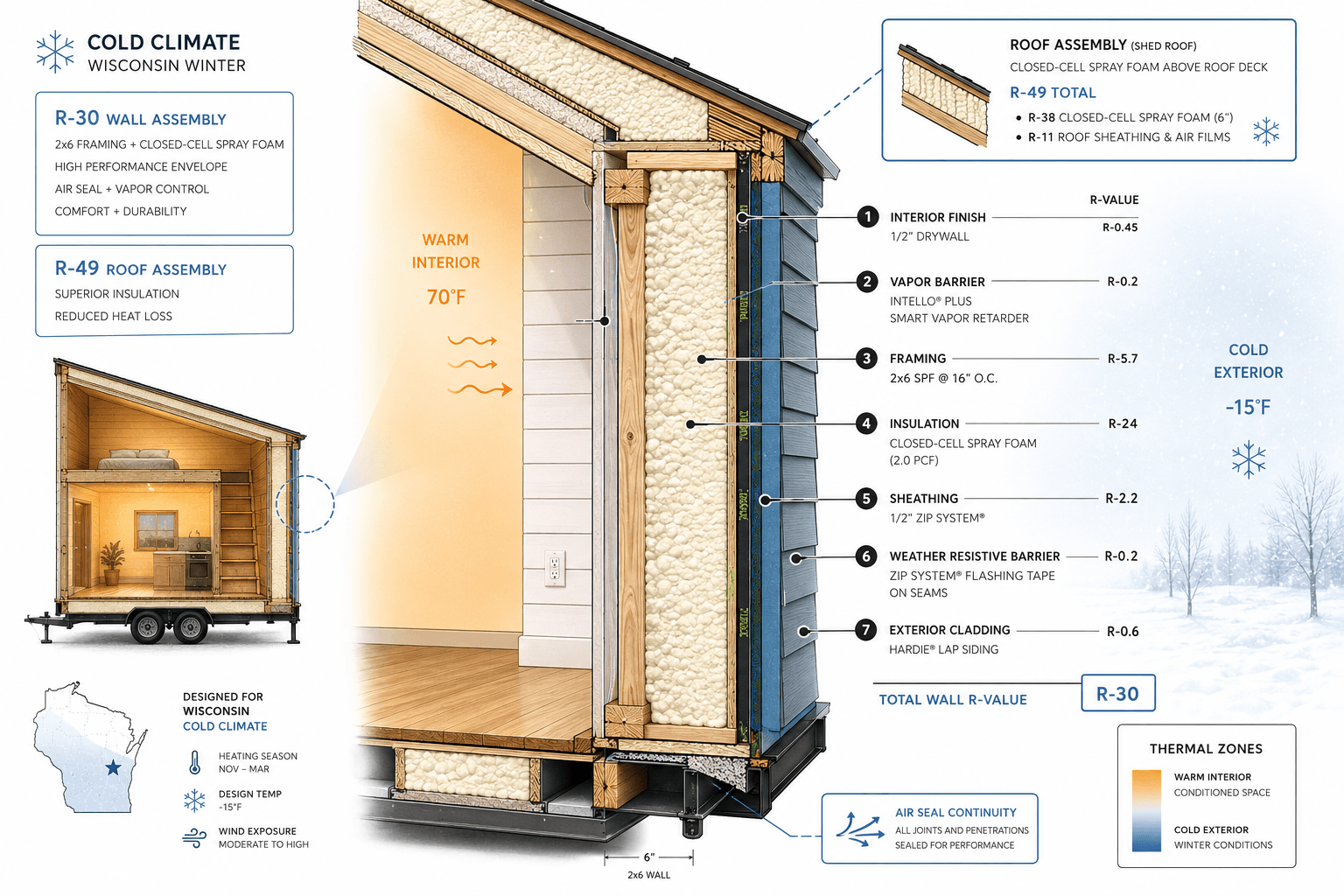
For Wisconsin's climate zone (Zone 6 and parts of Zone 7), the minimum practical targets are R-30 for walls and R-49 for the roof assembly. These numbers aren't arbitrary — they align with the energy code requirements for permanent residential structures in the region and reflect what's needed to keep heating costs manageable when outdoor temps are extreme.
Wall assembly options:
- 2x6 framing with closed-cell spray foam: Delivers roughly R-21 to R-25 within the cavity, plus additional value from sheathing layers. This is the most common high-performance choice for cold-climate THOWs (tiny homes on wheels).
- SIPs (Structural Insulated Panels): Factory-built panels that combine structure and insulation in one. A 6.5-inch SIP panel hits around R-27, and they're exceptionally airtight.
- Double-stud walls: Used in some foundation-set tiny homes, this approach creates a wider cavity for dense-pack cellulose or batts, reaching R-40 or more.
Roof/ceiling: Closed-cell spray foam applied directly to the roof deck (unvented assembly) is the most reliable approach for a tiny home, eliminating the risk of ice dams and condensation in the roof cavity.
Common mistake: Choosing R-13 or R-15 batt insulation because it's cheaper. In a Wisconsin winter, that choice shows up immediately in your heating bills and in cold spots near exterior walls.
Heating Systems That Work When It's 20 Below
A single, properly sized primary heating system plus one backup option is the right setup for Wisconsin winter tiny home living. Relying on a single source — especially electric resistance heat during a grid outage — is a gamble you don't want to take in January.
Primary heating options:
| System | Best For | Cold-Climate Notes |
|---|---|---|
| Propane forced air | Most tiny homes with ductwork | Reliable to extreme temps; keep tank above 20% full |
| Cold-climate mini-split | Well-insulated homes above 200 sq ft | Must be rated for operation at -13°F or lower |
| Wood or pellet stove | Off-grid or backup-primary setups | Requires proper clearances and flue installation |
| Radiant floor heating | Foundation-set tiny homes | Excellent comfort; slower response time |
Backup heating: A propane or kerosene portable heater rated for indoor use, stored and ready, is cheap insurance. Keep it fueled.
Programmable thermostats are worth every penny. Set a minimum floor temperature of 50°F to protect pipes and finishes even when you're away.
Protecting Your Plumbing From Wisconsin Winters
Frozen pipes are the single most common and most damaging winter problem in tiny homes. The fix is straightforward, but it has to be built in — not added as an afterthought.
The core rule: All supply lines and drain lines should run through conditioned (heated) interior space. If that's not possible due to your floor plan or chassis design, a fully insulated and actively heated underbelly is required.
Practical steps:
- Wrap all exposed pipes with UL-listed heat tape, especially at entry points and in any unheated chase
- Insulate the underbelly with rigid foam board or spray foam to at least R-19
- Install a low-temperature alarm (available for under $30) that alerts you when interior temps drop below a set threshold
- Use a water pressure regulator with a built-in freeze protection valve at your hookup point
- Know where your main shutoff is and how to drain the system quickly if you need to leave for an extended period
Edge case: If you're in a THOW parked at a campground or RV park, confirm the site's water supply has heat tape on the pedestal hookup. Many don't, and that's where freezes start.
Skirting: The Underrated Cold-Weather Essential
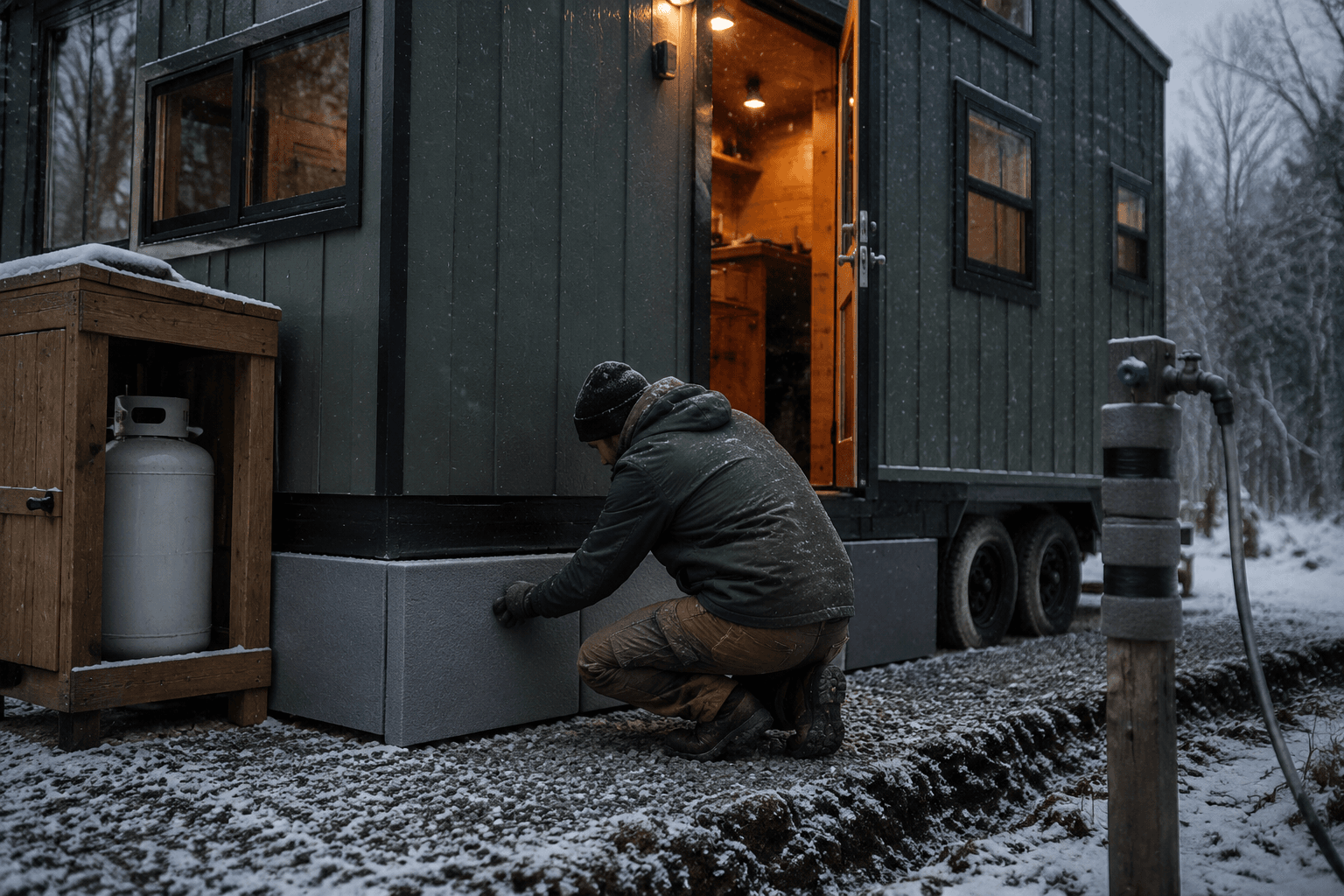
Skirting blocks cold air from circulating under your tiny home, protecting your plumbing, floor system, and underbelly insulation from wind-driven cold. It also meaningfully reduces heating costs by eliminating a major source of heat loss.
Skirting material options:
- Insulated vinyl skirting: Easy to install, widely available, handles freeze-thaw cycles well
- Rigid foam board (EPS or XPS): High R-value per inch; can be finished with a protective facing
- Metal or wood panels: More custom look; requires proper sealing at joints and corners
- Concrete block or masonry: Best for permanent or semi-permanent placements
Install skirting so it makes contact with the ground (or a frost-protected perimeter) with no gaps. Even a 2-inch gap at the corner defeats much of the purpose.
Foundation Options That Handle Frost Heave
Frost heave — the upward movement of soil as groundwater freezes and expands — is a real concern in Wisconsin, where frost depths can reach 48 to 60 inches in northern counties. A poorly chosen foundation can shift, crack, or tilt your tiny home over a single hard winter.
Foundation types suited to Wisconsin:
- Frost-Protected Shallow Foundations (FPSF): Use rigid foam insulation at the perimeter to keep soil temperatures above freezing, allowing a shallower footing. Widely accepted in Wisconsin building codes for permanent structures.
- Helical piers: Screw-type piers driven below the frost line. Excellent for tiny homes on permanent or semi-permanent sites.
- Concrete piers to frost depth: Traditional approach; reliable but requires excavation to 48–60 inches depending on location.
- Gravel pads (for THOWs): A well-compacted, well-drained gravel pad won't prevent frost heave in the soil beneath, but it does provide drainage and a stable surface. Pair with wheel chocks and stabilizer jacks.
Choose FPSF if you're building a foundation-set tiny home and want to minimize excavation costs while still meeting code. Choose helical piers if you need a permanent anchor with minimal site disturbance.
Moisture Control and Ventilation in a Tight Tiny Home
A well-insulated tiny home is also a very tight tiny home. That's good for energy efficiency and bad for moisture management if you don't address ventilation deliberately.
In a small space, cooking, showering, and even breathing generate significant humidity. Without adequate ventilation, that moisture condenses on cold surfaces — windows, exterior walls, and inside wall assemblies — leading to mold and structural damage.
What works:
- ERV (Energy Recovery Ventilator): The best solution for a tight tiny home. It exchanges stale interior air with fresh outdoor air while recovering most of the heat. Compact units designed for small spaces are available.
- Exhaust fans: Install in the kitchen and bathroom; run them during and after cooking and showering
- Dehumidifier: Run during winter months when interior humidity climbs above 50%
- Monitor humidity: A simple hygrometer (under $15) tells you when you need to act
Target indoor relative humidity between 30% and 50% during winter. Below 30% gets uncomfortable; above 50% risks condensation on cold surfaces.
Wisconsin Zoning and Legal Basics for Tiny Home Owners
Tiny homes are legal in Wisconsin, but the rules vary significantly from one county or municipality to the next. There is no single statewide tiny home zoning law — which means your research needs to be local and specific.
Key distinctions to understand:
- THOW (Tiny Home on Wheels): Often regulated as an RV. May be restricted to RV parks or campgrounds in many jurisdictions. Some counties allow year-round occupancy; others do not.
- Foundation-set tiny homes: Subject to standard residential building codes. Must meet minimum square footage requirements, which vary by municipality (some are as low as 150 sq ft; others require 600+).
- Park model homes: A specific RVIA (Recreational Vehicle Industry Association) classification for units 400 sq ft or less. Treated differently than both THOWs and standard homes in some counties.
- ADUs (Accessory Dwelling Units): Some Wisconsin municipalities allow tiny homes as ADUs on existing residential lots.
Before you site a tiny home anywhere in Wisconsin, contact the county zoning office directly. Ask specifically about minimum dwelling size, whether year-round occupancy is permitted, and what utilities connections are required.
For a broader look at how different states handle tiny home regulations, the tiny homes by state directory maps out the regulatory landscape across the country.
Winterizing Your Outdoor Spaces
Your deck, patio, and any outdoor structures need attention before the first hard freeze. Wisconsin winters don't give you a grace period.
Pre-winter checklist:
- Clean and store or cover all outdoor furniture
- Drain and store garden hoses; shut off and drain exterior spigots
- Inspect deck boards and railings for rot or loose fasteners — snow load amplifies any existing weakness
- Apply a water-repellent sealer to wood decking before freeze-up
- Clear roof valleys and gutters of debris before snowfall
- Designate a snow removal plan: know where you'll pile snow so it doesn't block exits, vents, or skirting panels
If you have a propane tank, keep it at least 20% full through winter. Propane pressure drops in extreme cold, and a near-empty tank in a polar vortex is a problem you don't want.
Finding Cold-Weather-Ready Builders
Not every tiny home builder designs for cold climates. Some produce beautiful homes that work perfectly in mild-weather states but aren't spec'd for Wisconsin winters. When evaluating builders, ask specific questions.
Questions to ask any builder:
- What is the wall R-value, and what insulation type is used?
- Is the underbelly fully enclosed and insulated? Is heat tape included?
- What is the roof R-value?
- Are windows double or triple-pane? What is the U-factor?
- Has the home been built for or delivered to cold-climate states before?
Several builders in the Tiny Home Sherpa directory have experience with cold-climate builds. Great Lakes Tiny Home and Tiny Midwest are worth reviewing for Midwest-specific experience. Timbercraft Tiny Homes and New Frontier Tiny Homes are also known for quality builds with strong insulation packages.
For a full list of vetted builders, the tiny home builders directory lets you filter and compare options. If you're exploring off-grid setups — common in rural Wisconsin — the off-grid tiny homes tag surfaces relevant builders and resources.
FAQ
Can you live in a tiny home year-round in Wisconsin? Yes. Many people do. The key is a home built to cold-climate specs: R-30+ walls, R-49 roof, protected plumbing, proper skirting, and a reliable heating system. A poorly insulated tiny home will be miserable and expensive to heat in a Wisconsin winter.
What is the minimum insulation R-value for a Wisconsin tiny home? Target R-30 for walls and R-49 for the roof/ceiling assembly. These align with Wisconsin's climate zone requirements (Zone 6–7) and are what's needed to keep heating costs manageable when temperatures drop below zero.
How do I keep my tiny home's pipes from freezing in Wisconsin? Run all plumbing through conditioned interior space. If that's not possible, use a fully insulated and actively heated underbelly, wrap pipes with UL-listed heat tape, and install a low-temperature alarm. Never let interior temps drop below 50°F.
Do I need skirting on my tiny home in Wisconsin? Yes. Skirting is essential in Wisconsin winters. It blocks wind-driven cold air from circulating under your home, protects your plumbing and floor system, and reduces heating costs. Insulated vinyl, rigid foam board, and metal or wood panels all work well.
What foundation type is best for a Wisconsin tiny home? For permanent or semi-permanent structures, frost-protected shallow foundations (FPSF) or helical piers driven below the frost line (48–60 inches in northern Wisconsin) are the most reliable options. For THOWs, a well-compacted gravel pad with proper drainage is standard.
Are tiny homes legal in Wisconsin? Yes, but regulations vary by county and municipality. THOWs are often regulated as RVs. Foundation-set tiny homes must meet local building codes, including minimum square footage rules that differ by location. Always contact your county zoning office before siting a tiny home.
Conclusion
Wisconsin winter tiny home living is genuinely achievable — but it rewards preparation and punishes shortcuts. The homes that handle a Wisconsin winter well share a few common traits: serious insulation (R-30 walls minimum, R-49 roof), protected plumbing, proper skirting, a frost-appropriate foundation, and a heating system with a backup.
If you're still in the planning phase, start with your insulation spec and your heating plan. Those two decisions shape everything else. If you already own a tiny home and are preparing for your first Wisconsin winter, work through the winterization checklist above before the first hard freeze — not after.
Your next steps:
- Confirm your wall and roof R-values with your builder or with a blower-door test
- Inspect your underbelly insulation and skirting before October
- Research your county's zoning rules for year-round tiny home occupancy
- Identify and stock a backup heat source
- Browse cold-weather-ready builders if you're still in the buying phase
Small footprint. Full life. Wisconsin winters included.