
Last updated: May 18, 2026
Quick Answer: Tiny homes in Connecticut are legal to build, but zoning — not building code — is the real barrier. The state follows IRC Appendix Q, which allows homes under 400 sq ft with relaxed code requirements. However, local municipalities control where you can actually place one, and rules vary dramatically from town to town. The most reliable legal pathway for most buyers is the Accessory Dwelling Unit (ADU) route created by Public Act 21-29. [1][2]
Key Takeaways
- Connecticut adopted IRC Appendix Q statewide, defining a tiny house as 400 sq ft or less and allowing features like loft ladders instead of full staircases [1]
- Building code compliance does not override local zoning — your town's rules are what really matter [2]
- Public Act 21-29 (effective January 1, 2022) gave homeowners a baseline right to add one ADU up to 1,000 sq ft per residential lot [3]
- Dozens of Connecticut towns opted out of parts of the ADU law or added their own restrictions — always check your specific municipality [6]
- A tiny home on wheels (THOW) is typically classified as a recreational vehicle, not a dwelling, which creates a separate set of legal challenges
- Seasonal-only placement is sometimes easier to permit than year-round occupancy, but it limits your options significantly
- Four-season insulation is essential in Connecticut — the state sees real winters, and under-built tiny homes struggle
- The ADU pathway is currently the clearest route for a backyard tiny home on an existing residential lot [5]
What Are the Building Code Rules for Tiny Homes in Connecticut?
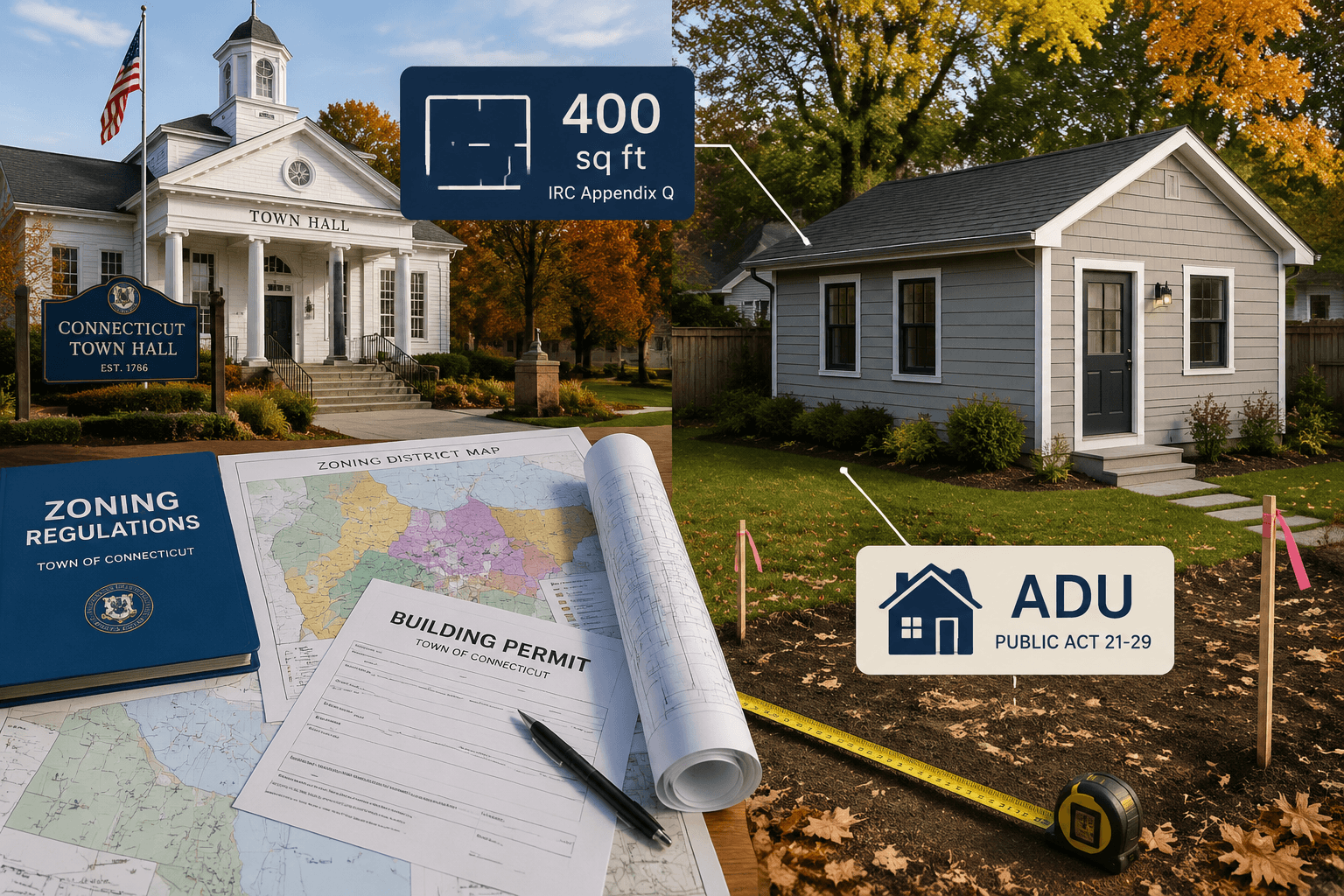
Connecticut follows the International Residential Code (IRC) with Appendix Q, which is the section specifically written for tiny homes. This is good news for builders and buyers.
Here's what Appendix Q allows for homes 400 sq ft or smaller:
- Minimum ceiling height: 6 feet 8 inches in main living areas (lower than the standard 7 feet)
- Loft spaces: Allowed with a minimum 35-inch ceiling height
- Loft access: Ladders are permitted instead of full staircases
- Reduced hallway and door widths in some configurations
Even with these relaxed standards, a tiny home built as a permanent dwelling still needs:
- A building permit
- Inspections during construction
- A certificate of occupancy before anyone moves in [1]
Common mistake: Many buyers assume that because Connecticut adopted Appendix Q, they can build a tiny home anywhere. That's not how it works. Appendix Q governs how you build. Zoning governs where you build. Those are two separate conversations. [2]
How Does Zoning for Tiny Homes in Connecticut Actually Work?
Zoning is controlled at the town level in Connecticut, and it's the main obstacle for most tiny home buyers. The state doesn't have a single unified zoning code — each of Connecticut's 169 municipalities sets its own rules. [5]
This means:
- A detached tiny home that's perfectly legal in one town may be prohibited two towns over
- Many suburbs enforce minimum house sizes for primary dwellings (often 800–1,200 sq ft or more)
- Some towns only allow one dwelling per lot, which blocks a backyard tiny home entirely
- Others require a variance or special permit even when the state ADU law seems to allow it [6]
The practical reality: Before you buy land, hire a builder, or order a tiny home, call your town's zoning office. Ask specifically:
- Does your zoning allow detached ADUs?
- Is there a minimum size requirement for the primary dwelling or the ADU?
- Are there owner-occupancy requirements?
- What's the permit process and timeline?
This single phone call can save you months of wasted effort.
What Is the ADU Law, and Does It Help Tiny Home Buyers?
Yes — for many Connecticut buyers, the ADU law is the clearest path forward. Public Act 21-29, which took effect January 1, 2022, requires every municipality to allow at least one Accessory Dwelling Unit (ADU) per residential lot in residential zones. [3]
An ADU is a secondary living space on the same property as a primary home. A backyard tiny home qualifies as a detached ADU.
What the law provides:
| Provision | Detail |
|---|---|
| Maximum ADU size | Up to 1,000 sq ft |
| Extra parking required | No |
| Applicable zones | All residential zones |
| Unit type | Attached or detached |
The catch: Towns were allowed to opt out of specific provisions or adopt their own more restrictive rules. Many did. Some towns:
- Limited ADUs to attached only (no detached backyard cottages)
- Set smaller maximum sizes (some as low as 800 sq ft)
- Added owner-occupancy requirements (you must live on the property)
- Banned short-term rental use of ADUs [6]
Choose this path if: You already own a home in Connecticut and want to add a small backyard unit. It's the most legally straightforward option in towns that allow detached ADUs.
Look elsewhere if: Your town opted out of detached ADUs or your lot doesn't have a primary dwelling on it yet.
For a broader look at how ADU and tiny home laws compare across the country, the Tiny Homes by State directory is a useful starting point.
What About Tiny Homes on Wheels in Connecticut?
A tiny home on wheels (THOW) is a small home built on a trailer chassis. In Connecticut — and in most states — a THOW is legally classified as a recreational vehicle (RV), not a permanent dwelling. [4]
That distinction matters a lot:
- You generally cannot park a THOW in a residential zone and live in it full-time
- RV parks and campgrounds may allow it, but many are seasonal (open April through October)
- Some agricultural or rural properties have more flexibility, but you still need to check local zoning
- Getting a THOW connected to utilities (water, sewer, electric) as a permanent hookup is often complicated or prohibited
RVIA certification (from the Recreational Vehicle Industry Association) helps establish your THOW as a legitimate RV for insurance and registration purposes, but it doesn't automatically make it legal to live in year-round.
If you want a mobile tiny home in Connecticut, plan for seasonal use or be prepared to do serious zoning research before committing to a location.
Can You Live in a Tiny Home Year-Round in Connecticut?
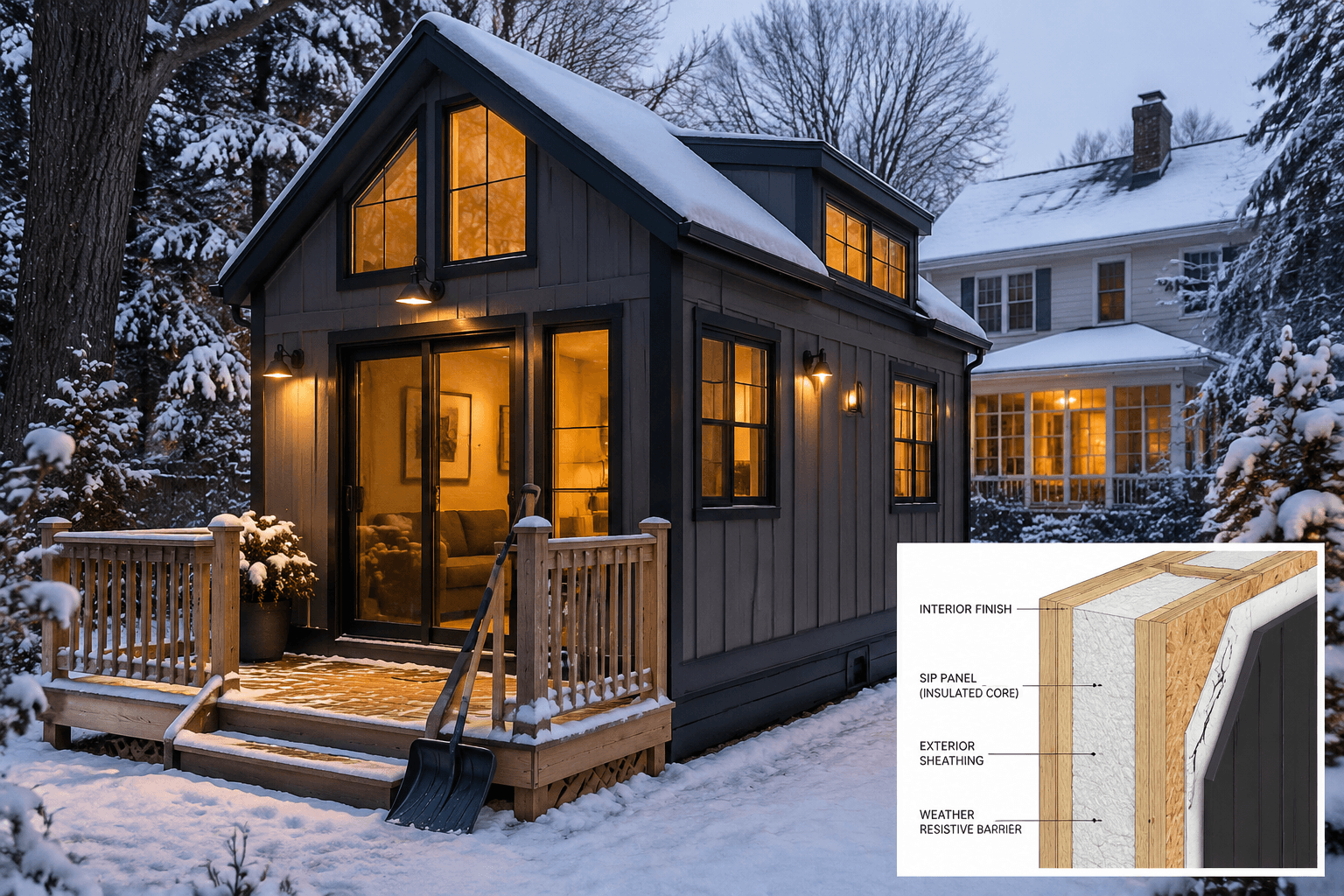
Yes — but your home needs to be built for it. Connecticut winters are serious. Temperatures regularly drop below 20°F, and the state averages 30–50 inches of snow per year depending on location.
What year-round tiny living in Connecticut requires:
- Insulation: Walls rated at R-20 or higher; roofs at R-38 or higher. SIPs (Structural Insulated Panels) are a popular choice because they provide both structure and insulation in one assembly.
- Heating system: A mini-split heat pump works well for mild shoulder seasons, but most Connecticut tiny homeowners add a backup propane or wood-burning stove for deep winter
- Plumbing protection: Pipes must be insulated or run through conditioned space to prevent freezing
- Foundation or skirting: If your tiny home sits on a permanent foundation, you're in better shape. If it's on a trailer, insulated skirting around the base is essential to protect the underside from cold air
Seasonal-only placement (May through October) is sometimes easier to permit — some campgrounds and RV parks allow it without the same hurdles as year-round zoning. But if you want a true primary residence, plan for all four seasons from day one.
Builders who specialize in cold-climate construction are worth seeking out. Tiny Homes of Maine and Sprout Tiny Homes both have experience building for harsh northeastern winters and are worth a look if you're sourcing from the region.
What Does a Tiny Home or ADU Cost in Connecticut?
Costs vary widely depending on whether you're buying a prefab unit, building custom, or converting an existing structure.
Rough cost ranges for 2026:
| Option | Estimated Cost Range |
|---|---|
| Prefab/modular backyard ADU (delivered + set) | $80,000 – $180,000 |
| Custom-built detached tiny home (on foundation) | $120,000 – $250,000+ |
| THOW (tiny home on wheels, new) | $50,000 – $120,000 |
| Permit and site prep costs (CT average estimate) | $10,000 – $30,000 |
These are estimates based on current market conditions and builder pricing. Always get multiple quotes.
Connecticut's construction costs are higher than the national average, and the permitting process adds time and expense. Budget for:
- Soil and site assessments
- Utility connection fees (water, sewer, electric)
- Permit fees (varies by town, but often $1,500–$5,000 for a new structure)
- Architect or designer fees if custom plans are required
Financing a tiny home in Connecticut is possible through personal loans, construction loans, or — if it's built on a permanent foundation — a traditional mortgage. A THOW is typically financed as an RV loan.
How Do You Find a Builder for a Tiny Home in Connecticut?
Connecticut doesn't have a large concentration of local tiny home builders, but the Northeast region has several reputable options. When evaluating any builder, ask:
- Do they have experience building to Connecticut code (IRC Appendix Q)?
- Can they provide references from completed projects in New England?
- Are their homes RVIA-certified (for THOWs) or built to IRC standards (for permanent dwellings)?
- What's included in the price — site prep, delivery, utility connections?
Builders worth researching for the Connecticut market include those with Northeast experience. Tiny Houses of the Hudson Valley operates nearby and understands the regional climate and zoning context. For a broader search, the Tiny Home Builders directory lists vetted builders across the country — you can filter by region to find options that ship to or build in Connecticut.
If you're open to a container-based design, Container Homes of Maryland is another Northeast-accessible option worth considering.
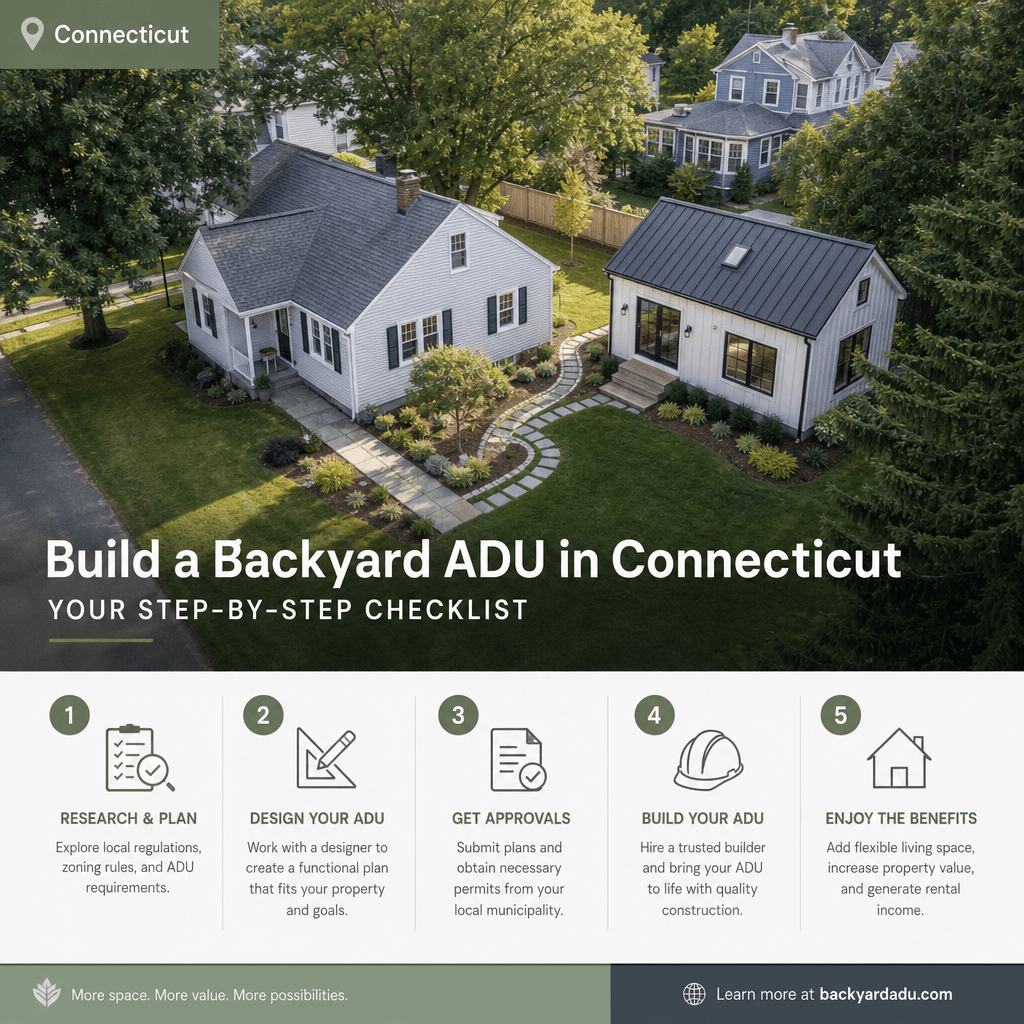
Step-by-Step: How to Place a Tiny Home in Connecticut
Here's a practical checklist to move from idea to occupancy:
- Identify your placement goal. Primary residence? Backyard ADU? Seasonal rental? Each path has different legal requirements.
- Check your town's zoning rules. Call the zoning office or visit the town website. Ask specifically about detached ADUs and minimum dwelling sizes.
- Confirm your lot meets requirements. Minimum lot sizes, setbacks, and utility access all affect feasibility.
- Choose your structure type. Foundation-based tiny home (treated as a dwelling) vs. THOW (treated as an RV) — each has different permit paths.
- Hire a local attorney or zoning consultant if your situation is complex. Jorgensen Law, for example, has published guidance specifically on Connecticut tiny home considerations. [2]
- Get your building permit. Submit plans that comply with IRC Appendix Q. Expect inspections at foundation, framing, and final stages.
- Complete utility connections. Water, sewer (or septic), and electrical must be inspected and approved.
- Receive your certificate of occupancy. This is required before legal occupancy as a dwelling.
FAQ: Tiny Homes in Connecticut
Q: What's the minimum size for a tiny home in Connecticut? Connecticut's IRC Appendix Q defines a tiny house as 400 sq ft or less, but there's no state-mandated minimum size. Your town's zoning code may impose a minimum, often 400–800 sq ft for primary dwellings. [1]
Q: Can I put a tiny home on my property as a second unit? Yes, in many towns. Public Act 21-29 created a baseline right to one ADU per residential lot, but your town may have restricted this through opt-outs or local ordinances. Check with your municipality first. [3]
Q: Is a tiny home on wheels legal in Connecticut? A THOW is classified as an RV, not a dwelling. Full-time residential use in most zones is not permitted. Seasonal use at an RV park or campground is more feasible. [4]
Q: Do I need a building permit for a tiny home in Connecticut? Yes. Any structure used as a dwelling requires a building permit, inspections, and a certificate of occupancy, regardless of size. [1]
Q: Can I rent out a backyard tiny home in Connecticut? Possibly — but many towns with ADU rules prohibit short-term rentals (like Airbnb) and some require owner occupancy. Long-term rental may be allowed depending on your town's ADU ordinance. [6]
Q: How long does the permit process take in Connecticut? It varies by town and project complexity. Simple ADU permits in cooperative towns may take 4–8 weeks. More complex projects or towns with heavy review processes can take 3–6 months or longer.
Q: What's the best foundation type for a tiny home in Connecticut? A poured concrete foundation or concrete block perimeter foundation is most common for permanent tiny homes in Connecticut. It handles frost depth requirements (typically 42–48 inches) and qualifies the structure for traditional mortgage financing.
Q: Are there tiny home communities in Connecticut? As of 2026, established tiny home communities (like those in some western states) are rare in Connecticut due to zoning restrictions. Some RV parks offer year-round or extended-season sites that function similarly.
Q: Does Connecticut have any towns that are particularly tiny-home friendly? Some rural and smaller towns in Windham County and Tolland County have shown more flexibility, but this changes frequently. Always verify current rules directly with the town. [5]
Q: Can I finance a tiny home in Connecticut? Yes. Options include personal loans, RV loans (for THOWs), construction loans, and traditional mortgages (for foundation-based units). Financing terms depend heavily on how the structure is classified. [2]
For a complete overview of all states, visit our Tiny Homes by State directory to compare zoning, costs, and builder options across the country.
Conclusion: Your Next Steps for Tiny Living in Connecticut
Connecticut isn't the easiest state for tiny home placement, but it's absolutely doable with the right approach. The building code is on your side — IRC Appendix Q gives you real flexibility in how you design a small home. The ADU law gives you a legal pathway for backyard placement in most towns. The challenge is that zoning is still fragmented, and the rules in your specific town matter more than anything at the state level.
Here's where to start:
- Call your town's zoning office before spending money on plans or builders. This is the single most important step.
- Decide on your structure type — foundation-based tiny home vs. THOW — because the legal paths are very different.
- Get a builder who knows the Northeast. Cold-climate construction isn't optional in Connecticut.
- Browse vetted builders in our Tiny Home Builders directory to find options with regional experience.
- Explore state-by-state comparisons at Tiny Homes by State if you're open to relocating for a more permissive regulatory environment.
Small footprint. Full life. Connecticut can get you there — you just need to know the terrain first.
Looking for a builder in Connecticut? Check out Contemporary Tiny Homes (Norwalk), Tiny Nooks (Fairfield), or Southern New England Modular Living for modular and ADU options in the state.
References
[1] Tiny Home Regulations In Connecticut - https://www.zookcabins.com/regulations/tiny-home-regulations-in-connecticut
[2] Considerations For Buying Or Building A Tiny Home In Connecticut - https://www.jorgensenlaw.com/blog/2024/12/considerations-for-buying-or-building-a-tiny-home-in-connecticut/
[3] Connecticut FAQ On Tiny Homes And ADUs - https://ctiny.homes/knowledge-center/c/renting-income/b/connecticut-faq-on-tiny-homes-and-adus
[4] Tiny House (Reddit r/Connecticut) - https://www.reddit.com/r/Connecticut/comments/1rc2wnf/tiny_house/
[5] Can I Build A Tiny Home In My Town - https://ctiny.homes/knowledge-center/c/zoning/b/can-i-build-a-tiny-home-in-my-town
[6] Where You Can And Can't Build An ADU In Connecticut - https://www.peragalloconstructionct.com/post/where-you-can-and-can-t-build-an-adu-in-connecticut