
Last updated: June 24, 2026
Quick Answer: Off-grid tiny home living is legal in Nevada, but the rules vary significantly by county. State law requires larger counties and cities to zone for tiny homes, yet rural counties operate under their own ordinances. Before you buy land or order a build, you need to know exactly what your specific county allows — because what works in Washoe County may not fly in a rural township.
Key Takeaways
- Nevada off-grid tiny home laws are primarily governed at the county level, not the state level
- Nevada Revised Statutes § 278.253 requires counties with 100,000+ residents and cities with 150,000+ residents to create zoning districts that accommodate tiny homes
- Off-grid living is fully legal in Nevada, with no major statewide restrictions added since 2023
- Tiny homes on wheels (THOWs) and foundation-built tiny homes face different permitting paths
- Solar access, water rights, and composting toilet acceptance all vary by county
- Building permits and code compliance are required even for off-grid structures
- Clark County (Las Vegas metro) and Washoe County (Reno) have more formal tiny home frameworks than rural counties
- Rural Nevada counties can be more flexible — but "flexible" doesn't mean permit-free
Table of Contents
- What Nevada State Law Actually Says About Tiny Homes
- How Nevada Off-Grid Tiny Home Laws Differ by County
- Permits and Building Codes: What You Still Need Off-Grid
- Water Rights and Off-Grid Water Systems in Nevada
- Solar Access and Off-Grid Power in Nevada
- Composting Toilets and Waste Systems
- Tiny Homes on Wheels vs. Foundation Homes: Which Path Is Easier?
- Finding Land and Builders for Nevada Off-Grid Tiny Homes
- FAQ
What Nevada State Law Actually Says About Tiny Homes
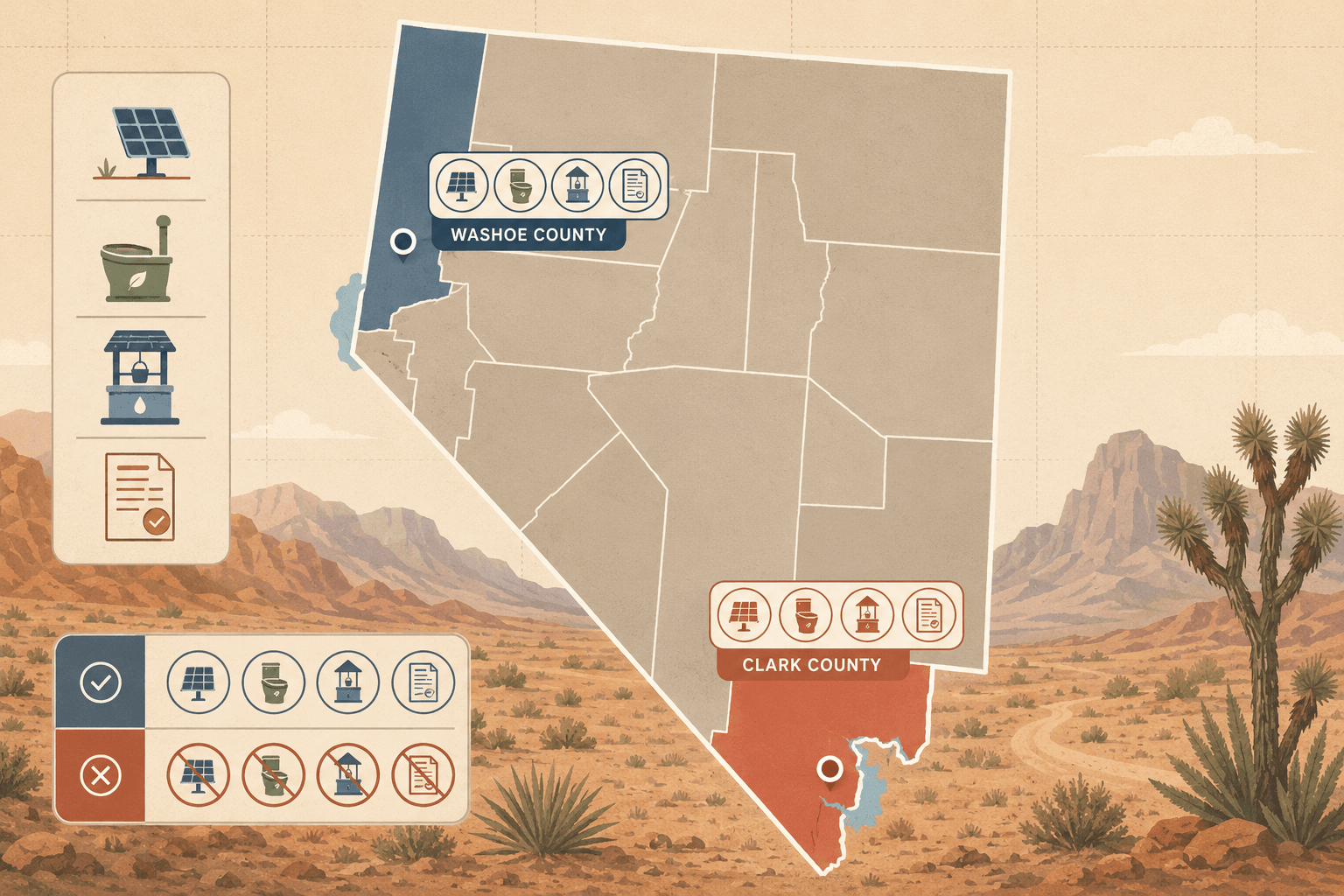
Nevada has a clear statewide framework for tiny home zoning — but it only applies to the state's most populated jurisdictions. Under Nevada Revised Statutes § 278.253, counties with populations of 100,000 or more and cities with populations of 150,000 or more must adopt ordinances that designate zoning districts for tiny houses. Those districts must allow tiny homes as accessory dwelling units (ADUs), single-family residential units, and within tiny house parks.
For everyone else — meaning most of rural Nevada — local county ordinances fill the gap. That's actually good news for off-grid seekers, because rural counties tend to have lighter regulatory footprints.
What this means practically:
- If you're near Las Vegas or Reno, formal tiny home zoning exists and you can work within it
- If you're in a rural county like Nye, Elko, or Lander, you'll need to research local ordinances directly
- "Legal" at the state level doesn't automatically mean "permitted" at the parcel level
Off-grid living is legal in Nevada with no significant statewide restrictions. The challenge isn't the state — it's knowing your county's specific rules before you commit to a piece of land.
How Nevada Off-Grid Tiny Home Laws Differ by County
County-level rules are where Nevada off-grid tiny home laws get specific — and where most people run into surprises. There is no single answer that covers the whole state.
Clark County (Las Vegas Metro) Clark County follows the state mandate and has formal ADU and tiny home ordinances. Off-grid setups are possible but face stricter scrutiny on utility connections, especially in suburban zones. Rural portions of Clark County offer more flexibility.
Washoe County (Reno/Sparks Area) Washoe County has also developed a more structured framework for tiny homes, including provisions for THOWs in certain zones. Off-grid systems are reviewed on a case-by-case basis by the building department.
Rural Counties (Nye, Elko, Lander, Humboldt, Mineral, Esmeralda) These counties are where off-grid tiny home living has the most room to breathe. Minimum lot sizes, setback requirements, and utility connection mandates are often more lenient. Some rural counties have very limited building department oversight for structures under a certain square footage. That said, "limited oversight" is not the same as "no oversight" — you still need to verify.
Common mistake: Assuming that buying rural Nevada land automatically means you can place any structure on it. Agricultural and open-range zoning designations each carry their own rules about residential use.
For a broader look at how state-level tiny home rules compare across the region, the Tiny Homes in Arizona: 2026 Guide to Desert Living, Solar & Zoning is a useful reference point for neighboring desert state approaches.
Permits and Building Codes: What You Still Need Off-Grid
Even a fully off-grid tiny home in Nevada requires permits and code compliance. This is one of the most common misconceptions in the off-grid community.
Off-grid homes must comply with standard building codes and obtain necessary permits — including approvals for private power systems, water sources, and waste disposal. The fact that you're not connecting to municipal utilities doesn't exempt you from the permitting process. In many counties, it actually adds steps, because your off-grid systems need individual review and approval.
Typical permits required for an off-grid tiny home in Nevada:
- Building permit (structure itself)
- Electrical permit (solar and battery systems)
- Plumbing permit (well, rainwater, or hauled water systems)
- Septic or alternative waste system permit
- Grading or land disturbance permit (if applicable)
Decision rule: If your county has a building department, assume you need permits. If it doesn't have one, you may fall under state jurisdiction — contact the Nevada State Contractors Board to confirm.
Water Rights and Off-Grid Water Systems in Nevada
Water is the most complex piece of off-grid living in Nevada, and it deserves serious attention before you choose a parcel.
Nevada operates under the prior appropriation doctrine — meaning water rights are separate from land ownership and are allocated based on seniority. Buying land does not automatically give you the right to use water on or under that land.
Key points on Nevada water:
- Groundwater wells require a permit from the Nevada Division of Water Resources
- Domestic wells (for personal household use) are generally allowed but must be permitted
- Water rights for irrigation or larger use require a formal appropriation application
- Rainwater harvesting is legal in Nevada — the state passed legislation permitting residential collection, though volume limits apply
- Hauling water to a storage tank is a common and fully legal option for remote parcels
Edge case: Some rural parcels are sold with existing water rights attached. Always verify whether those rights are active, the priority date, and the permitted use before closing on land.
Solar Access and Off-Grid Power in Nevada
Nevada is one of the best states in the country for solar energy — and the legal framework supports off-grid solar setups well.
Nevada law protects solar access rights, meaning neighbors generally cannot construct improvements that unreasonably block sunlight to your solar panels. For off-grid tiny homes, this matters most in rural subdivisions where future development is possible.
What you need to know about off-grid solar in Nevada:
- Off-grid solar and battery systems are legal statewide
- Systems must meet NEC (National Electrical Code) standards and be permitted through your county
- Nevada's net metering laws apply to grid-tied systems, not off-grid — but the state's solar incentives can still reduce upfront costs if you're considering a hybrid setup
- The Nevada average of 300+ sunny days per year makes solar a reliable primary power source for tiny homes
For builders who specialize in solar-ready off-grid builds, browsing the Tiny Home Builders directory is a good starting point for finding experienced contractors.
Composting Toilets and Waste Systems
Composting toilets are legal in Nevada, but acceptance varies by county and depends on how your overall waste system is configured.
Most Nevada counties require some form of permitted waste disposal system, even if you use a composting toilet. In practice, this often means you still need a greywater system (for sink and shower drainage) and may need a small leach field or approved greywater disposal method alongside the composting toilet.
What to expect:
- Composting toilets must typically be NSF-certified (National Sanitation Foundation) to qualify for permit approval
- Greywater systems need separate permits in most counties
- Some rural counties have minimal requirements for low-use residential systems — confirm with your local health district
- Clark and Washoe counties apply stricter standards than most rural counties
Tiny Homes on Wheels vs. Foundation Homes: Which Path Is Easier?
For Nevada off-grid tiny home laws, the THOW vs. foundation distinction matters a lot. These two paths go through different regulatory channels.
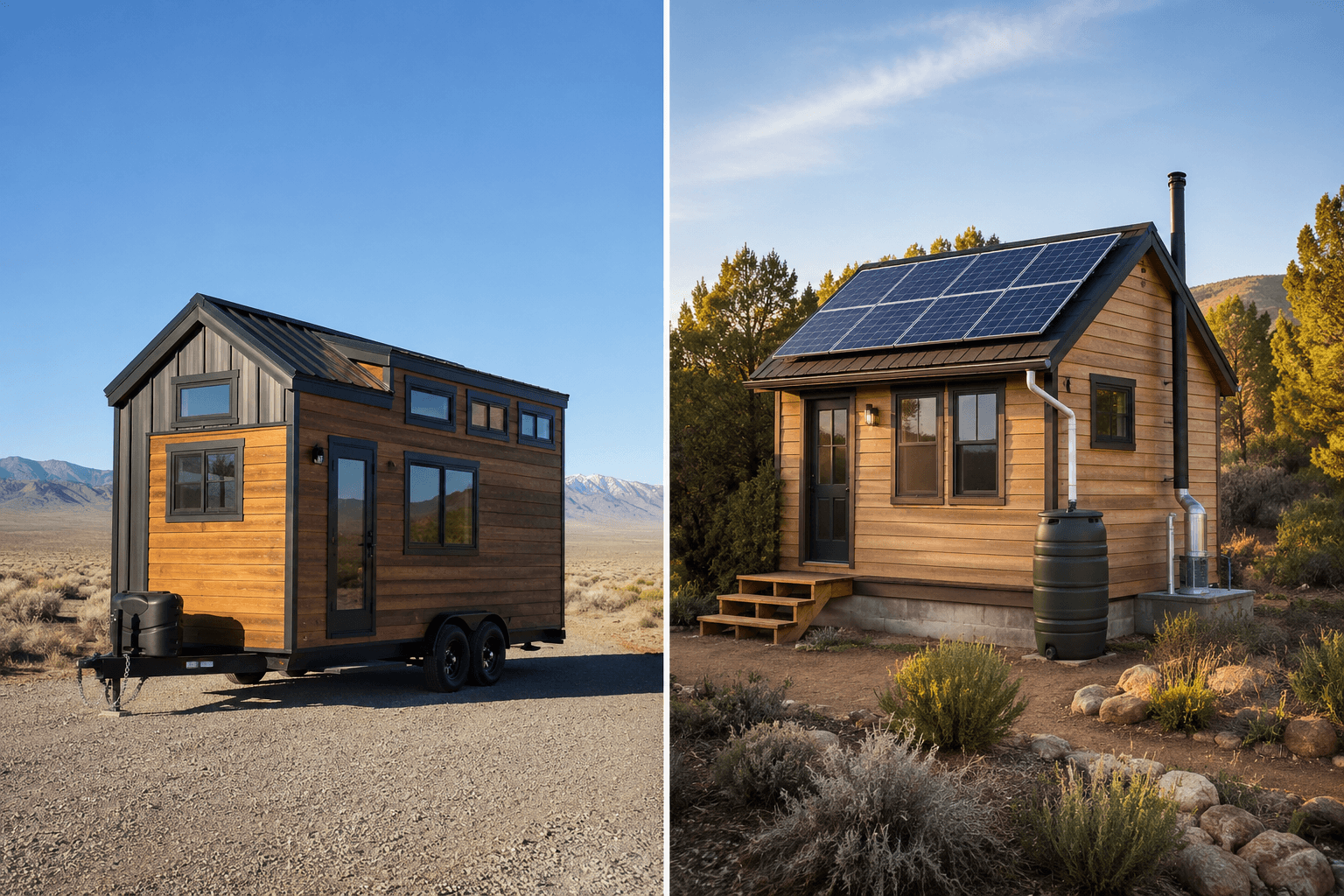
Tiny Homes on Wheels (THOWs) A THOW is classified as a vehicle or recreational vehicle in most Nevada jurisdictions. This means:
- It may be registered with the DMV rather than permitted as a structure
- RVIA certification (Recreational Vehicle Industry Association) can help with placement in RV parks and some rural zones
- Permanent placement as a primary residence is restricted in many zones — check your county's definition of "permanent dwelling"
- Some counties require THOWs to connect to approved water and sewage facilities; off-grid systems may be approved if they meet local standards
Foundation-Built Tiny Homes A foundation-built tiny home follows the same permitting path as a conventional home, just smaller. This path is generally clearer for off-grid setups because the permitting process for wells, septic, and solar is well-established.
| Feature | THOW | Foundation Tiny Home |
|---|---|---|
| Permitting path | Vehicle/RV registration | Building permit |
| Off-grid systems | Case-by-case | Standard permit process |
| Permanent residence | Restricted in many zones | Allowed in residential zones |
| Mobility | Yes | No |
| Financing options | RV loans, personal loans | Mortgage, construction loans |
If you're leaning toward a THOW, builders like Southwest Tiny Homes and New Frontier Tiny Homes build units designed for off-grid capability. For a foundation approach, Sprout Tiny Homes is worth exploring for their sustainable build options.
Finding Land and Builders for Nevada Off-Grid Tiny Homes
Choosing the right land and the right builder are the two decisions that will shape everything else about your off-grid tiny home project in Nevada.
For land:
- Look for parcels in counties with light regulatory oversight if full off-grid autonomy is your goal
- Verify water rights, road access, and zoning classification before making an offer
- Ask specifically whether the parcel has been used for residential purposes before — existing permits or infrastructure can save significant time
For builders:
- Choose a builder with experience in off-grid systems, not just tiny home construction
- Ask whether they've built in Nevada before and whether they handle permit coordination
- Confirm they're familiar with Nevada's water and waste permitting requirements
You can browse vetted builders through the Tiny Home Builders directory on Tiny Home Sherpa. For state-by-state comparisons and additional context on how Nevada fits into the broader tiny home landscape, the Tiny Homes by State: Complete 2026 Directory is a solid resource to keep bookmarked.
FAQ
Is off-grid living legal in Nevada? Yes. Off-grid living is fully legal in Nevada with no significant statewide restrictions. You'll need to comply with county-level building, water, and waste permitting requirements, but there is no law prohibiting off-grid residential use.
Do I need a permit for a tiny home in rural Nevada? In most cases, yes. Even in rural counties with minimal oversight, structures intended for residential use typically require some form of permit. Contact your county's building department or, if none exists, the Nevada State Contractors Board.
Can I use a composting toilet in my Nevada tiny home? Generally yes, but you'll likely still need a permitted greywater disposal system. Composting toilets should be NSF-certified. Requirements vary by county, so check with your local health district before purchasing a system.
What are the water rights rules for off-grid tiny homes in Nevada? Water rights in Nevada are separate from land ownership. You'll need a domestic well permit from the Nevada Division of Water Resources for groundwater use. Rainwater harvesting is legal with volume limits. Hauling water is also a common and legal option.
Can I park a tiny home on wheels permanently on rural Nevada land? It depends on the county and the zoning classification of the parcel. Some rural counties allow permanent THOW placement with minimal restrictions; others require connection to approved utilities or limit THOWs to temporary use. Verify with your county before purchasing land for this purpose.
How does Nevada's state tiny home law affect my plans? Nevada Revised Statutes § 278.253 requires larger counties and cities to zone for tiny homes as ADUs, single-family units, and in tiny home parks. If you're in Clark or Washoe County, this gives you a formal framework to work within. In rural counties, local ordinances govern — and they vary widely.
What's the easiest Nevada county for off-grid tiny home living? Rural counties like Nye, Esmeralda, and Mineral generally have lighter regulatory requirements and more available land at lower prices. That said, "easier" still means doing your due diligence on zoning, water access, and road access before buying.
Conclusion
Nevada is genuinely one of the more accessible states for off-grid tiny home living. The legal foundation is solid, the land is available, and the sun is reliable. But the details — county zoning, water rights, waste system permits — require real research before you commit.
Your next steps:
- Identify the county you're targeting and contact their building and planning department directly
- Verify water access and rights for any parcel you're seriously considering
- Decide early whether you want a THOW or a foundation build — the permitting paths diverge significantly
- Find a builder with Nevada off-grid experience through the Tiny Home Builders directory
- Review how neighboring states handle similar regulations — the Tiny Homes in Arizona guide offers useful comparison context
Start where you are. The path to a small footprint, full life in Nevada is clearer than it might seem — you just need the right map.