
Last updated: June 24, 2026
Quick Answer: Michigan tiny home financing options depend heavily on one thing: whether your tiny home sits on a permanent foundation or on wheels. Foundation-based tiny homes can qualify for conventional mortgages, FHA loans, and MSHDA down payment assistance. Tiny homes on wheels (THOWs) typically require RV loans, personal loans, or chattel financing. Knowing which category your home falls into is the first step toward finding the right loan.
Key Takeaways
- Michigan tiny home financing options split into two main tracks: foundation homes (mortgage-eligible) and THOWs (RV/personal/chattel loans)
- MSHDA's MI Home Loan program offers up to $10,000 in down payment assistance for qualifying buyers
- FHA loans require a minimum 400 square feet and a permanent foundation — most tiny homes do not qualify
- RV loans are the most common path for THOW buyers; credit unions like Lake Trust and MSUFCU are worth contacting for competitive rates
- Chattel loans treat a tiny home as personal property and often bridge the gap between personal loans and traditional mortgages
- Some Michigan builders, including Great Lakes Tiny Home, offer in-house rent-to-own and layaway plans
- Zoning compliance directly affects your financing — lenders will ask about it
- VA and USDA loans are available for eligible buyers with foundation-based tiny homes in qualifying areas
Table of Contents
- Why Financing a Tiny Home in Michigan Is Different
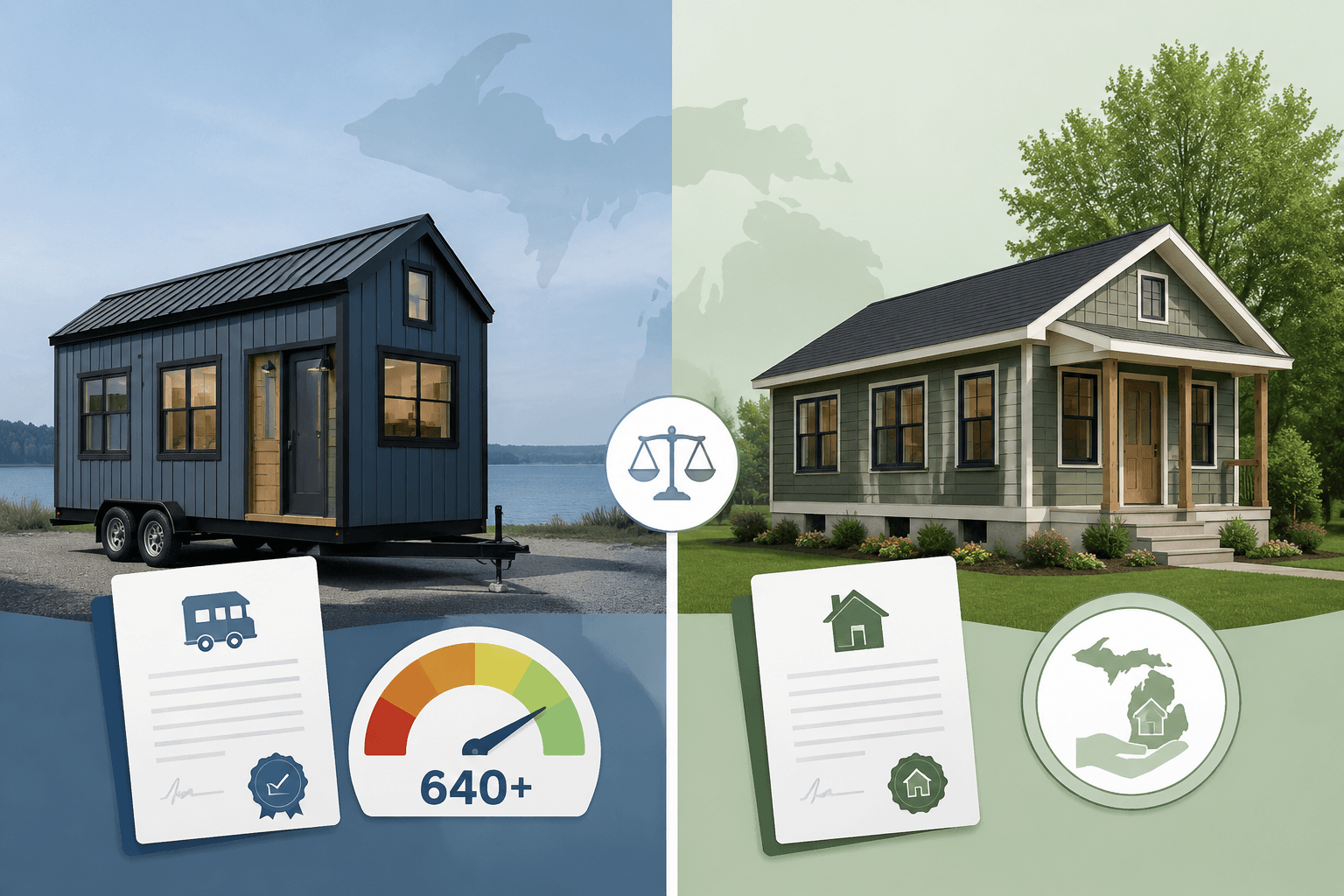
- Foundation vs. On Wheels: The Decision That Shapes Everything
- Mortgage-Based Michigan Tiny Home Financing Options
- RV Loans and Chattel Loans for THOWs
- Personal Loans: When They Make Sense (and When They Don't)
- Michigan Credit Unions and Local Lenders Worth Knowing
- Builder Financing and Rent-to-Own Programs
- How Zoning Affects Your Loan Approval
- FAQ
Why Financing a Tiny Home in Michigan Is Different
Most lenders built their products around conventional homes. Tiny homes — especially those under 400 square feet or built on trailers — don't fit neatly into those boxes. That creates real friction when you're trying to borrow money.
The good news: Michigan has a stronger support structure than many states. The Michigan State Housing Development Authority (MSHDA) offers meaningful down payment assistance, several Michigan credit unions have experience with non-traditional housing loans, and at least one Michigan-based builder offers in-house financing. The path exists. It just takes some mapping.
Start where you are — with your home type, your credit profile, and your land situation — and work outward from there.
Foundation vs. On Wheels: The Decision That Shapes Everything
Before comparing any loan products, you need to know which category your tiny home falls into. This single factor determines which lenders will talk to you.
Tiny home on a permanent foundation:
- Treated as real property
- Eligible for conventional mortgages, FHA, VA, and USDA loans
- Must meet local building codes and minimum square footage requirements
- Lenders will require a standard appraisal
Tiny home on wheels (THOW):
- Treated as personal property or a vehicle
- Not eligible for traditional mortgages
- Financed through RV loans, chattel loans, or personal loans
- RVIA certification (from the Recreational Vehicle Industry Association) can help with lender approval
Choose a foundation if you want the widest financing options and plan to stay put. Choose a THOW if mobility matters more than loan variety — just go in knowing your lender pool is smaller.
Mortgage-Based Michigan Tiny Home Financing Options
For tiny homes on permanent foundations that meet size requirements, traditional mortgage products are on the table. Here's how the main options break down:
| Loan Type | Min. Down Payment | Min. Credit Score | Key Requirement |
|---|---|---|---|
| FHA | 3.5% | 580 | 400 sq ft min, permanent foundation |
| Conventional | 5–20% | 620 | Standard appraisal, local code compliance |
| VA | 0% | Varies | Veteran/active military eligibility |
| USDA | 0% | Varies | Rural location, income limits apply |
| Construction Loan | 10–20% | 620+ | For builds not yet complete |
MSHDA MI Home Loan: Michigan buyers who qualify can access up to $10,000 in down payment assistance through MSHDA's MI Home Loan program. This money can cover down payments, closing costs, and prepaid expenses. Loan commitments are valid for 90 days on existing homes and 180 days for new construction. This is one of the most practical tools available for Michigan tiny home buyers going the foundation route.
Common mistake: Assuming your tiny home qualifies for FHA just because it's on a foundation. FHA also requires a minimum of 400 square feet. Many tiny homes fall below that threshold and get declined at underwriting. Confirm your square footage before applying.
RV Loans and Chattel Loans for THOWs
For tiny homes on wheels, RV loans are the most widely available financing option. If your THOW carries RVIA certification, you'll have a much easier time qualifying.
RV Loans:
- Typical down payment: 10–20%
- Minimum credit score: around 640
- Terms: often 10–20 years
- Rates vary but are generally lower than personal loans
Chattel Loans: A chattel loan treats the tiny home as movable personal property rather than real estate. Rates typically land between personal loan rates and conventional mortgage rates. Some lenders offer chattel loans up to $450,000 with down payments as low as 5%, and certain products can bundle in land purchase and utility hookup costs — which is worth asking about if you're buying land and a home together.
Chattel loans are a solid middle-ground option for buyers who don't qualify for a traditional mortgage but want better terms than an unsecured personal loan.
Choose an RV loan if: Your THOW is RVIA-certified and you want competitive rates with a structured repayment term. Choose a chattel loan if: Your home isn't RVIA-certified but is on wheels, or if you want to bundle land costs.
Personal Loans: When They Make Sense (and When They Don't)
Personal loans require no down payment and no collateral, which makes them accessible. But they carry higher interest rates than any mortgage product, and loan amounts are often capped in ways that won't cover a full tiny home purchase.
When a personal loan works:
- You're buying a very small, lower-cost unit
- You have strong credit and can secure a competitive rate
- You need bridge financing while another loan processes
- You're covering a gap — say, a builder deposit — not the full purchase
When to look elsewhere:
- You're financing $80,000 or more
- You plan to hold the loan for many years (interest costs compound quickly)
- A chattel or RV loan is available to you
A personal loan can be a useful tool, but it's rarely the best primary financing option for a full tiny home purchase.

Michigan Credit Unions and Local Lenders Worth Knowing
National lenders often have rigid product categories that leave tiny homes out in the cold. Michigan credit unions tend to be more flexible — and more willing to have a real conversation.
Lake Trust Credit Union and Michigan State University Federal Credit Union (MSUFCU) are two institutions worth contacting directly. Credit unions are member-owned, which often means more flexibility on underwriting and a genuine willingness to work through non-standard situations. Call, explain your project clearly, and ask specifically about personal loans, chattel products, or RV loan options.
Riverbank Finance LLC specializes in manufactured home loans in Michigan, offering FHA loans with 3.5% down, conventional options starting at 5% down, and VA loans for eligible veterans. If your tiny home is built to HUD manufactured housing standards, this is a lender worth adding to your list.
For veterans, VA loans remain one of the most powerful tools available — zero down payment for qualifying buyers on foundation-based homes. USDA loans offer similar zero-down terms for rural Michigan locations, which covers a significant portion of the state.
You can also browse Michigan tiny home listings on Tiny Home Sherpa to find builders who may have established lender relationships and can point you toward financing partners they've worked with before.
Builder Financing and Rent-to-Own Programs
Some Michigan builders offer financing directly, which can be a practical route when traditional lenders won't engage.
Great Lakes Tiny Home offers both rent-to-own programs and layaway plans. The layaway option lets you lock in current pricing and make flexible payments over time, with terms available up to 10 years. For buyers who aren't ready to qualify for a loan but want to start building equity now, this is a legitimate path forward.
If you're exploring builders, the Great Lakes Tiny Home listing on Tiny Home Sherpa is a good starting point. You can also browse the broader tiny home builders directory to find builders who serve Michigan and may offer similar programs.
Builder financing typically comes with fewer credit requirements than bank loans, but read the terms carefully. Understand what happens if you miss a payment and whether you hold any ownership interest during the payment period.
How Zoning Affects Your Loan Approval
Financing and zoning are more connected than most buyers realize. A lender won't fund a home that can't legally be placed where you intend to put it.
Michigan zoning rules vary significantly by municipality. Some counties welcome tiny homes on foundations as primary residences. Others restrict them to RV parks or prohibit them outright in residential zones. Before you apply for any loan, confirm that your intended placement location actually permits your home type.
Key questions to answer before applying:
- Is the land zoned for residential use?
- Does the municipality have a minimum square footage requirement for dwellings?
- Is the tiny home classified as a manufactured home, RV, or site-built structure?
- Are utilities (water, sewer, electric) accessible and permitted?
Getting these answers upfront saves you from a loan denial late in the process. For a broader look at how zoning plays out across states, the Tiny Homes by State directory is a useful reference point.
FAQ
Can I use an FHA loan for a Michigan tiny home? Only if the home is on a permanent foundation and is at least 400 square feet. Most tiny homes don't meet both requirements, so FHA financing is the exception rather than the rule.
What credit score do I need for a tiny home loan in Michigan? It depends on the loan type. RV loans typically require 640 or higher. Conventional mortgages generally need 620+. Personal loans can go lower, but rates climb sharply with lower scores. Chattel loans often sit around 620.
Does MSHDA help with tiny home purchases? MSHDA's MI Home Loan program can apply to tiny homes that qualify as real property on permanent foundations and meet standard FHA, RD, or conventional loan requirements. THOWs won't qualify.
Are there Michigan lenders who specialize in tiny home loans? No lenders market exclusively to tiny home buyers in Michigan, but Riverbank Finance LLC handles manufactured home loans, and credit unions like Lake Trust and MSUFCU are worth approaching for flexible personal or chattel products.
What's the difference between a chattel loan and an RV loan? An RV loan is designed for vehicles and often requires RVIA certification. A chattel loan treats the home as movable personal property and may offer more flexibility on home type, sometimes bundling land and utility costs.
Can I finance land and a tiny home together in Michigan? Some chattel loan products allow combined land-and-home financing. Construction loans can also cover land purchase plus build costs. This is worth asking about specifically when you contact lenders, as not all products allow it.
What if I want to build my own tiny home? Owner-built tiny homes are harder to finance because they lack a manufacturer's certification. A personal loan or home equity product (if you own another property) are the most realistic options. Some credit unions will consider these on a case-by-case basis.
Conclusion
Michigan tiny home financing options are genuinely workable — but they require you to know your home type, your credit profile, and your land situation before you start shopping for loans. Foundation homes open the door to mortgages, MSHDA assistance, and VA or USDA programs. THOWs point you toward RV loans, chattel financing, and builder programs.
Start by classifying your home. Then contact Michigan credit unions directly, ask builders about in-house options, and verify your zoning before any lender conversation. The financing exists. The key is matching the right product to your specific situation.
For vetted builders serving Michigan and resources to help you take the next step, explore the Michigan tiny home listings on Tiny Home Sherpa and browse our tiny home financing resources. Small footprint. Full life. And a clear path to get there.