
Last updated: June 24, 2026
Quick Answer: The best tiny house trailers for sale are purpose-built, heavy-duty steel trailers rated for the full weight of a finished tiny home — typically requiring a GVWR (Gross Vehicle Weight Rating) of at least 10,000 lbs for most builds. Leading manufacturers include Tiny House Basics, Iron Eagle, and PJ Trailers. The right choice depends on your trailer type (bumper-pull, gooseneck, or deck-over), your target build length, and whether you want a stock unit or a custom-engineered frame.
Key Takeaways
- Tiny house trailers are not standard utility trailers — they need to be engineered for the weight and wind loads of a full structure
- The three main types are bumper-pull, gooseneck, and deck-over, each with real tradeoffs for interior space and towing
- A finished tiny home averages 500 to 550 lbs per linear foot of trailer, so weight planning matters from day one
- GVWR options typically run 7,000 lbs, 10,000 lbs, or 12,000 lbs — most builds need at least 10,000 lbs
- Trailer lengths range from 10 to 56 feet depending on type; bumper-pull tops out around 48 feet
- Manufacturers like Tiny House Basics, Iron Eagle, and PJ Trailers each serve different budgets and customization needs
- Many builders include the trailer in their package price — worth asking before you buy separately
- RVIA certification (Recreational Vehicle Industry Association) affects financing, insurance, and parking options
Table of Contents
- Why Your Trailer Choice Matters More Than You Think
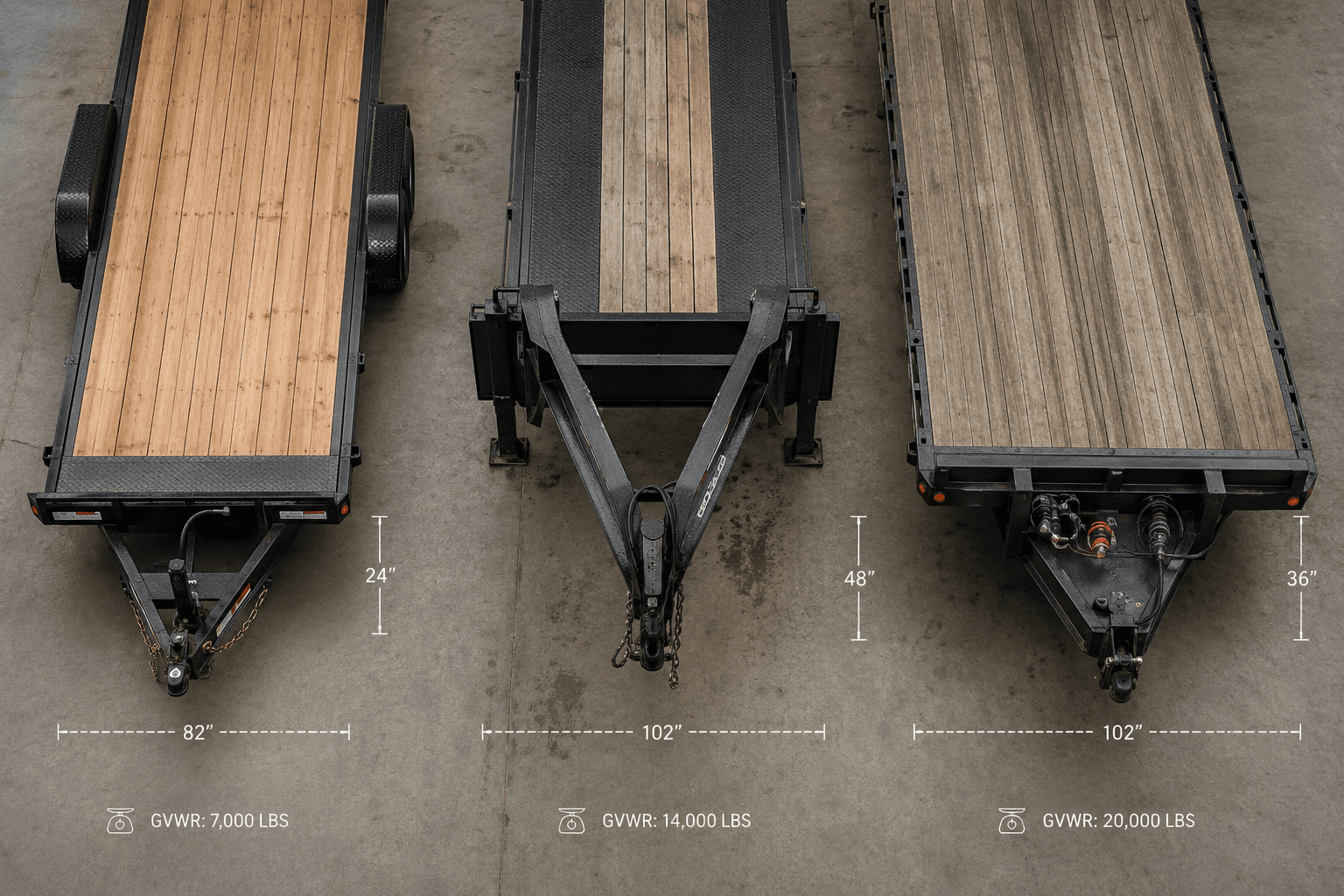
- The Three Main Trailer Types Explained
- Understanding GVWR and Weight Ratings
- Best Tiny House Trailers for Sale: Manufacturer Comparison
- Custom vs. Stock Trailers — Which Is Right for You?
- Builders Who Include the Trailer in Their Package
- What to Look for Before You Buy
- FAQ
Why Your Trailer Choice Matters More Than You Think
Your trailer is the foundation of everything. Get it wrong, and no amount of beautiful woodwork or clever storage will fix it. A trailer that's undersized for your build creates structural stress, towing hazards, and potential legal problems on the road.
Most people start researching tiny homes by looking at floor plans and finishes. The trailer tends to be an afterthought — and that's a mistake. Here's why it deserves your attention early:
- Weight capacity determines your build options. Heavier insulation, metal roofing, and full appliances all add up fast.
- Trailer dimensions set your legal road width. Most states cap towing width at 8.5 feet without a permit.
- The trailer type affects your interior layout — specifically where wheel wells sit and how much headroom you gain or lose.
- It's one of the harder things to change later. Unlike a countertop or a loft ladder, you can't easily swap your trailer after the build is done.
Start where you are: even if you're early in your research, understanding trailer basics now will save you real headaches later.
The Three Main Trailer Types Explained
There are three types of trailers commonly used for tiny homes on wheels (THOWs). Each one suits a different kind of builder and lifestyle.
Bumper-Pull Trailers The most common choice. These hitch to the back of a truck via a standard ball hitch. They're widely available, easier to find used, and simpler to tow for most drivers. Lengths run from 10 to 48 feet. The main limitation: at longer lengths, they can sway more than a gooseneck setup.
Gooseneck Trailers These connect over the truck bed via a gooseneck ball in the truck's bed. They offer more stability at length, and the "neck" section can be converted into usable living space — a popular option for adding a small loft or storage area. Lengths range from 18 to 56 feet. The tradeoff is that they require a truck with a gooseneck hitch installed, and the overall profile can look more like an RV.
Deck-Over Trailers The deck sits above the wheel wells rather than between them. This gives you a completely flat, uninterrupted floor — no wheel well bumps inside your home. The catch: the deck height is higher off the ground, which can reduce your effective interior ceiling height if you're working within road height limits (typically 13.5 feet).
| Trailer Type | Length Range | Best For | Main Tradeoff |
|---|---|---|---|
| Bumper-Pull | 10–48 ft | Most builds, first-time buyers | Sway at longer lengths |
| Gooseneck | 18–56 ft | Larger builds, added living space | Requires gooseneck-equipped truck |
| Deck-Over | 10–40 ft | Clean flat floor, no wheel wells | Higher deck = less headroom |
Understanding GVWR and Weight Ratings
GVWR stands for Gross Vehicle Weight Rating — the maximum weight the trailer is engineered to carry, including the structure, contents, and the trailer itself. This number is not a suggestion. Exceeding it creates safety and liability risks.
A finished tiny home typically weighs 500 to 550 lbs per linear foot of trailer. So a 24-foot build could weigh 12,000 to 13,200 lbs fully loaded. That math matters when you're selecting axle configurations.
Common axle setups and their GVWR:
- Two 3,500 lb axles = 7,000 lb GVWR (suitable for very small, lightweight builds only)
- Two 5,000 lb axles = 10,000 lb GVWR (the most common starting point for standard builds)
- Two 6,000 lb axles = 12,000 lb GVWR (recommended for builds over 24 feet or heavier materials)
A common mistake: buyers choose a trailer based on the empty shell weight, not the finished weight. Always calculate your expected finished weight — structure, insulation, roofing, windows, appliances, furniture, and personal belongings — before selecting your GVWR.
Best Tiny House Trailers for Sale: Manufacturer Comparison
Three names come up consistently when buyers are searching for the best tiny house trailers for sale: Tiny House Basics, Iron Eagle, and PJ Trailers. Here's how they compare.
Tiny House Basics One of the most recognized names specifically in the tiny home trailer space. They offer trailers purpose-designed for THOW builds, with features like recessed decks, integrated tie-down points, and pre-drilled sill plates. Pricing typically starts around $4,500 for a basic 20-foot bumper-pull and climbs to $8,000+ for longer or custom configurations. They also publish detailed weight and spec guides, which is genuinely useful for first-time buyers.
Iron Eagle Iron Eagle trailers are built by Kaufman Trailers and are a popular choice among custom builders. They're known for consistent steel quality and competitive pricing. Iron Eagle offers both stock and semi-custom configurations, making them a solid middle-ground option. Many professional tiny home builders spec Iron Eagle frames as their default.
PJ Trailers PJ is a large-scale trailer manufacturer with a wide dealer network across the US. They don't build tiny-home-specific trailers the way Tiny House Basics does, but their heavy-duty flatbed and equipment trailers are frequently adapted for THOW builds. The advantage: you can often find PJ trailers in stock at local dealers, which cuts lead time. The disadvantage: you may need to add tiny-home-specific features yourself or through a builder.
| Manufacturer | Tiny-Home Specific | Custom Options | Avg. Starting Price | Lead Time |
|---|---|---|---|---|
| Tiny House Basics | Yes | Yes | ~$4,500+ | 4–10 weeks |
| Iron Eagle (Kaufman) | Partial | Semi-custom | ~$4,000+ | 3–8 weeks |
| PJ Trailers | No | Limited | ~$3,500+ | Often in stock |
Prices above are estimates based on 2026 market conditions and will vary by configuration, length, and dealer.
Custom vs. Stock Trailers — Which Is Right for You?
Stock trailers are pre-built to standard dimensions and available faster, often at lower cost. Custom trailers are engineered to your specific build plan — length, deck height, axle placement, and add-ons like electric brakes or tongue storage boxes.
Choose a stock trailer if:
- Your build follows a standard floor plan (20, 24, or 28 feet)
- You're working with a builder who already has a preferred trailer spec
- You need the trailer quickly and your timeline is tight
Choose a custom trailer if:
- Your build has unusual weight distribution or a non-standard length
- You want a recessed deck for extra headroom
- You're building with heavy materials like concrete board, metal roofing, or a full masonry feature wall
The price difference between stock and custom can range from a few hundred to a few thousand dollars. For most buyers following a standard plan, a stock or semi-custom trailer is the practical choice.
Builders Who Include the Trailer in Their Package
Many reputable tiny home builders include the trailer as part of their build package. This can simplify your purchase significantly — the builder handles trailer sourcing, spec matching, and often warranty coordination.
If you're working with a builder, ask these questions upfront:
- What trailer manufacturer do you use, and why?
- What GVWR does the trailer carry, and how does that match my build weight?
- Is the trailer cost included in the quoted price, or is it a separate line item?
- Can I upgrade the trailer spec (axles, deck height) within the package?
Builders like Rocky Mountain Tiny Houses, Tumbleweed Tiny House Company, and Liberation Tiny Homes are known for transparent build packages that include trailer specs in their documentation. Slabtown Customs and Incredible Tiny Homes are also worth exploring if you want builders with strong reputations for structural integrity.
For a broader search by region, the Tiny Homes by State directory is a practical starting point to find vetted builders near you.
What to Look for Before You Buy
Whether you're buying directly from a manufacturer or through a builder package, these are the non-negotiables to verify before signing anything.
Structural specs to confirm:
- Steel grade and wall thickness (look for 3-inch main beams minimum for most builds)
- Axle brand and individual axle rating
- Electric brake compatibility (required in most states for trailers over 3,000 lbs)
- Coupler type and rating (must match your tow vehicle)
Documentation to request:
- Manufacturer's Certificate of Origin (MCO) — needed for title and registration
- GVWR rating plate (should be physically attached to the trailer)
- Warranty terms in writing
Red flags to watch for:
- No MCO or title documentation
- GVWR that seems low for the stated build size
- Welds that look inconsistent or unfinished
- A seller who can't explain the axle rating or steel spec
If you're buying a used trailer, have it inspected by a qualified welder or trailer mechanic before committing. Rust at the welds, bent frame members, or worn axle bearings are deal-breakers.
FAQ
What size trailer do I need for a tiny house? Most tiny homes are built on trailers between 20 and 28 feet long. A 24-foot bumper-pull is the most common starting point, offering enough space for a functional layout while staying manageable to tow.
How much does a tiny house trailer cost? Expect to pay between $4,000 and $10,000 for a purpose-built tiny house trailer, depending on length, axle configuration, and customization. Stock trailers from general manufacturers like PJ can run lower, but may need modifications.
Do I need an RVIA-certified trailer? Not always, but RVIA certification (from the Recreational Vehicle Industry Association) can make financing, insurance, and finding legal parking significantly easier. If mobility and long-term flexibility matter to you, it's worth prioritizing.
Can I use a regular flatbed trailer for a tiny house? Technically yes, but it's not recommended without engineering review. Standard flatbed trailers aren't designed for the lateral wind loads and structural stress of a full building. A purpose-built tiny house trailer has features — like integrated tie-down points and reinforced decks — that a generic flatbed lacks.
What truck do I need to tow a tiny house? For a typical 24-foot tiny home weighing around 12,000 to 14,000 lbs fully loaded, you'll need a heavy-duty pickup (F-350, Ram 3500, or equivalent) with a tow rating that exceeds your trailer's GVWR. Always check your truck's tow rating, not just the trailer's weight.
Is a gooseneck or bumper-pull better for a tiny house? For most buyers, a bumper-pull is simpler and more practical. A gooseneck offers more stability and usable space at longer lengths, but requires a gooseneck hitch in your truck bed and a higher level of towing experience.
Conclusion
Your trailer is the one part of your tiny home you can't renovate your way out of later. Getting the spec right from the start — the right type, the right GVWR, from a manufacturer you can trust — sets up everything that comes after it.
Here's a practical path forward:
- Decide on your target build length and rough material choices, then estimate your finished weight using the 500–550 lbs per linear foot benchmark.
- Match that weight to a GVWR — and add a buffer. A 10,000 lb GVWR trailer for a 12,000 lb build is a problem waiting to happen.
- Compare Tiny House Basics, Iron Eagle, and PJ Trailers against your timeline and budget.
- Ask any builder you're considering whether the trailer is included in their package and what manufacturer they use.
- Request the MCO and GVWR documentation before any money changes hands.
The tiny home world is full of good options — and a few shortcuts that look tempting but create real problems down the road. Taking the time to get your trailer right is one of the clearest ways to start this journey on solid ground.
For vetted builders who take structural quality seriously, browse the Tiny Homes by State directory or explore builders like Homestead Tiny House Co. and Bear Creek Tiny Houses to see how the best in the industry approach the trailer question. Small footprint. Full life. It starts with the right foundation.