

Last updated: June 24, 2026
Quick Answer: Tiny homes on permanent foundations are legal throughout Kentucky's Bluegrass region, provided they meet the Kentucky Building Code and local zoning requirements. Tiny homes on wheels (THOWs) face tighter restrictions — most Bluegrass counties classify them as recreational vehicles, limiting placement to designated RV parks. Your best path forward depends heavily on which county or city you're targeting and whether your home will have a foundation.
Key Takeaways
- Kentucky has adopted Appendix Q of the International Residential Code (IRC), which sets specific standards for tiny homes up to 400 square feet on permanent foundations
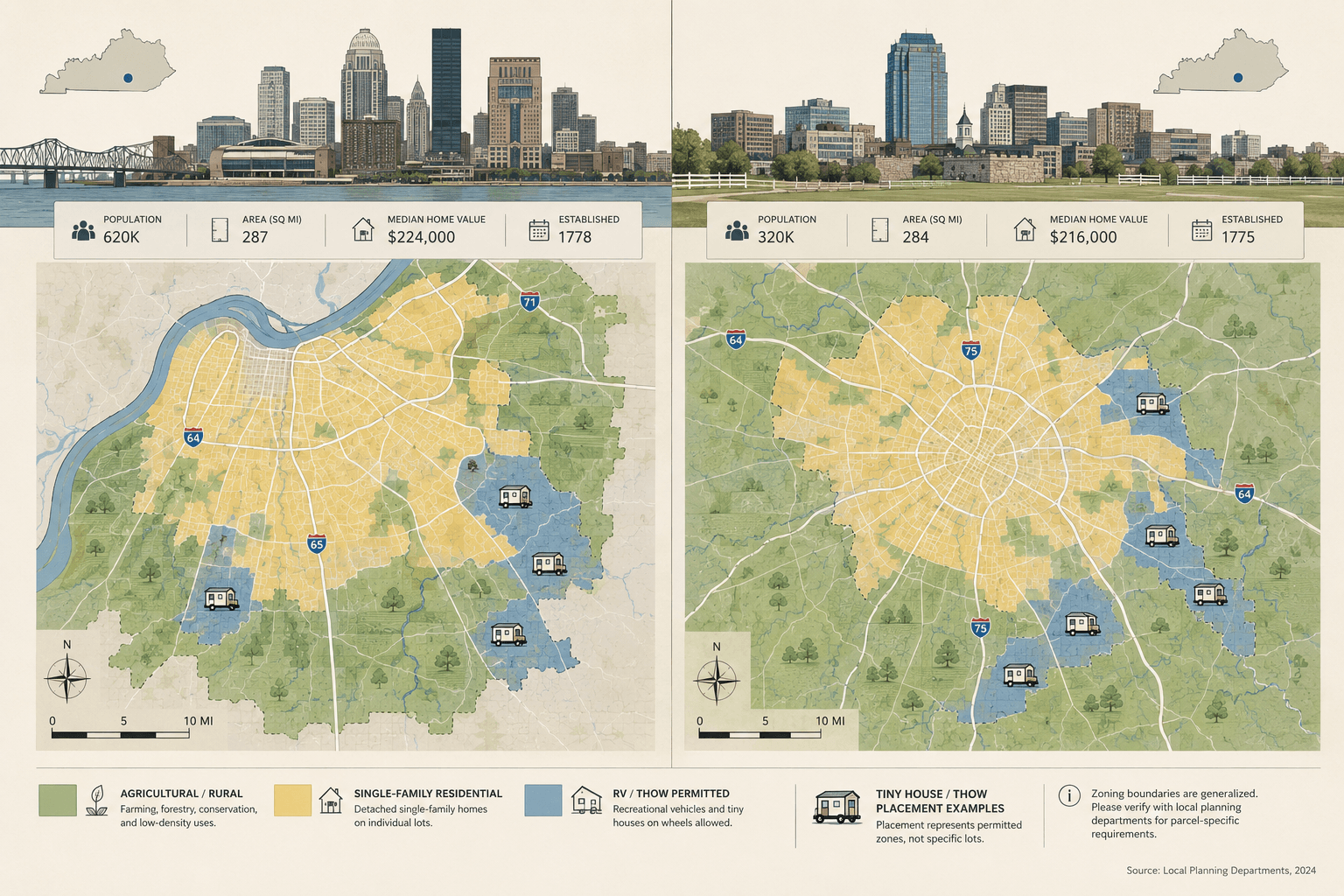
- Louisville permits both foundation-based tiny homes and THOWs, though THOWs are treated as mobile homes subject to state standards
- Lexington allows foundation tiny homes with a 150 square foot minimum but does not permit THOWs as permanent dwellings
- THOWs are classified as recreational vehicles statewide, restricting them to RV parks or designated areas in most jurisdictions
- Agricultural zoning in rural Bluegrass counties can offer more flexibility for tiny home placement than residential zones
- A 2024 state law (KRS 100.348) gives local governments the ability to set compatibility standards for manufactured homes in single-family zones
- Ceiling heights, loft dimensions, egress windows, and guardrail specs are all governed by Appendix Q statewide
Table of Contents
- What Are Kentucky Bluegrass Region Tiny House Laws, Really?
- Foundation Tiny Homes vs. THOWs: Which Path Makes Sense?
- Louisville's Rules: What You Can (and Can't) Do
- Lexington's Approach to Tiny Home Zoning
- Rural Bluegrass Counties: Agricultural Zoning and Flexibility
- Appendix Q Explained: The Building Code Details That Matter
- ADU Ordinances in the Bluegrass Region
- The Most Permissive Municipalities in the Bluegrass Area
- Finding Kentucky Builders Who Know the Rules
- FAQ
What Are Kentucky Bluegrass Region Tiny House Laws, Really?
Kentucky bluegrass region tiny house laws are not one single rulebook. They're a layered system: state building codes set the floor, and local zoning ordinances determine what's actually allowed on any given parcel. Understanding both layers is the starting point for any serious tiny home plan in central Kentucky.
At the state level, Kentucky has adopted Appendix Q of the International Residential Code. This appendix was written specifically for homes 400 square feet or under and covers everything from ceiling heights to loft access. It gives tiny homes on permanent foundations a clear legal framework — which is genuinely good news for buyers and builders alike.
What Appendix Q does not do is override local zoning. A county can still restrict where tiny homes are placed, what minimum lot sizes apply, and whether THOWs are welcome at all. That's why two properties 20 miles apart can have completely different outcomes.
Foundation Tiny Homes vs. THOWs: Which Path Makes Sense?
Foundation-based tiny homes are the more straightforward option in Kentucky. They're treated as conventional dwellings, subject to the Kentucky Building Code and local zoning, but they have a clear permitting path in most Bluegrass jurisdictions.
THOWs — tiny homes on wheels — are a different story. Across Kentucky, THOWs are classified as recreational vehicles. That classification limits them to RV parks or areas specifically zoned for RV use. In most residential and agricultural zones, parking a THOW and living in it full-time is not permitted.
Choose a foundation tiny home if:
- You want to own your land and establish permanent residency
- You're building in a city like Louisville or Lexington where THOW rules are strict
- You need a conventional mortgage or financing
Choose a THOW if:
- You plan to move frequently and don't need a fixed address
- You have access to a compliant RV park or campground
- You want flexibility over permanence
For a broader look at how these rules vary across the country, the Tiny Homes by State directory is a useful reference point.
Louisville's Rules: What You Can (and Can't) Do
Louisville permits tiny homes on permanent foundations, and they must comply with the Kentucky Building Code, including Appendix Q standards. The city's construction review office has published guidance specifically addressing tiny houses, which signals a relatively welcoming stance compared to many peer cities.
For THOWs in Louisville, the classification as mobile homes under state standards applies. That means local zoning regulations govern where they can be parked, and full-time habitation in a non-designated zone is generally not allowed.
Key Louisville considerations:
- Zoning matters as much as building code — a tiny home won't be approved on a lot already occupied by a primary residence unless ADU rules apply
- Permits are required for all permanent tiny home construction
- The lot must be zoned appropriately for residential use
One common mistake: assuming that because a tiny home is small, it skips the permitting process. It doesn't. Every foundation tiny home in Louisville needs a building permit, inspections, and zoning clearance.
Lexington's Approach to Tiny Home Zoning
Lexington allows tiny homes on permanent foundations, with a minimum size of 150 square feet. They must meet local zoning and building codes, and the permitting process mirrors that of any other residential construction.
THOWs are not permitted as permanent dwellings in Lexington. They're treated as recreational vehicles, which means full-time living in a THOW parked in a standard residential zone isn't a legal option.
Lexington's zoning code is managed through the Lexington-Fayette Urban County Government, and zoning classifications here can be specific. If you're targeting a particular parcel, verify its zoning designation before going further — a quick call to the planning office can save weeks of wasted effort.
Rural Bluegrass Counties: Agricultural Zoning and Flexibility
Outside Louisville and Lexington, rural Bluegrass counties often offer more flexibility. Agricultural zoning — common across much of central Kentucky — sometimes allows accessory dwellings or caretaker residences on working farms, which can create a legal path for tiny homes that wouldn't exist in a suburban residential zone.
This isn't a blanket loophole. Each county sets its own rules, and what's permitted in one agricultural zone may be restricted in another. But if you own or are considering purchasing rural land in counties like Woodford, Scott, or Jessamine, it's worth asking specifically about:
- Accessory dwelling unit (ADU) provisions on agricultural parcels
- Caretaker or farm worker housing allowances
- Minimum acreage requirements for additional dwellings
- Whether THOWs are permitted as temporary or seasonal structures
A 2024 Kentucky state law, KRS 100.348, also gives local governments the ability to set compatibility standards for manufactured homes in single-family zones. Ashland's community development office highlighted in early 2026 that this law both limits and enables local flexibility — tiny homes that meet modern building codes and go through proper permitting can qualify in many single-family zones.
Appendix Q Explained: The Building Code Details That Matter
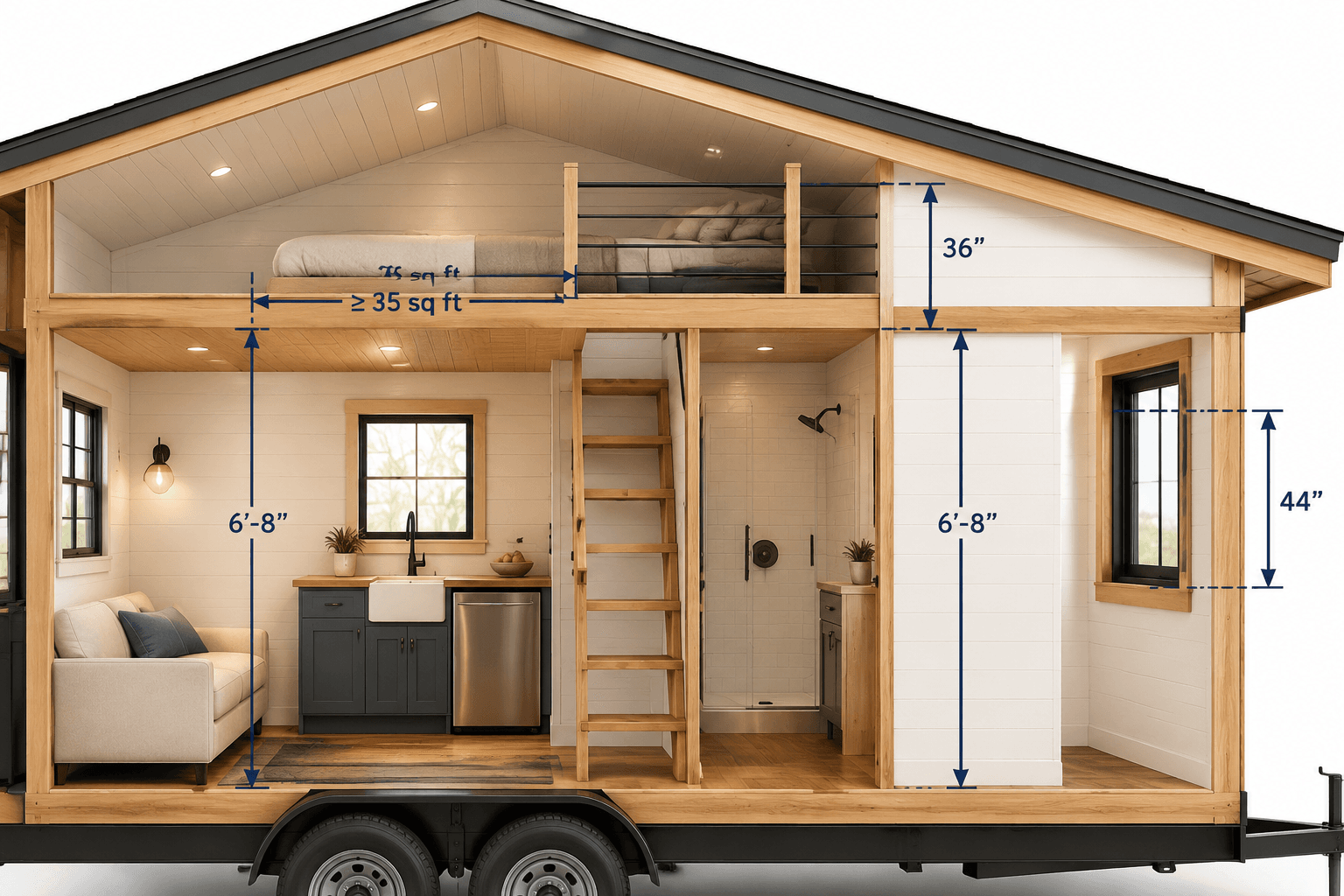
Appendix Q is the foundation of Kentucky bluegrass region tiny house laws for any home under 400 square feet. Here's what it actually requires:
| Feature | Minimum Standard |
|---|---|
| Habitable room ceiling height | 6 feet 8 inches |
| Bathroom/kitchen ceiling height | 6 feet 4 inches |
| Loft area (sleeping/living) | 35 square feet minimum, 5 feet wide in any direction |
| Loft guardrail height | 36 inches or half the distance to ceiling (whichever is less) if loft is 30+ inches above floor |
| Emergency egress window height | Bottom of opening no more than 44 inches above loft floor |
Loft access must be provided via a stairway, ladder, alternating tread device, or ship's ladder — each with its own safety specifications. These aren't suggestions; they're code requirements that inspectors will check.
The egress requirement is one that surprises many first-time tiny home builders. If your loft is a sleeping area, it needs a roof access window that meets specific dimensions. Plan for this early in the design phase, not after framing is complete.
ADU Ordinances in the Bluegrass Region
Accessory dwelling units (ADUs) are a growing avenue for tiny home placement in the Bluegrass region. An ADU is a secondary dwelling on a lot that already has a primary residence — think a small cottage behind a main house, or a converted garage apartment.
Louisville and Lexington both have ADU provisions in their zoning codes, though the specifics vary by zone. In some cases, a tiny home on a permanent foundation can qualify as an ADU, giving it a legal path on lots that wouldn't otherwise permit a second dwelling.
What to check for ADU eligibility:
- Is your lot in a zone that permits ADUs?
- What is the maximum square footage for an ADU in that zone?
- Are owner-occupancy requirements in place?
- Are there setback or lot coverage limits that affect placement?
ADU rules are changing faster than most zoning codes right now. Check with your local planning office for the most current standards before committing to a design.
The Most Permissive Municipalities in the Bluegrass Area
Not every city in the Bluegrass region treats tiny homes the same way. Based on available zoning information as of 2026, here's a general picture:
More permissive:
- Louisville: Clear permitting path for foundation tiny homes, published guidance available
- Smaller agricultural communities with flexible ADU or farm dwelling provisions
More restrictive:
- Lexington: Permits foundation tiny homes but has stricter THOW rules and minimum size requirements
- Suburban municipalities with large minimum square footage requirements for residential dwellings
The most practical advice: contact the planning or zoning office in your target municipality directly. Ask specifically about tiny homes, not just "small houses." The terminology matters, and a direct conversation will give you more accurate information than any online resource — including this one.
For zoning research across multiple states, the tiny home zoning resource hub is a good place to start your comparison.
Finding Kentucky Builders Who Know the Rules
Working with a builder who understands Kentucky's specific code requirements is worth more than a lower price tag. Appendix Q compliance, local permitting experience, and familiarity with Bluegrass county zoning can save you months of back-and-forth with inspectors.
A few builder options worth exploring:
- Amish Kentucky builds in the Kentucky market and brings regional construction knowledge
- Tennessee Tiny Homes operates close to the Kentucky border and has experience with southeastern building codes
- Timbercraft Tiny Homes is known for high-quality builds and code-compliant designs
- New Frontier Tiny Homes has a strong reputation for custom foundation-ready designs
When vetting any builder, ask directly: Have you pulled permits in Kentucky? Are your designs Appendix Q compliant? Can you provide references from Kentucky buyers? Those three questions will tell you a lot.
For builders focused on the broader southeastern region, Southeastern Tiny Homes is another resource worth checking.
FAQ
Can I legally live in a THOW full-time in Kentucky's Bluegrass region? In most cases, no. THOWs are classified as recreational vehicles throughout Kentucky, which limits full-time habitation to designated RV parks or campgrounds. Living in a THOW on a standard residential or agricultural lot is generally not permitted without specific local allowances.
What is the minimum size for a tiny home in Lexington, Kentucky? Lexington requires a minimum of 150 square feet for tiny homes on permanent foundations. This applies to foundation-based dwellings subject to local zoning and building codes.
Does Kentucky require a permit for a tiny home on a foundation? Yes. Any tiny home on a permanent foundation requires a building permit, inspections, and zoning approval. The permitting process follows the Kentucky Building Code, including Appendix Q for homes under 400 square feet.
What does Appendix Q cover for tiny homes in Kentucky? Appendix Q sets minimum standards for ceiling heights (6 feet 8 inches in habitable rooms), loft dimensions (35 square feet minimum), loft access, guardrail heights, and emergency egress windows. It applies to homes 400 square feet or under on permanent foundations.
Can I place a tiny home on agricultural land in the Bluegrass region? Possibly. Agricultural zoning in rural Bluegrass counties sometimes allows accessory dwellings or farm-related housing. Requirements vary by county, so check with the local planning office about specific provisions for your parcel.
What is KRS 100.348 and how does it affect tiny homes? KRS 100.348 is a 2024 Kentucky state law that allows local governments to set compatibility standards for manufactured homes in single-family residential zones. It gives municipalities both the authority to regulate and the flexibility to permit tiny homes that meet modern building codes through proper permitting channels.
Are ADUs a viable path for tiny homes in Louisville or Lexington? Yes, in many zones. Both cities have ADU provisions that can allow a tiny home as a secondary dwelling on a lot with an existing primary residence. Eligibility depends on the specific zoning designation, lot size, and local ADU rules, which are worth verifying directly with the planning office.
Conclusion
Kentucky bluegrass region tiny house laws reward people who do their homework before they fall in love with a floor plan. The state framework is genuinely supportive — Appendix Q gives tiny homes on foundations a clear legal identity, and cities like Louisville have published guidance that makes the process more transparent than in many states.
The real variables are local. Whether you're eyeing a lot in Lexington, a rural parcel in Woodford County, or an ADU opportunity in Louisville's East End, the zoning details on that specific property will shape everything.
Your next steps:
- Identify your target location and pull the current zoning designation
- Contact the local planning office and ask specifically about tiny homes, ADUs, and any minimum size requirements
- Determine whether you want a foundation home or a THOW — and choose your site accordingly
- Connect with a builder who has Kentucky permitting experience
- Review Appendix Q requirements before finalizing any floor plan
Start where you are. Even if you're still in the early research phase, a single call to a local planning office can give you more clarity than hours of online searching. The path to a smaller, more intentional home in the Bluegrass region is real — it just takes the right map.