
Last updated: June 24, 2026
Quick Answer: Tiny homes are legal in Salt Lake County if they sit on a permanent foundation, meet the underlying zoning requirements for the district, and pass standard building code inspections. Tiny homes on wheels (THOWs) are classified as recreational vehicles and cannot serve as permanent residences in standard residential zones. Most paths to tiny living in the county run through the ADU (accessory dwelling unit) framework or a small-footprint primary dwelling on a properly zoned lot.
Key Takeaways
- Tiny homes under 400 sq ft are allowed in Salt Lake County when placed on a permanent foundation and located in a compliant residential zone
- Salt Lake City has no special "tiny house" zoning category — all homes, regardless of size, must meet the underlying zoning district rules and building code
- THOWs are treated as RVs in Salt Lake County and Salt Lake City; they cannot be used as permanent dwellings outside of approved RV parks
- Detached ADUs (the most common tiny home path) are capped at 1,200 sq ft with 4-foot side and rear setbacks, a 6-foot building separation, and a 20-foot height limit when within 10 feet of a property line
- Only one ADU is permitted per single-family lot in Salt Lake County
- Permits are required for any tiny home placement, construction, or ADU build — no exceptions
- Some municipalities within the county, including Sandy and West Valley City, have their own zoning codes that may differ from unincorporated county rules
- Working with a builder experienced in Utah regulations can save significant time and money
Table of Contents
- What Counts as a Tiny Home Under Salt Lake County Rules?
- Foundation vs. THOW: The Rule That Changes Everything
- How Salt Lake County Tiny House Regulations Apply to ADUs
- Which Municipalities Are Most Tiny-Home Friendly?
- The Permit Process: What to Expect
- Common Mistakes That Derail Tiny Home Plans
- Finding the Right Builder for Utah
- FAQ
What Counts as a Tiny Home Under Salt Lake County Rules?
Salt Lake County and Salt Lake City both define tiny homes as residential structures under 400 square feet. Neither jurisdiction has created a separate regulatory category just for tiny homes — they're treated as small houses, plain and simple.
That framing matters. It means:
- A 350 sq ft home on a foundation is evaluated the same way as a 1,800 sq ft home — same permit process, same building code, same zoning rules
- There is no minimum dwelling size beyond what the building code requires for habitability (adequate ceiling height, ventilation, egress)
- The size of the home is less important than where it sits and how it's classified
The practical takeaway: If your tiny home is on a foundation, properly permitted, and located in a zone that allows residential use, Salt Lake County tiny house regulations don't create extra hurdles just because the home is small.
Foundation vs. THOW: The Rule That Changes Everything
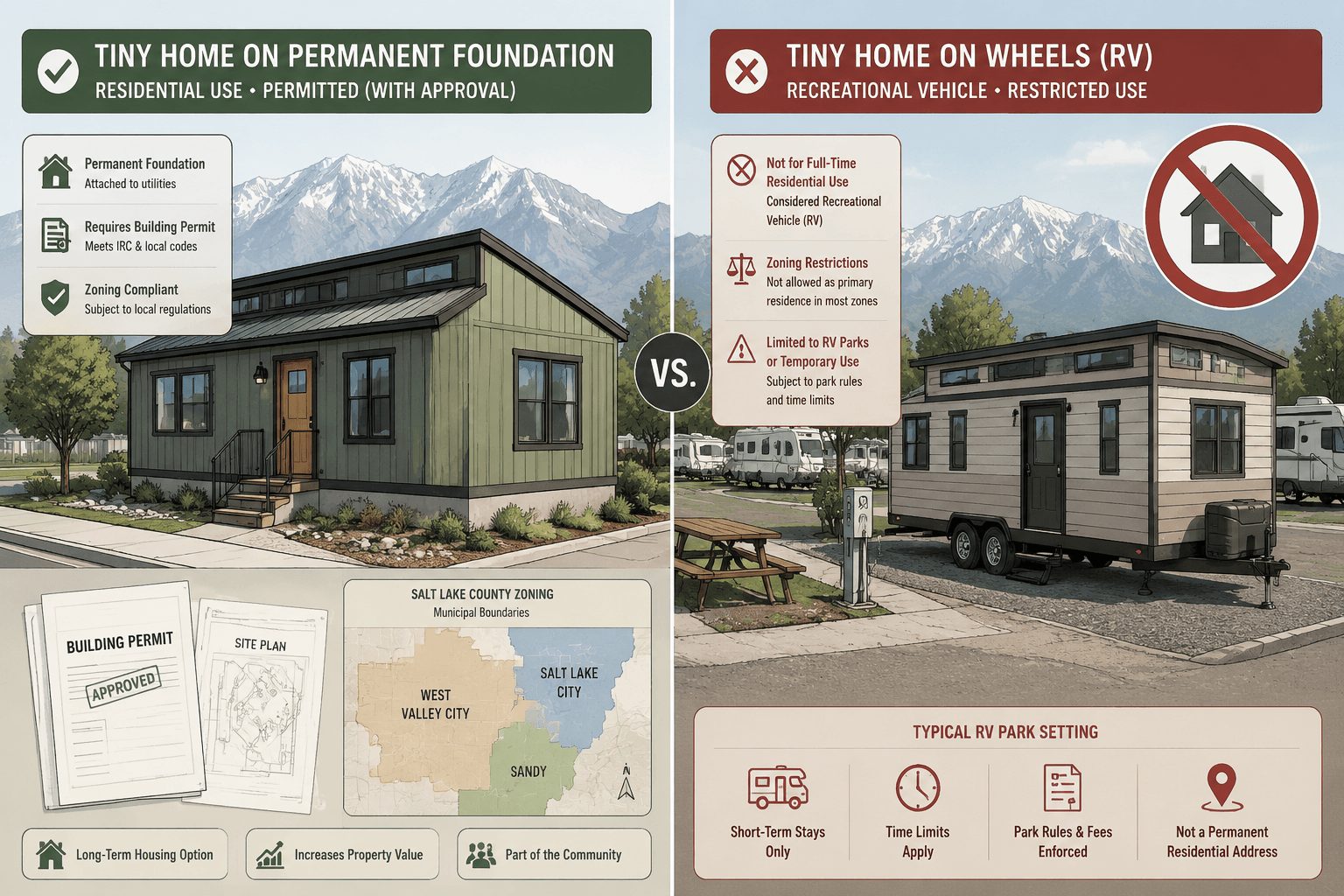
This is the single most important distinction in Salt Lake County tiny house regulations. Your home's legal status hinges almost entirely on whether it has a permanent foundation.
Tiny homes on a foundation are treated as standard residential structures. They can be permitted as primary dwellings or detached ADUs, depending on lot configuration and zoning.
Tiny homes on wheels (THOWs) are classified as recreational vehicles under Utah law. In Salt Lake County and Salt Lake City, that classification means:
- They cannot serve as permanent residences on private residential land
- They are restricted to RV parks or communities specifically zoned for RV use
- Parking one in a backyard or driveway as a full-time home is not permitted in standard residential zones
Some people work around this by placing a THOW in a licensed RV park long-term, but that's a different lifestyle model than owning land. If land ownership and permanence are your goals, a foundation-based build is the only path that works cleanly under current Salt Lake County rules.
"The foundation question isn't a technicality — it's the fork in the road that determines your entire legal and financial path."
If you're still deciding between a THOW and a foundation build, builders like Rocky Mountain Tiny Houses and Backcountry Tiny Homes work in the Mountain West and can help you think through which approach fits your situation.
How Salt Lake County Tiny House Regulations Apply to ADUs
The most common legal path for tiny home living in Salt Lake County runs through the ADU framework. An ADU (accessory dwelling unit) is a secondary living unit on a lot that already has a primary residence.
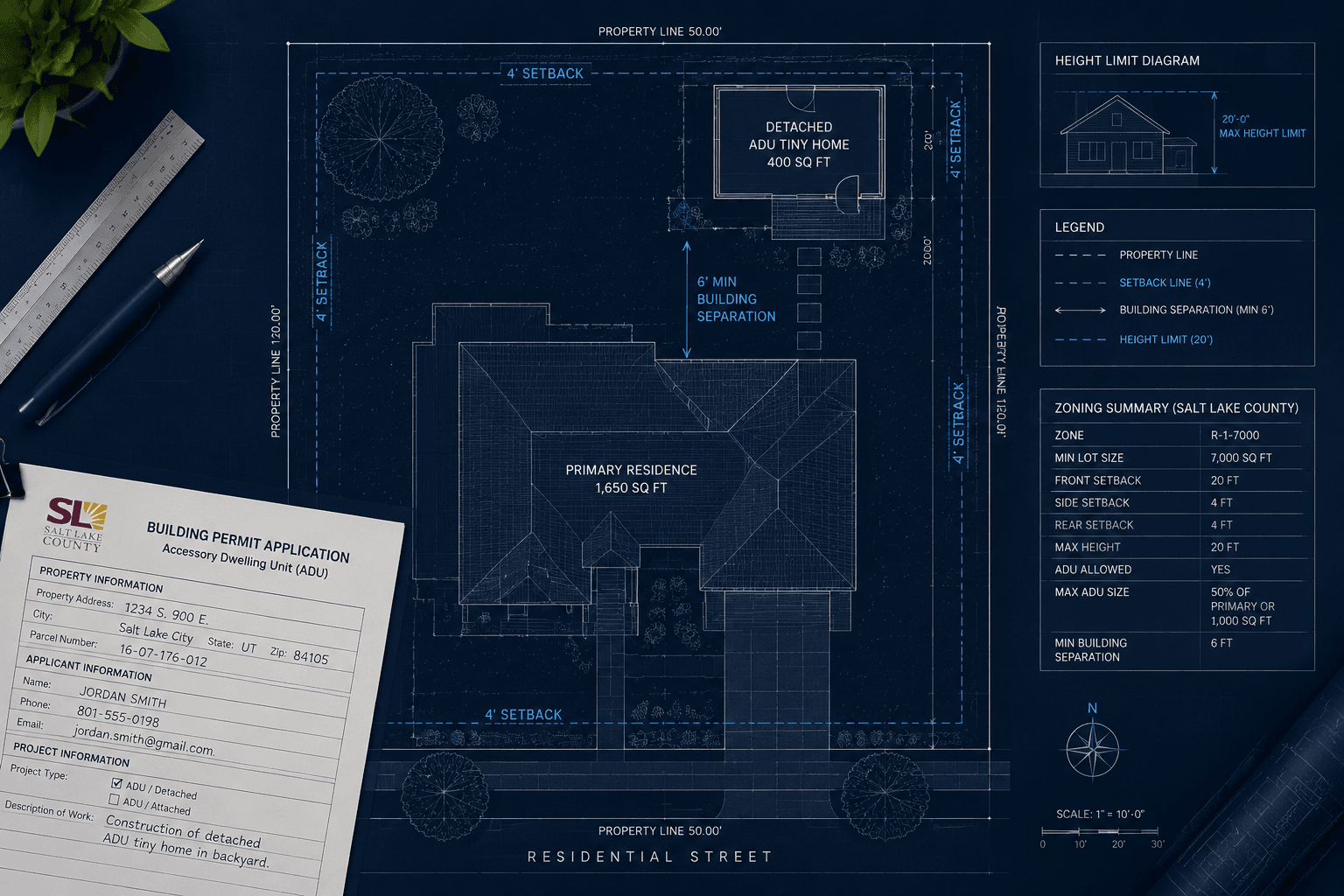
Here are the key limits for detached ADUs in unincorporated Salt Lake County:
| Requirement | Limit |
|---|---|
| Maximum size | 1,200 sq ft |
| Side and rear setbacks | 4 feet minimum |
| Building separation from primary home | 6 feet minimum |
| Maximum height (within 10 ft of property line) | 20 feet |
| Stories allowed | Up to two |
| ADUs per single-family lot | One |
A few things worth noting:
- The 1,200 sq ft cap is a ceiling, not a target. A 300 sq ft studio ADU is perfectly legal if it meets all other requirements
- Owner-occupancy requirements for ADUs vary — check with the Salt Lake County Planning Division for the current rule, as these policies have shifted in recent years
- Utility connections (water, sewer, electrical) must meet code, which adds cost but also ensures the unit is livable long-term
For anyone considering an ADU build, the Tumbleweed Tiny House Company and New Frontier Tiny Homes are established builders with experience designing units that meet ADU size and structural requirements.
Which Municipalities Are Most Tiny-Home Friendly?
Salt Lake County contains multiple incorporated cities, each with its own zoning code. The county's unincorporated rules apply only to areas outside city limits. Here's a quick breakdown of what to expect in the most populated areas:
Salt Lake City No special tiny home zoning exists. All homes must comply with the underlying zoning district. The city allows small foundation homes with no separate minimum size requirement beyond building code. THOWs are not permitted as permanent residences.
Sandy Sandy follows a fairly standard residential zoning framework. ADUs are permitted in single-family zones with similar setback and size constraints to the county. The city has been incrementally updating its ADU rules — worth a direct call to Sandy's planning department before buying land.
West Valley City West Valley has shown some openness to ADU development as part of broader housing density efforts. Zoning rules allow detached ADUs in residential zones, and the city's planning staff is generally accessible for pre-application consultations.
Unincorporated Salt Lake County The county's own rules apply here. The ADU framework described above is your primary guide. Permits are required, and the county planning division is the right first contact.
Choose a municipality based on: lot size, proximity to utilities, existing zoning classification, and whether the city has a pre-application consultation process (most do, and it's worth using).
The Permit Process: What to Expect
Permits are required for any tiny home in Salt Lake County — no exceptions, regardless of size. Here's a simplified version of the process for a foundation-based tiny home or ADU:
- Confirm zoning — Verify the lot's zoning classification allows residential use and ADUs (if applicable). Use the county or city's online parcel viewer.
- Pre-application meeting — Most jurisdictions offer this at no cost. Bring your lot dimensions, proposed structure size, and intended use.
- Submit building permit application — Include site plan, floor plan, and structural drawings. For ADUs, you'll also need to show the primary dwelling.
- Plan review — Typically takes 2–6 weeks depending on the municipality and current workload.
- Permit issuance and construction — Work must follow approved plans. Inspections are required at key stages (foundation, framing, electrical, final).
- Certificate of occupancy — Issued after final inspection. Required before the unit can be legally occupied.
Working with a builder who has pulled permits in Salt Lake County before is a real advantage here. They know what reviewers look for and can catch plan issues before they cause delays.
Common Mistakes That Derail Tiny Home Plans
A few patterns show up repeatedly among people navigating Salt Lake County tiny house regulations for the first time:
- Buying land before confirming zoning. Not every residential parcel allows ADUs or has the minimum lot size required. Always verify before purchasing.
- Assuming a THOW is a workaround. It isn't — not in standard residential zones. If you want to live on private land full-time, a foundation build is the path.
- Skipping the pre-application meeting. This free step can surface deal-breakers early, before you've spent money on plans.
- Underestimating utility connection costs. Running water and sewer to a backyard ADU can cost $10,000–$30,000 or more depending on distance and existing infrastructure. Budget for it.
- Choosing a builder unfamiliar with Utah codes. A builder who primarily works in another state may not know Salt Lake County's specific ADU rules. Look for regional experience.
For builders with Mountain West experience, Alpine Tiny Homes and Tiny Heirloom are worth exploring as starting points.
Finding the Right Builder for Utah
Not every tiny home builder is set up to deliver a permitted, foundation-ready home in Utah. When evaluating builders, ask directly:
- Have you completed permitted builds in Salt Lake County or Salt Lake City?
- Can you provide references from Utah clients?
- Do your plans meet IRC (International Residential Code) standards, which Utah has adopted?
- Can you handle the permit submission process, or will that fall to me?
Builders who specialize in the region or have completed Utah projects will have a much shorter learning curve with local inspectors and plan reviewers. The Tiny Home Sherpa builder directory is a good place to compare vetted options side by side. For off-grid builds — which are increasingly popular in rural Salt Lake County parcels — the off-grid tiny homes resource covers additional considerations around solar, water catchment, and septic systems.
FAQ
Can I put a tiny home on wheels in my Salt Lake County backyard? No. THOWs are classified as recreational vehicles under Utah law. In standard residential zones in Salt Lake County and Salt Lake City, they cannot be used as permanent dwellings. They are restricted to licensed RV parks or communities zoned for RV use.
Is there a minimum square footage for a home in Salt Lake City? Salt Lake City has no separate minimum dwelling size beyond what the building code requires for habitability — things like ceiling height, ventilation, and egress. A properly permitted home under 400 sq ft is legal if it meets those standards.
How many ADUs can I have on my single-family lot in Salt Lake County? One. Salt Lake County limits single-family lots to one ADU per parcel in residential zones.
Do I need a permit for a tiny home ADU in Salt Lake County? Yes. Permits are required for all construction, including ADUs of any size. There are no size exemptions.
What's the maximum size for a detached ADU in unincorporated Salt Lake County? The maximum is 1,200 square feet. The unit can be up to two stories, with a 20-foot height limit when located within 10 feet of a rear or side property line.
Are Sandy and West Valley City more flexible than Salt Lake City on tiny homes? All three cities follow broadly similar residential zoning frameworks. West Valley City has shown some openness to ADU development as part of housing density goals. Sandy has been updating its ADU rules incrementally. In all cases, a pre-application meeting with the city's planning department is the best way to get current, accurate information for your specific parcel.
Conclusion
Salt Lake County tiny house regulations aren't designed to stop you — they're designed to make sure small homes are safe, sanitary, and properly integrated into residential neighborhoods. The rules are navigable once you understand the two core principles: foundation-based homes are legal and permitted like any other residence, and THOWs are treated as RVs.
Your clearest path forward in 2026 looks like this: confirm your lot's zoning, schedule a pre-application meeting with the relevant planning department, and work with a builder who has real experience in Utah. The ADU route is well-established and increasingly supported by local policy. Small footprint. Full life. That's entirely achievable here — it just takes a few deliberate steps to get there.
Start where you are. The regulations are a map, not a wall.