
Last updated: May 15, 2026
Quick Answer: Tiny homes in Arizona are legal in most counties, with prices ranging from roughly $23,000 for a basic shell to $155,000 for a fully off-grid setup. The state's year-round sun makes solar power practical and affordable, and several counties — including Mohave, Cochise, and Yavapai — are known for flexible zoning that welcomes tiny home placement. For retirees and snowbirds especially, Arizona offers a rare combination of affordable land, mild winters, and an established tiny home community.
Key Takeaways
- Prices range widely: Entry-level shell models start around $32,000; fully equipped off-grid homes run $85,000–$155,000 [2]
- Solar is a natural fit: Arizona averages 300+ sunny days per year, making off-grid solar setups genuinely cost-effective
- Zoning varies by county: Mohave, Cochise, Yavapai, and La Paz counties are generally the most tiny-home-friendly
- Land is accessible: Desert parcels start as low as $88/month in areas like Winslow, with no zoning restrictions [8]
- Retirement communities exist: Several Arizona communities specifically welcome tiny homes and park-model RVs
- Owner financing is available: Some land-plus-home packages allow as little as $25,000 down [1]
- THOWs (tiny homes on wheels) need careful placement: Arizona treats them as RVs in most jurisdictions, so permanent placement requires specific zoning
- Off-grid living can eliminate utility bills entirely when solar and water storage are properly sized [4]
What Does It Actually Cost to Buy a Tiny Home in Arizona?
Arizona tiny home prices depend heavily on whether you want a shell, a move-in-ready unit, or a full land package. Budget buyers can find shell models starting around $32,000, while turnkey off-grid setups land between $85,000 and $155,000.
Here's a practical breakdown of what the market looks like in 2026:
| Option | Size | Price Range | Notes |
|---|---|---|---|
| Shell model (Desert Rose) | 205 sq ft | ~$32,000 | Prescott area; no interior finish [2] |
| Entry off-grid THOW | 192 sq ft | ~$85,495 | Solar, water system, deck included [2] |
| Land + tiny home package | 372 sq ft + 20 acres | ~$55,000 | Owner financing available [1] |
| Fully furnished THOW | 380 sq ft | ~$147,000 | Phoenix area; 2 bed/1 bath [2] |
| Premium A-Frame off-grid | Varies | ~$154,800 | Full off-grid systems included [2] |
| Converted shed option | Small | ~$11,000 | Budget DIY route; documented examples [5] |
Builder financing is also available. Some builders offer reservation spots with as little as $2,500 down, with models like The Traveler starting at $79,300 and smaller A-Frame Solo units at $29,700 [3].
Common mistake: Many buyers price only the home and forget land costs. In Arizona, raw desert parcels in Winslow run as low as $88/month [8], but parcels with utilities or road access cost more. Always budget land separately.
If you're exploring builders who work in the Southwest, check out Southwest Tiny Homes and Tiny House AZ — both listed in our vetted builder directory.
How Does Solar Power Work for Tiny Homes in Arizona?
Arizona is one of the best states in the country for off-grid solar. With 300+ sunny days per year, a properly sized solar array can cover most or all of a tiny home's power needs — and many Arizona tiny home owners report eliminating their monthly utility bills entirely [4].
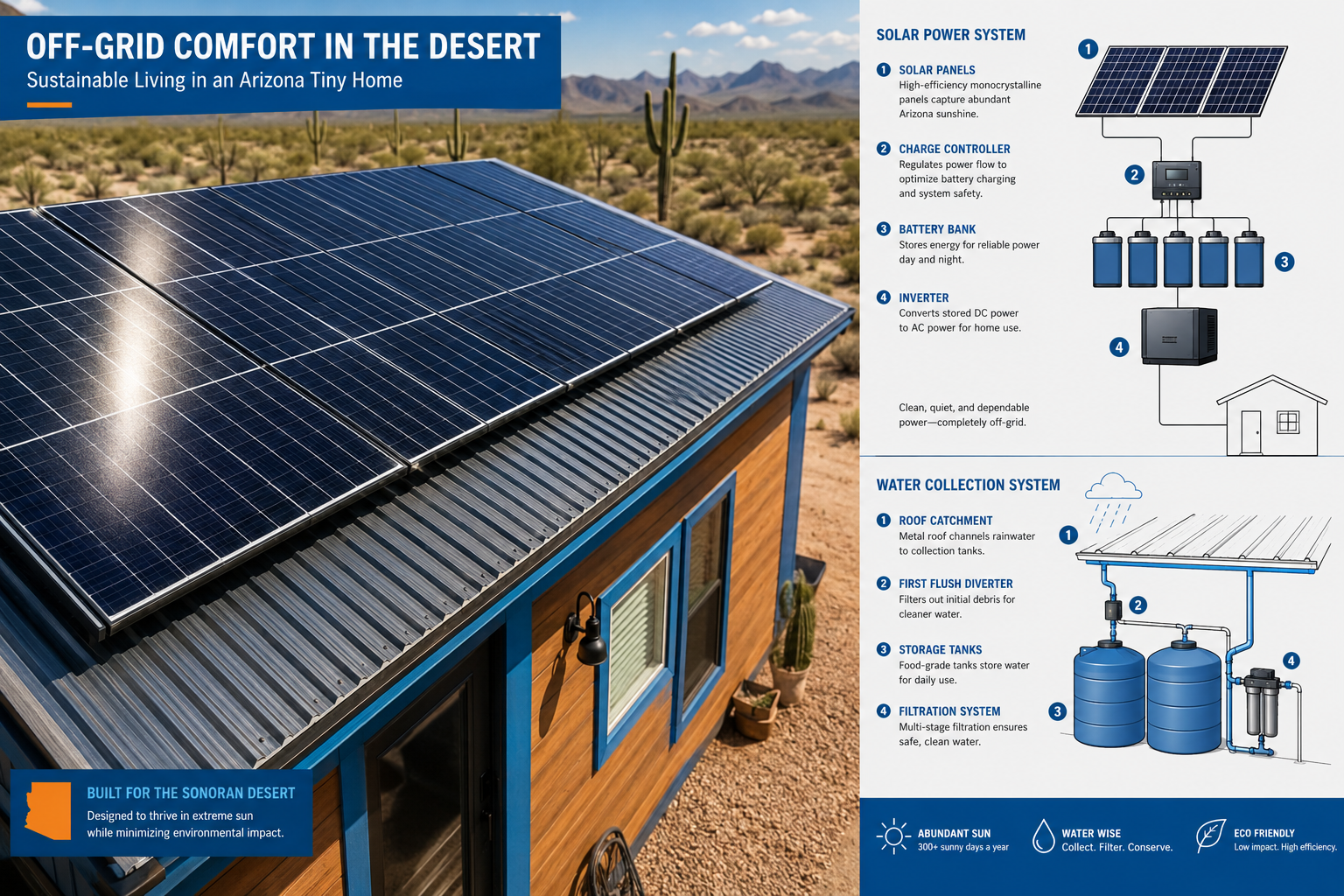
What a basic off-grid solar setup includes:
- Solar panels: Most tiny homes need 1,000–3,000 watts of panel capacity
- Battery bank: Lithium iron phosphate (LiFePO4) batteries are the current standard for off-grid storage
- Charge controller: Manages power flow from panels to batteries
- Inverter: Converts stored DC power to AC for regular appliances
- Water system: Many off-grid setups pair solar with rainwater collection or hauled water storage tanks
A fully permitted, move-in-ready one-bedroom off-grid home with a solid solar setup and water storage runs around $99,000 in Arizona [6]. That sounds like a lot until you factor in zero monthly utility bills.
Choose solar-first if:
- You're buying land more than a mile from grid hookups
- You plan to stay in Arizona year-round (or at least October through April)
- You want long-term cost predictability
Be cautious if:
- Your land has heavy shade from canyon walls or trees (rare in the desert, but it happens)
- You run high-draw appliances like electric HVAC without sizing your system accordingly
The desert heat is real. A mini-split air conditioner is the most power-hungry item in most Arizona tiny homes. Size your solar system around your cooling needs first, then everything else.
Which Arizona Counties Are Most Zoning-Friendly for Tiny Homes?
Zoning is the single biggest variable for tiny home placement in Arizona. Some counties welcome tiny homes; others have minimum square footage rules that make it difficult. The good news is that several counties are genuinely open to smaller structures.
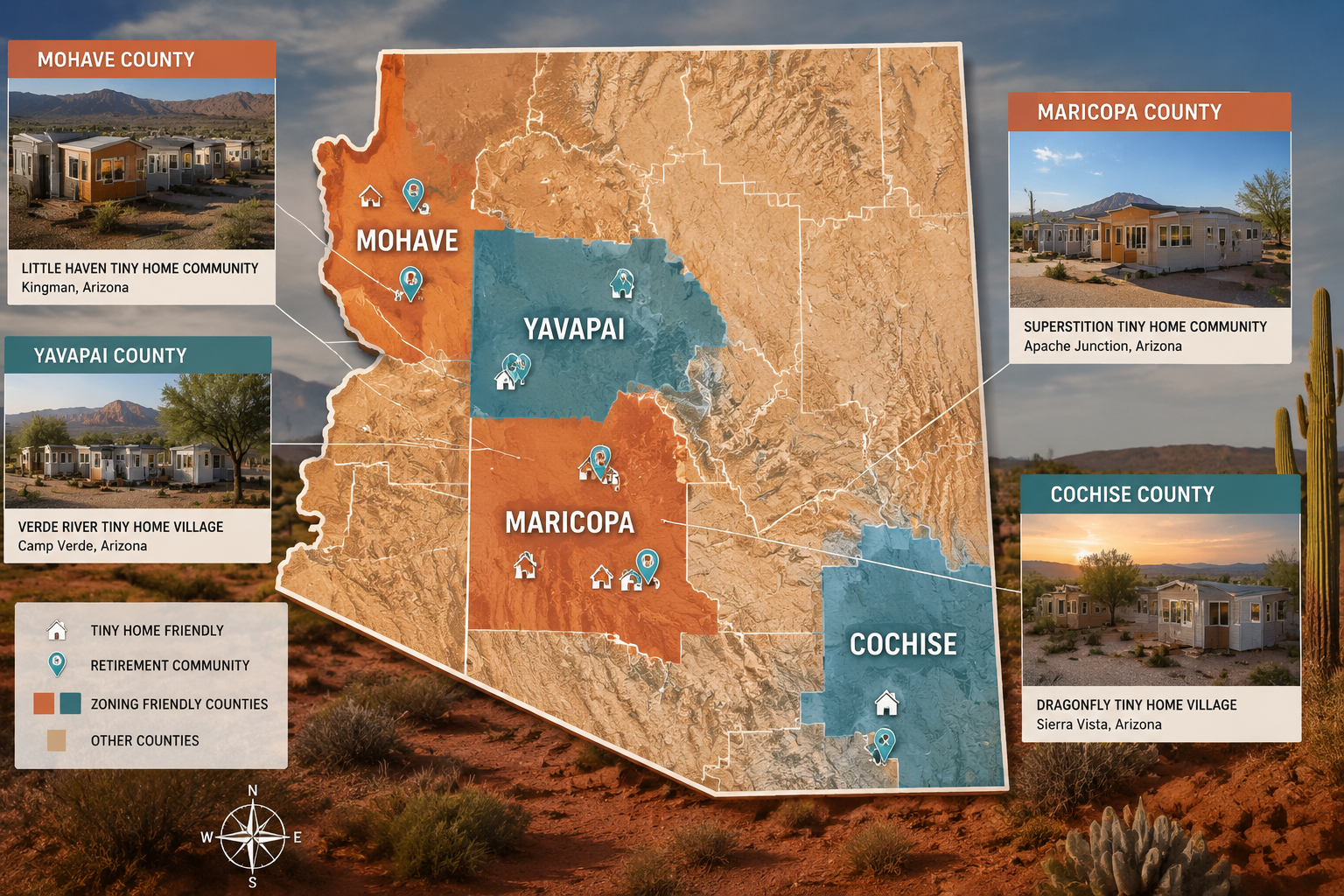
Most zoning-friendly counties in 2026:
- Mohave County — Large parcels, low density, and relatively relaxed rural zoning. Popular with off-grid buyers.
- Cochise County — Southeastern Arizona near the New Mexico border. Known for affordable land and minimal restrictions in unincorporated areas.
- Yavapai County — Home to Prescott and Chino Valley. More regulations than Mohave but has active tiny home communities.
- La Paz County — Very rural, minimal zoning in unincorporated areas, popular with snowbirds.
- Apache County — Remote northeastern Arizona; few restrictions but limited services.
Arizona has 91+ tiny home properties with land currently listed, with parcels ranging from 2.1 to 5.74 acres in Mohave and Apache counties, priced from $72,000 to $107,000+ [9].
Important distinction: A THOW (tiny home on wheels) is legally treated as an RV in most Arizona jurisdictions. That means you generally can't place one permanently on a residential lot without specific zoning approval. A foundation-built tiny home (also called an ADU or accessory dwelling unit) follows different rules and may be easier to permit in some areas.
Edge case: Some rural parcels in Arizona are zoned as "General Rural" with no minimum dwelling size. These are your best bet for THOW placement without jumping through hoops. Always verify zoning with the county assessor before buying land.
For a broader look at how Arizona compares to neighboring states, our Tiny Homes by State directory covers zoning highlights across the country.
Are There Tiny Home Retirement Communities in Arizona?
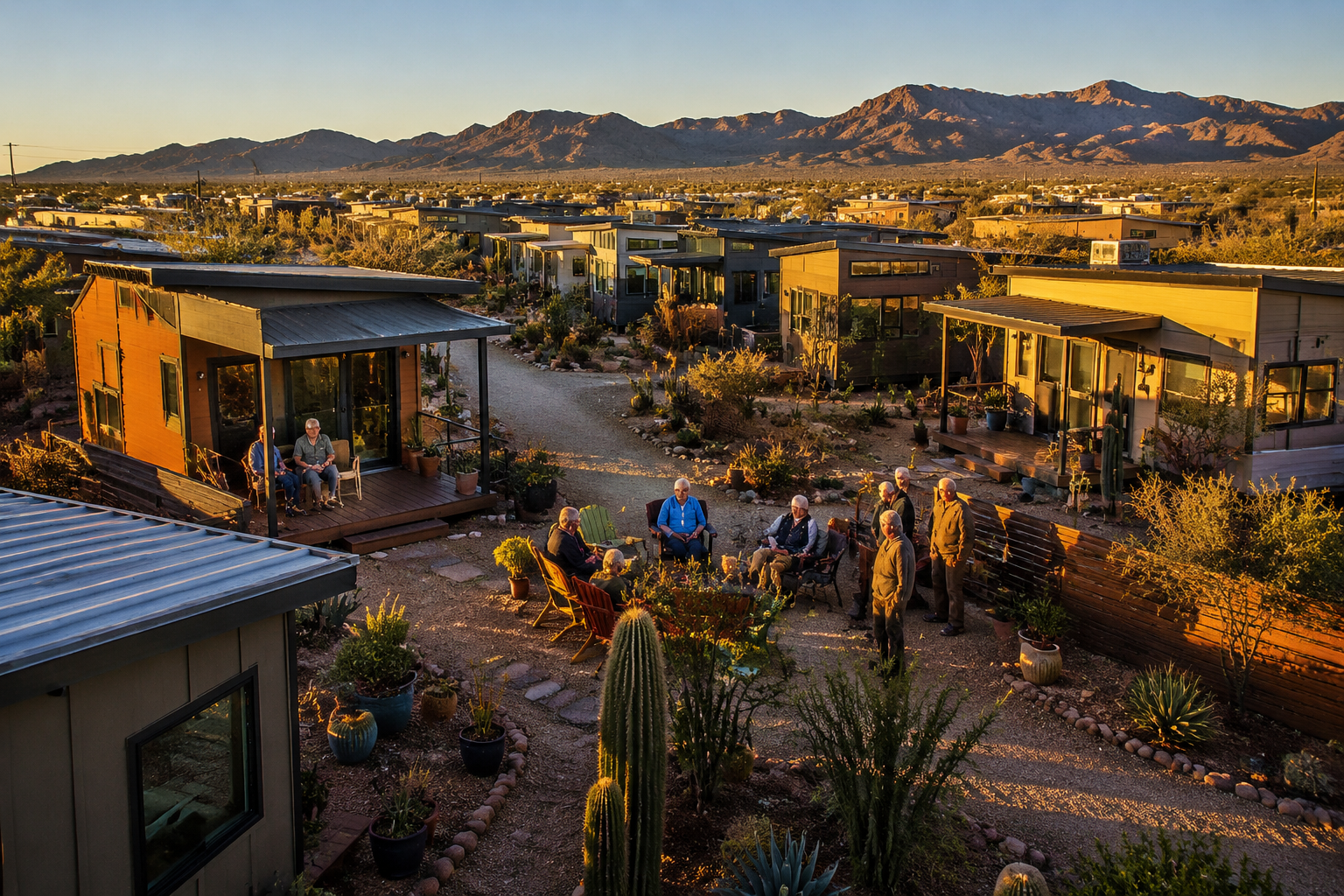
Yes — and this is one of Arizona's biggest draws for retirees and snowbirds interested in tiny living. Several established communities welcome park-model tiny homes, THOWs, and smaller manufactured homes.
What to look for in an Arizona retirement tiny home community:
- Age-restricted (55+) communities — Common in the Phoenix metro, Tucson, and Yuma areas. Many accept park-model RVs (typically 400 sq ft or less) as permanent residences.
- RV resorts with long-term lots — Some offer annual leases and allow semi-permanent tiny home placement. Amenities often include pools, clubhouses, and organized activities.
- Land-lease communities — You own the home, lease the land. Lower upfront cost, but read the lease terms carefully.
- Co-op communities — Less common but growing. You buy a share of the community land.
Popular areas for retirement tiny living:
- Yuma — Extremely popular with Canadian and Midwest snowbirds. Mild winters, affordable lots.
- Mesa/Apache Junction — Large 55+ RV and park-model communities with full amenities.
- Prescott/Chino Valley — Higher elevation means cooler summers; active retiree community.
- Bisbee/Sierra Vista (Cochise County) — Artsy, affordable, and tiny-home-curious culture.
What retirees should know: Social Security income and pension income are both taxed in Arizona, but the state has relatively low property taxes — typically under 1% of assessed value. That matters a lot when you're on a fixed income and choosing between a tiny home and a traditional house.
If you're comparing builders for a retirement-focused build, Zen Cottages and Tumbleweed Tiny House Company both offer designs well-suited to accessible, single-level living.
What Are the Practical Realities of Desert Living in a Tiny Home?
Desert living in a tiny home is genuinely great — but it comes with specific challenges that don't apply in other climates. Going in with clear eyes makes the difference between loving it and regretting it.
The real challenges:
- Heat: Summer temperatures in Phoenix and Tucson regularly exceed 110°F. Your tiny home's insulation, window placement, and cooling system matter enormously. Look for spray foam insulation (R-30 or better in walls) and a properly sized mini-split.
- Dust and sand: Fine desert dust gets into everything. Tight door and window seals are a must.
- Water: Many rural Arizona parcels have no well or municipal water. You'll either drill a well (expensive, not always feasible), haul water, or collect rainwater. Know your water plan before you buy land.
- Wildlife: Rattlesnakes, scorpions, and Gila woodpeckers are real. Skirt your THOW properly and check your shoes in the morning.
- Fire risk: Wildfire risk exists in forested areas like Flagstaff and the White Mountains. Check fire risk maps before buying.
The genuine advantages:
- Low humidity means your home stays cleaner and mold is rarely an issue
- Mild winters (below 4,000 ft elevation) mean minimal heating costs
- Stargazing is extraordinary in rural areas
- Land is affordable compared to most of the country
- The off-grid lifestyle is well-supported by a community of experienced practitioners [4]
Small footprint. Full life. That's the real promise of Arizona tiny living — and it holds up, as long as you plan for the heat and the water.
How Do You Find Land for a Tiny Home in Arizona?
Finding the right land is often harder than finding the right home. Here's a practical approach.
Step-by-step land search process:
- Decide on your region — Phoenix metro (more services, more restrictions), Northern Arizona (cooler, more regulations), or rural desert (fewer restrictions, fewer services)
- Check county zoning — Visit the county assessor or planning department website. Search the parcel's zoning code before making any offer.
- Verify access — Does the parcel have legal road access? Is it a dirt road that floods in monsoon season?
- Confirm utilities or plan alternatives — Power, water, and septic/composting toilet options
- Search listing sites — LandSearch, Landwatch, and Landish Home list Arizona parcels regularly [8][9]
- Ask about owner financing — More common in rural Arizona than you might expect [1]
Vacant desert land in Winslow, Arizona (2.5 acres) is currently listed at $88/month with no zoning restrictions — suitable for tiny home placement, solar, or wind power [8]. That's a real entry point for buyers who want to start slow.
For buyers comparing multiple states, our complete state-by-state tiny home directory is a useful starting point before you commit to Arizona.
FAQ: Tiny Homes in Arizona
Q: Are tiny homes legal in Arizona? Yes. Tiny homes are legal in Arizona, but rules vary by county and municipality. Foundation-built tiny homes follow local building codes; THOWs are typically regulated as RVs.
Q: What is the minimum square footage for a home in Arizona? There's no statewide minimum. Individual counties and cities set their own rules. Some rural areas have no minimum at all.
Q: Can I live in a tiny home on wheels (THOW) permanently in Arizona? In most jurisdictions, a THOW is classified as an RV. Permanent residence in an RV is restricted in many areas. Some rural counties allow it with few restrictions. Always verify locally.
Q: How much does off-grid solar cost for an Arizona tiny home? A basic functional system runs $8,000–$20,000 depending on size and battery capacity. Many turnkey tiny homes include solar in the purchase price.
Q: Do Arizona tiny home communities allow retirees? Yes. Many 55+ communities in Yuma, Mesa, and the Prescott area welcome park-model tiny homes and THOWs on long-term leases.
Q: Is Arizona a good state for snowbirds with tiny homes? It's one of the best. Mild winters, affordable land, and an established RV/tiny home community infrastructure make it a natural fit for seasonal residents.
Q: What is a park-model tiny home? A park-model is a factory-built home under 400 sq ft, built to ANSI A119.5 standards. It looks like a tiny home but is classified differently from a THOW. Many Arizona retirement communities accept them.
Q: Can I get a mortgage for a tiny home in Arizona? Traditional mortgages are hard to get for homes under 400 sq ft. Chattel loans, personal loans, and builder financing (some with $2,500 down) are the more common routes [3].
Q: What counties in Arizona have the fewest tiny home restrictions? Mohave, Cochise, La Paz, and Apache counties are generally the most permissive for rural tiny home placement.
Q: How do I handle water in an off-grid Arizona tiny home? Options include drilling a well, hauling water to a storage tank, or collecting rainwater (legal in Arizona with some limits). Most off-grid setups use a combination of hauled water and conservation practices.
Conclusion: Your Next Steps Toward Arizona Tiny Living
Tiny homes in Arizona make a lot of sense — especially if you're a retiree, snowbird, or off-grid buyer who wants affordable land, reliable sun, and a smaller monthly footprint. The pieces are genuinely in place: flexible rural zoning, a strong solar resource, accessible land prices, and an established community of people already living this way.
Here's how to move forward from wherever you are right now:
- Pick your region first. Phoenix metro, Northern Arizona, and the rural desert each offer different tradeoffs. Decide what matters most — services, climate, or freedom from restrictions.
- Understand the zoning before you buy land. Call the county planning department. It takes 20 minutes and saves enormous headaches.
- Size your solar system around cooling. In Arizona, your air conditioner is your biggest power draw. Start there.
- Explore vetted builders. Our directory includes Southwest Tiny Homes, Tiny House AZ, and Tumbleweed Tiny House Company — all worth a look for Arizona buyers.
- Browse the full state directory. If you're still comparing Arizona to other states, our Tiny Homes by State guide maps out your options across the country.
Start where you are. The desert is patient, and so are we.
References
[1] Tiny House On 10 Acres Of Off Grid Land Northern Arizona 70 000 - https://www.tinyhomebuilders.com/tiny-house-marketplace/tiny-house-on-10-acres-of-off-grid-land-northern-arizona-70-000-
[2] Arizona - https://tinyhouselistings.com/countries/united-states/states/arizona
[3] Arizona - https://greatlakestinyhome.com/locations/arizona/
[4] Off Grid Solar Home Arizona - https://steveadcock.us/off-grid-solar-home-arizona/
[5] Watch - https://www.youtube.com/watch?v=9WHmz7uEvuE
[6] facebook - https://www.facebook.com/groups/304709620652412/posts/1640973367026024/
[8] Tiny Home Land 2 5 Acres Winslow Az - https://landishome.com/shop/tiny-home-land-2-5-acres-winslow-az/
[9] Arizona - https://www.landsearch.com/tiny-home/arizona