
Last updated: May 15, 2026
Quick Answer: Tiny homes by state vary widely in what's legal, what's available, and what makes sense for your climate. This directory breaks down zoning rules, builder availability, and climate factors for every U.S. region — so you can find the right fit for your land, your budget, and your life. Whether you want a tiny house on wheels (THOW) or a foundation-built home, where you live changes almost everything.
Key Takeaways
- Zoning laws are the biggest variable. Some states welcome tiny homes openly; others make it nearly impossible without a special permit or variance.
- Climate drives construction choices. A tiny home built for Arizona summers needs very different insulation and ventilation than one built for Minnesota winters.
- Builder availability is uneven. States like Texas, Oregon, and Colorado have dense builder networks. Others have just a handful of options.
- THOWs (tiny houses on wheels) follow different rules than foundation homes — often regulated as RVs, not residences.
- Prefab and custom builds each have tradeoffs. Prefab is faster and often cheaper. Custom gives you more control over layout and materials.
- Financing is possible but requires the right lender. Personal loans, RV loans, and specialty tiny home lenders are the most common paths.
- Off-grid setups add complexity. Solar, rainwater collection, and composting systems are legal in some states and restricted in others.
- Your state's ADU (accessory dwelling unit) laws may be your easiest path to a legal foundation tiny home on existing property.
- RVIA certification (Recreational Vehicle Industry Association) matters if you want to finance or insure a THOW.
- Start with your county, not just your state. Zoning is often set at the county or municipality level, not statewide.
What Does "Tiny Homes by State" Actually Mean — and Why Does It Matter?
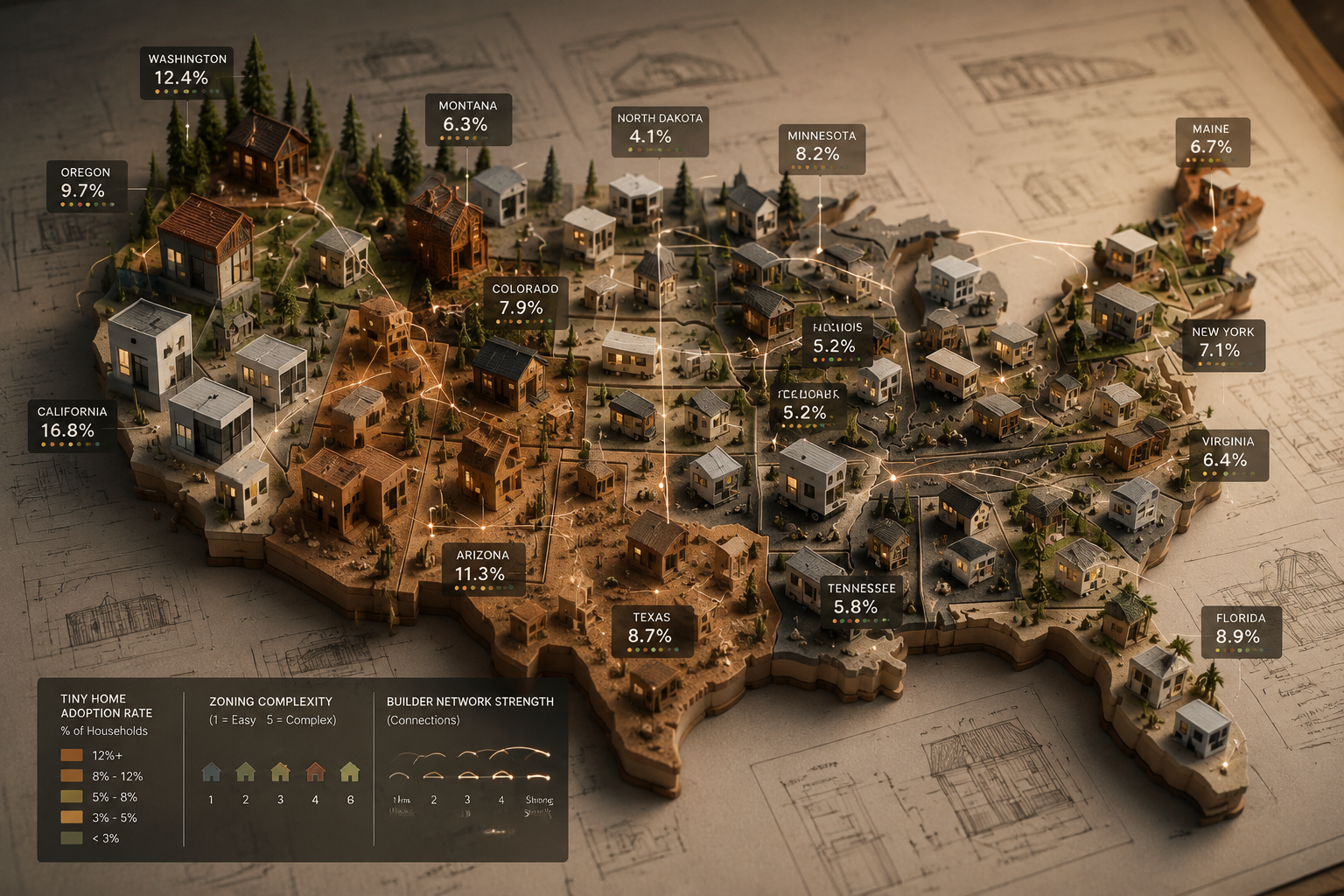
The phrase "tiny homes by state" covers a lot of ground. It means the rules, builders, and practical realities of tiny living are different depending on where you are in the country.
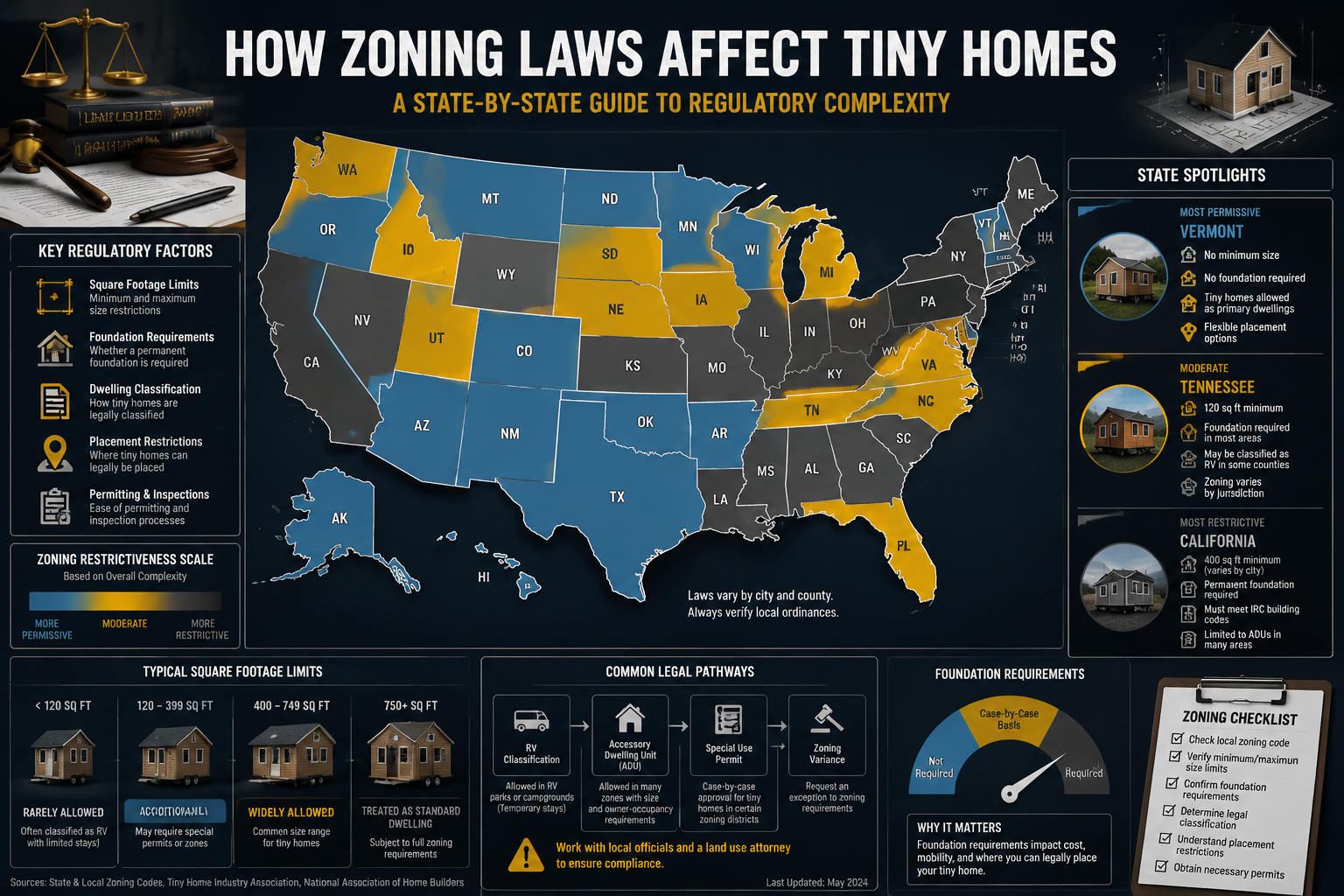
A tiny home is generally defined as a dwelling under 400 square feet. That's the rough industry consensus, though some builders and zoning codes draw the line at 500 square feet. They come in two main forms:
- THOWs (Tiny Houses on Wheels): Built on a trailer chassis. Technically classified as RVs in most states. Mobile, flexible, and often easier to build — but harder to park legally as a permanent residence.
- Foundation tiny homes: Built on a permanent foundation, like a traditional house. Subject to standard residential building codes. More legally stable but less mobile.
Why does your state matter so much? Because zoning laws, building codes, minimum square footage requirements, and even utility hookup rules are set at the state, county, and municipal level. A tiny home that's perfectly legal in Asheville, North Carolina might be impossible to permit in a neighboring county.
The bottom line: Before you fall in love with a floor plan, you need to understand what your state and county actually allow.
How Do Zoning Laws Affect Tiny Homes by State?
Zoning is the single biggest factor in whether your tiny home dream is achievable — and it varies more than most buyers expect.
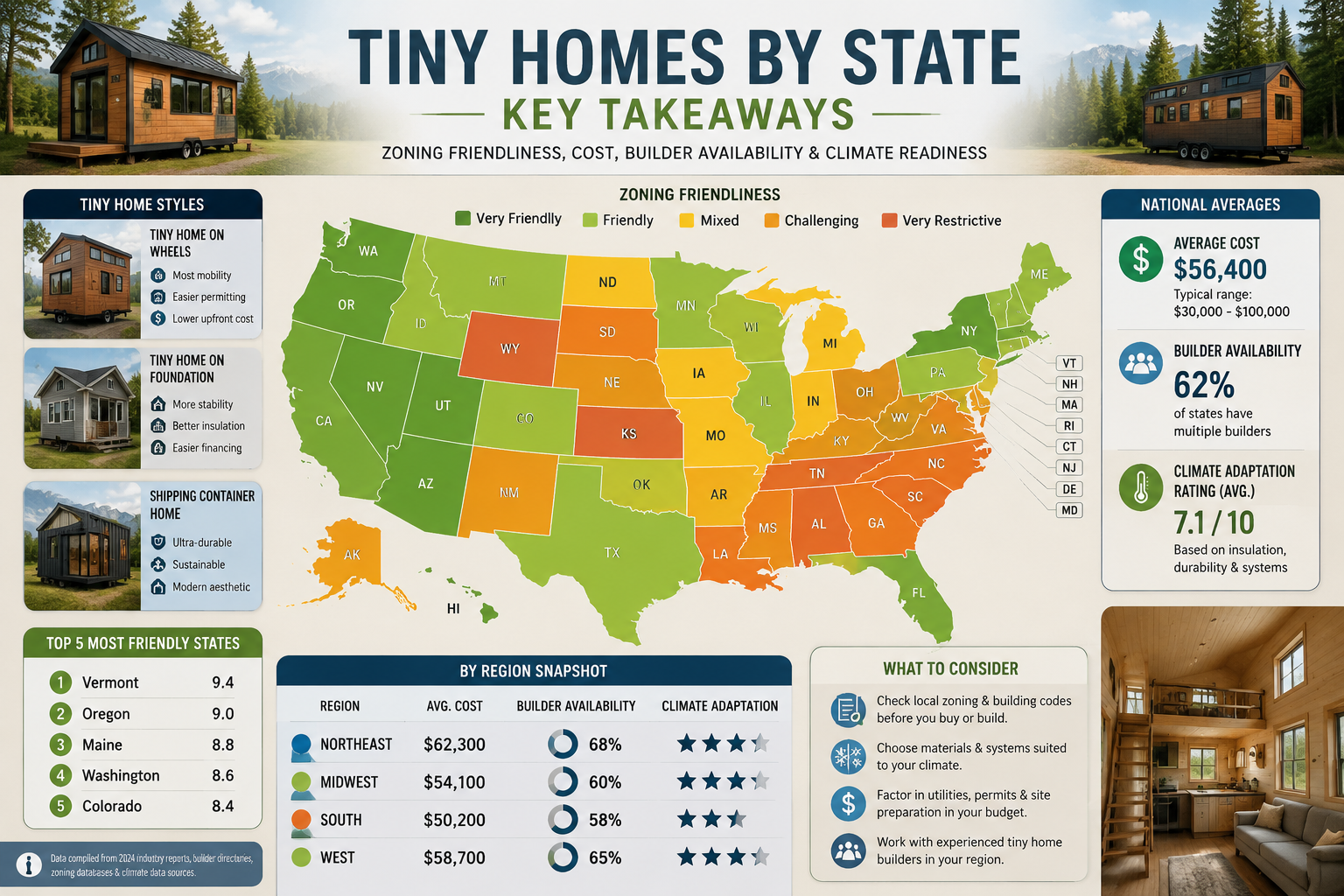
Here's a simplified breakdown of how states tend to fall:
Tiny-Home-Friendly States
These states have passed legislation or have widespread county-level acceptance that makes tiny home placement more straightforward:
| State | Why It's Friendly | Key Notes |
|---|---|---|
| Texas | No statewide zoning restrictions | County rules vary; rural land is easiest |
| Oregon | ADU-friendly laws statewide | Portland metro has specific THOW rules |
| Colorado | Many counties allow THOWs | Mountain counties have altitude/snow load requirements |
| Florida | Warm climate + RV park infrastructure | Deed-restricted communities may ban THOWs |
| Tennessee | Growing tiny home community | Sevier County is a known tiny home hub |
| North Carolina | ADU laws expanding | Asheville area is particularly welcoming |
| Arizona | Desert climate suits off-grid | Some counties have minimum sq ft rules |
| Montana | Rural land is abundant | Harsh winters require heavy insulation specs |
States With More Restrictions
- California: Strong ADU laws, but high land costs and complex permitting in urban areas. Rural counties can be more flexible.
- New York: NYC and suburban counties are very restrictive. Upstate rural areas are more open.
- Massachusetts: Strict building codes. Some towns are experimenting with tiny home ordinances.
- Illinois: Suburban zoning is tough. Rural southern Illinois is more accessible.
Important edge case: Even in "friendly" states, your specific county or municipality sets the real rules. Always call your county planning department before buying land or a tiny home.
Common mistake: Buyers assume state-level friendliness means they can park anywhere. In reality, even in Texas, many counties have minimum square footage requirements (often 1,000 sq ft) for permanent residences.
Which States Have the Best Tiny Home Builder Networks?
Builder availability by state is uneven — some regions have dozens of established shops, others have almost none.
The states with the strongest tiny home builder ecosystems in 2026 are:
Top Builder Hubs:
- Texas — Home to builders like Indigo River Tiny Homes, Liberation Tiny Homes, and dozens of smaller custom shops. The sheer size of the state and its lack of income tax has attracted manufacturers.
- Oregon — A long-established tiny home culture. Builders like Shelter Wise and Tiny Heirloom (based in Portland) serve the Pacific Northwest broadly.
- Colorado — Strong off-grid and sustainable building community. Builders often specialize in mountain-rated construction.
- Tennessee — Growing fast. Several builders cluster around the Knoxville and Chattanooga areas.
- North Carolina — Appalachian building traditions meet modern tiny home design. Strong custom builder presence.
- Washington State — Pacific Northwest ethos drives demand for eco-friendly builds. Several RVIA-certified manufacturers operate here.
- Georgia — Atlanta metro has spawned a growing builder network serving the Southeast.
- California — Despite high costs, the ADU boom has created a large prefab and modular builder market.
States with limited local builder options: Maine, North Dakota, South Dakota, Wyoming, and most of the rural Midwest. Buyers in these areas often work with out-of-state builders who ship finished units.
Tip: Working with an out-of-state builder is common and often fine — but confirm they understand your local climate and code requirements before signing a contract.
What Are the Main Types of Tiny Home Construction?
Knowing your construction options helps you match the right build to your state, climate, and budget.
The Four Main Construction Methods
1. Stick-Built (Traditional Framing)
The same method used in standard homes. Wood framing, insulation batts, drywall. Familiar to most contractors, easier to permit as a foundation home. Slower to build than other methods.
2. SIPs (Structural Insulated Panels)
Panels made of foam insulation sandwiched between two boards. Extremely energy-efficient. Great for cold climates (Montana, Minnesota, Colorado). Higher upfront cost, but lower heating bills.
3. Steel Frame
Durable, fire-resistant, and great for humid or coastal climates (Florida, Gulf Coast). Heavier than wood, which matters for THOWs. Some builders specialize in steel-frame tiny homes for durability.
4. Prefab/Modular
Factory-built in sections, then assembled on-site. Faster timeline (often 8–16 weeks vs. 6–12 months for custom). Less customizable but more predictable in cost and quality. Several RVIA-certified prefab manufacturers operate nationally.
Custom vs. Prefab: Which Is Right for You?
| Factor | Custom Build | Prefab/Modular |
|---|---|---|
| Cost | $60,000–$200,000+ | $30,000–$120,000 |
| Timeline | 6–18 months | 8–20 weeks |
| Customization | High | Low to medium |
| Builder availability | Varies by state | Ships nationally |
| Code compliance | Varies | Often pre-certified |
Choose custom if you have specific layout needs, want to use particular materials, or are building for an unusual climate or site.
Choose prefab if you need to move in quickly, have a tighter budget, or want predictable costs and a proven design.
How Does Climate Affect Tiny Home Choices by State?
Climate is a practical factor that buyers often underestimate. A tiny home's small size means it heats and cools faster than a standard house — which is both an advantage and a challenge.
Climate Zones and What They Mean for Your Build
Cold Climates (Minnesota, Montana, Maine, Michigan, Wisconsin):
- You need high R-value insulation (R-30 walls, R-49+ roof minimum)
- SIPs panels or spray foam insulation perform best
- Pipe freeze protection is essential for plumbing
- Snow load ratings matter for the roof structure
- Radiant floor heating is popular and efficient in small spaces
Hot and Dry Climates (Arizona, Nevada, New Mexico, West Texas):
- Reflective roofing and radiant barriers reduce cooling loads
- Cross-ventilation design matters more than insulation R-value
- Off-grid solar is highly viable — excellent sun hours
- Water conservation systems are practical and often incentivized
Humid and Hot Climates (Florida, Louisiana, Georgia, South Carolina):
- Moisture management is the top priority
- Steel framing resists mold better than wood in high humidity
- Vapor barriers and proper ventilation prevent rot
- Hurricane-rated construction is worth the extra cost in coastal areas
Mild Climates (Pacific Coast, Pacific Northwest, parts of the Southeast):
- More flexibility in construction method
- Rainy climates (Oregon, Washington) need excellent roof drainage and moisture barriers
- Wildfire risk in California and Oregon affects insurance and material choices
Quick example: A buyer in Tucson, Arizona can run a 400 sq ft tiny home almost entirely on solar with minimal insulation investment. The same buyer in Duluth, Minnesota needs a heavily insulated SIPs build and a reliable backup heating source — the energy math is completely different.
What Does a Tiny Home Cost by State?
Costs vary based on construction type, builder location, land prices, and local permitting fees. Here are realistic ranges for 2026:
Average Tiny Home Costs by Construction Type
| Build Type | Low End | Mid Range | High End |
|---|---|---|---|
| DIY THOW | $15,000 | $35,000 | $60,000 |
| Prefab THOW | $30,000 | $65,000 | $100,000 |
| Custom THOW | $60,000 | $95,000 | $150,000+ |
| Foundation Prefab | $40,000 | $80,000 | $130,000 |
| Custom Foundation | $80,000 | $140,000 | $250,000+ |
Note: These are builder/construction costs only. Land, permits, utility hookups, and site prep add to the total.
State-Specific Cost Factors
- California, Hawaii, New York: Land costs and labor rates push total project costs significantly higher than the national average.
- Texas, Tennessee, Arkansas, Missouri: Lower land costs and competitive builder markets make these among the most affordable states for tiny home ownership.
- Colorado, Montana: Builder costs are moderate, but site prep for mountain terrain can add $10,000–$30,000.
- Florida: Hurricane-rated construction adds cost but is genuinely worth it in coastal counties.
How Do You Finance a Tiny Home?
Financing a tiny home is possible — but it works differently than a traditional mortgage. Here's what actually works in 2026:
The Main Financing Paths
1. Personal Loans
Available from banks, credit unions, and online lenders. No collateral required. Rates vary based on credit score. Best for builds under $50,000.
2. RV Loans
If your THOW is RVIA-certified, it qualifies for RV financing. Rates are often better than personal loans. Terms of 10–20 years are common. Requires the builder to be RVIA-certified.
3. Construction Loans
For foundation tiny homes built on land you own. Works like a traditional construction loan — draws paid to the builder as work progresses. Converts to a mortgage on completion in some cases.
4. Home Equity Loans / HELOCs
If you own existing property, borrowing against it is often the cheapest path. Rates are lower than personal loans and terms are longer.
5. Specialty Tiny Home Lenders
A small but growing number of lenders specialize in tiny home financing. They understand the unique challenges of appraising and lending on non-traditional dwellings.
Common mistake: Assuming a standard mortgage will work for a THOW. Most traditional lenders won't finance a home on wheels as real property. You need the right loan type for the right home type.
What Are the Best States for Off-Grid Tiny Living?
Off-grid tiny living — where your home operates independently from municipal water, sewer, and power — is a growing choice. But legality and practicality vary a lot by state.
Top States for Off-Grid Tiny Homes
Arizona: Excellent solar potential, relatively permissive rural land use, and a strong off-grid community. Rainwater collection is legal and practical.
New Mexico: Low land costs, abundant sun, and a long history of alternative building (adobe, earthships). Very welcoming to off-grid setups.
Montana: Abundant land, strong DIY culture, and relatively permissive rural zoning. Winters are brutal, so your energy system needs to be robust.
Tennessee: Growing off-grid community, especially in the eastern mountain counties. Rainwater collection laws are favorable.
Texas: Large rural land tracts, no income tax, and county-level flexibility make off-grid living very achievable outside city limits.
What Off-Grid Systems to Plan For
- Power: Solar panels + battery storage (lithium iron phosphate batteries are the current standard)
- Water: Well, rainwater collection, or water delivery + large tank storage
- Waste: Composting toilet + greywater system (check state laws — some restrict both)
- Heat: Propane, wood stove, or mini-split heat pump (depending on climate)
How to Choose a Tiny Home Builder: A Practical Checklist
Choosing the right builder is the most important decision you'll make in this process. Here's what to look for:
Builder Vetting Checklist
- RVIA certification (required for RV loan financing of THOWs)
- State contractor license (required for foundation builds in most states)
- Portfolio of completed builds (ask for photos and references)
- References from past clients (actually call them)
- Clear contract with payment schedule (never pay 100% upfront)
- Warranty terms (what's covered and for how long)
- Experience with your climate zone (ask specifically)
- Familiarity with your state's codes (especially for foundation homes)
- Insurance coverage (builder's liability and workers' comp)
- Timeline transparency (get a realistic build schedule in writing)
Vetted builders. Real answers. Fewer dead ends. — That's what this directory is built to give you. We don't list builders we haven't evaluated. If a builder is in our directory, they've met a baseline of legitimacy.
Regional Builder Directory: Tiny Homes by State
This section gives you a starting point for each U.S. region. For city-specific listings and deeper builder profiles, explore the individual state pages linked below.
Northeast (Maine, Vermont, New Hampshire, Massachusetts, Connecticut, Rhode Island, New York, New Jersey, Pennsylvania)
Key facts: Strict building codes, cold winters, high land costs near cities. Foundation tiny homes as ADUs are the most viable path in most of this region. Rural areas of Vermont, Maine, and upstate New York are more open to THOWs.
Builder availability: Limited local builders. Many buyers work with builders from the Mid-Atlantic or Southeast who ship to the region.
Climate note: Minimum R-30 wall insulation recommended. Snow load ratings are non-negotiable.
Mid-Atlantic (Maryland, Delaware, Virginia, West Virginia, Washington D.C.)
Key facts: Virginia and West Virginia have growing tiny home communities, especially in rural counties. Maryland and D.C. have stricter urban zoning but expanding ADU laws.
Builder availability: Moderate. Several builders operate in Virginia and serve the broader region.
Southeast (North Carolina, South Carolina, Georgia, Florida, Alabama, Mississippi, Tennessee, Kentucky)
Key facts: One of the most active tiny home regions in the country. Tennessee and North Carolina lead in builder density and community development. Florida's RV park infrastructure supports THOWs well.
Builder availability: Strong. Multiple RVIA-certified and custom builders throughout the region.
Climate note: Humidity management is critical. Hurricane-rated construction matters in coastal Florida and the Gulf Coast.
Midwest (Ohio, Indiana, Illinois, Michigan, Wisconsin, Minnesota, Iowa, Missouri, Kansas, Nebraska, South Dakota, North Dakota)
Key facts: Rural land is affordable and abundant. Zoning is a mixed bag — some counties are very open, others have minimum square footage requirements that effectively ban tiny homes.
Builder availability: Moderate in Ohio, Missouri, and Michigan. Sparse in the Dakotas and Nebraska.
Climate note: Extreme cold requires serious insulation investment. SIPs construction is popular here.
South Central (Texas, Oklahoma, Arkansas, Louisiana)
Key facts: Texas is the standout — large builder network, low land costs, flexible rural zoning, and a massive tiny home community. Oklahoma and Arkansas are growing. Louisiana's humidity requires careful construction planning.
Builder availability: Excellent in Texas. Growing in Arkansas and Oklahoma.
Mountain West (Colorado, Wyoming, Montana, Idaho, Utah, Nevada)
Key facts: Stunning landscapes drive demand, but mountain terrain adds site prep costs. Colorado has a mature tiny home market. Wyoming and Montana offer cheap land but limited builder options.
Builder availability: Strong in Colorado. Limited elsewhere — out-of-state builders often serve this region.
Climate note: Altitude affects insulation needs. Snow load ratings are critical above 6,000 feet.
Southwest (Arizona, New Mexico, West Texas)
Key facts: Excellent for off-grid living. Affordable land in rural areas. Growing tiny home and alternative housing communities (especially around Taos, NM and Tucson, AZ).
Builder availability: Moderate. Several off-grid specialists operate in this region.
Pacific Coast (California, Oregon, Washington)
Key facts: Oregon and Washington have strong tiny home cultures and established builder networks. California's ADU boom has created a large prefab market, though land costs are high.
Builder availability: Excellent in Oregon and Washington. Strong in Northern California.
Climate note: Wildfire risk affects insurance and material choices in California and Eastern Oregon.
Alaska and Hawaii
Alaska: Extreme climate demands specialized construction. Very limited builder availability locally. Off-grid systems are common and well-developed.
Hawaii: High land costs and strict zoning make tiny homes challenging but not impossible. Some counties are experimenting with ADU-friendly policies.
FAQ: Tiny Homes by State
Q: What states allow tiny homes as permanent residences?
Most states allow tiny homes as permanent residences if they meet local building codes and minimum size requirements. Texas, Tennessee, Oregon, North Carolina, and Colorado are among the most accommodating. The key is county-level zoning, not just state law.
Q: Can I park a tiny house on wheels anywhere?
No. THOWs need an approved location — an RV park, a campground, a property with RV hookups, or land in a county that allows RV living. Many residential zones prohibit parking a THOW as a permanent residence.
Q: What is RVIA certification and why does it matter?
RVIA (Recreational Vehicle Industry Association) certification means a THOW was built to industry safety standards. It's required by most RV lenders and many RV parks. It also makes insurance easier to obtain.
Q: How long does it take to build a tiny home?
Prefab builds typically take 8–20 weeks from order to delivery. Custom builds range from 6 months to 18 months depending on the builder's schedule and complexity of the design.
Q: Can I get a mortgage on a tiny home?
Traditional mortgages are rarely available for THOWs. Foundation tiny homes on owned land are more likely to qualify. RV loans, personal loans, and construction loans are the most common financing paths.
Q: What's the minimum square footage required by law?
It varies by state and county. Some counties have no minimum. Others require 1,000 square feet or more for a permanent residence. Always check with your county planning department before purchasing land or a tiny home.
Q: Are tiny homes a good investment?
Tiny homes on land can appreciate like traditional real estate. THOWs typically depreciate, similar to RVs. The financial case for tiny living is usually about lower monthly costs and reduced debt, not resale appreciation.
Q: What's the difference between a tiny home and a manufactured home?
Manufactured homes (formerly called mobile homes) are built to HUD federal standards and are typically larger than tiny homes. Tiny homes are usually built to IRC (International Residential Code) or RVIA standards. They're different regulatory categories.
Q: Can I build a tiny home myself?
Yes. DIY tiny home builds are legal in most places, though you'll still need to meet local code requirements and may need permits. DIY builds are the most affordable path but require significant time and skill.
Q: Do tiny homes work for families with children?
They can, with the right design. Lofted sleeping areas, multi-use furniture, and outdoor living space help. Many families find 300–500 square feet workable with intentional design. It's not for everyone, but it's not impossible either.
Q: What's the best state for a first-time tiny home buyer?
Texas and Tennessee consistently rank as the most accessible for first-time buyers — affordable land, strong builder networks, flexible rural zoning, and active tiny home communities.
Q: How do I find a reputable tiny home builder in my state?
Use a vetted directory (like this one), ask for RVIA certification or state contractor licensing, check references, and look for builders with a portfolio of completed projects in your climate zone.
Conclusion: Start Where You Are
The tiny home world is big — and it's mapped out differently in every state. That's what makes this journey feel overwhelming at first. But here's the truth: you don't need to figure out all 50 states. You need to figure out your state, your county, and your situation.
Your next steps:
- Identify your state's zoning reality. Call your county planning department or use our state-specific pages to get the current rules.
- Decide on your home type. THOW or foundation? Custom or prefab? Your climate and lifestyle will guide this.
- Set a realistic budget. Include land, permits, site prep, and the home itself — not just the builder's quote.
- Explore financing options. If you need a loan, start with RVIA-certified builders so you have access to RV financing.
- Connect with builders in your region. Use our directory to find vetted builders who know your climate and your codes.
Small footprint. Full life. That's what tiny living is really about — and we're here to help you get there, one clear step at a time.
Navigate tiny living with confidence. Your guide to living smaller, on purpose.
References
- U.S. Department of Housing and Urban Development (HUD). Manufactured Housing and Standards. https://www.hud.gov/program_offices/housing/rmra/mhs/mhshome (2023)
- American Tiny House Association. State Zoning Resources. https://www.americantinyhouseassociation.org (2024)
- Recreational Vehicle Industry Association (RVIA). RVIA Certification Standards. https://www.rvia.org (2024)
- National Conference of State Legislatures (NCSL). Accessory Dwelling Units: State Legislative Landscape. https://www.ncsl.org (2024)
- U.S. Energy Information Administration. Residential Energy Consumption Survey. https://www.eia.gov/consumption/residential/ (2023)
🏡 Tiny Home State Fit Finder
Answer three quick questions to discover how your state compares for tiny home zoning, builders, climate, and off-grid living potential.
Data based on current ADU legislation trends, tiny home zoning research, RVIA builder networks, and state-level housing reforms through 2026.